
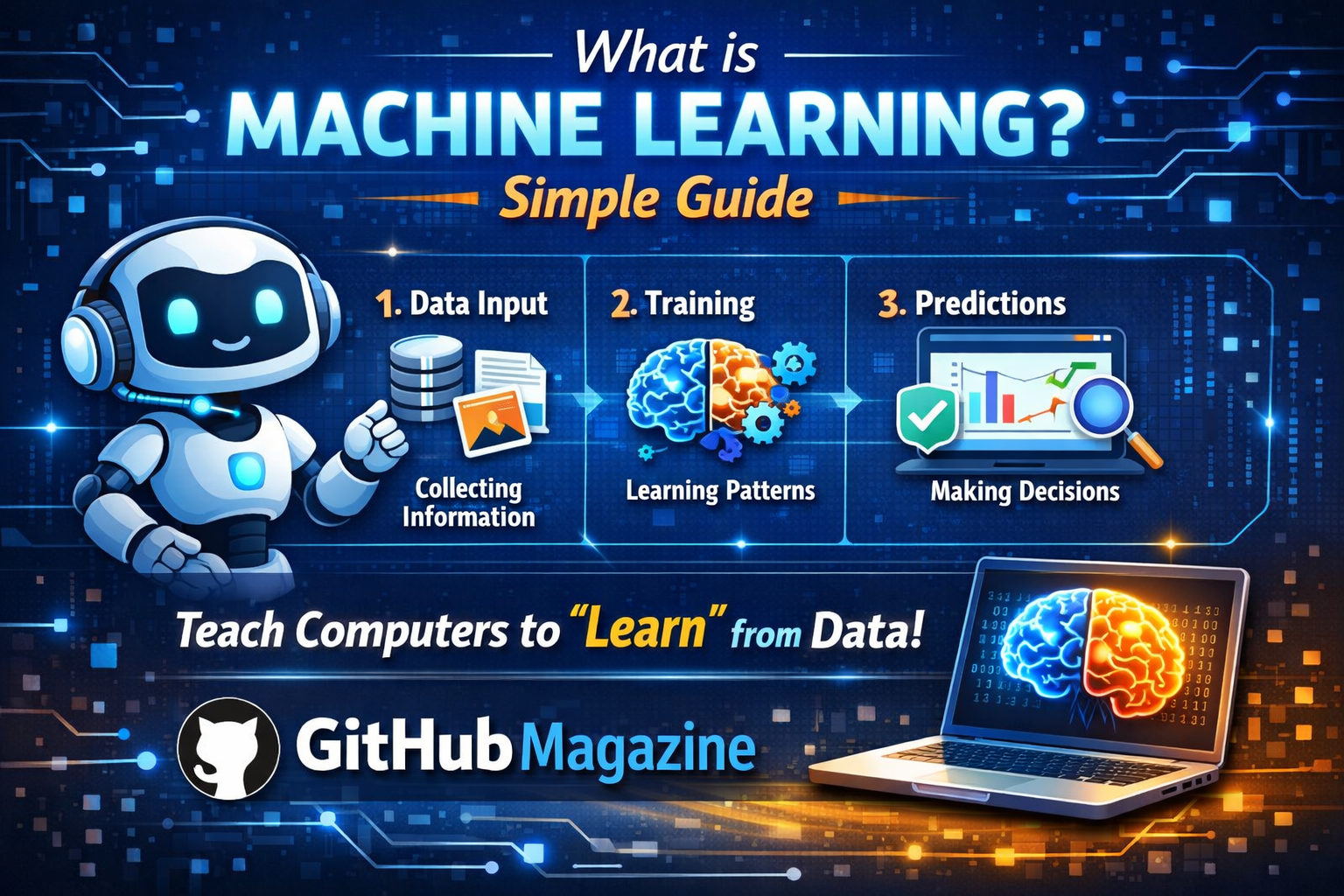
What Is Machine Learning Simple Explanation
I like to explain machine learning as a simple idea: teaching computers to learn from experience instead of giving them fixed instructions. In the first place, it means that instead of telling a machine exactly what to do in every situation, we provide it with data and let it discover patterns. These patterns help the machine make decisions or predictions. Whether it is recommending videos, filtering spam, or recognizing faces, machine learning is already part of everyday life.
At its heart, machine learning is about learning from data and improving over time. The more examples a system sees, the better it becomes at its task. This makes it different from traditional programming, where every rule must be written manually. Machine learning allows systems to adapt, which is why it is so powerful in complex situations.
Over the last two decades, this technology has grown rapidly due to better computing power and the explosion of digital data. Today, it is used across industries including healthcare, finance, education, and transportation. Even though the systems behind it can be complex, the core idea remains simple and accessible: machines can learn from experience just like humans do, only faster and at a much larger scale.
The Basic Idea: Teaching Machines Like Students
When I think about machine learning, I picture a classroom where data replaces the teacher. The algorithm acts like a student, learning from examples rather than memorizing rules. This comparison makes the concept easier to understand because it mirrors how humans learn through repetition and feedback.
In traditional programming, developers must define every rule. For instance, if you wanted to detect spam emails, you would have to specify exact keywords or patterns. This becomes difficult when the problem is complex or constantly changing. Machine learning solves this by allowing the system to learn directly from examples. By showing it thousands of emails labeled as spam or not spam, the system learns the difference on its own.
The key idea here is improvement through experience. As the system processes more data, it refines its understanding and becomes more accurate. This shift from rigid instructions to flexible learning is what makes machine learning so effective in solving real-world problems.
Types of Machine Learning Explained Simply
Machine learning is not a single method but a group of approaches that differ in how learning happens. Each type serves a specific purpose depending on the kind of data and problem involved.
| Type of Learning | Simple Explanation | Example Use Case |
|---|---|---|
| Supervised Learning | Learning from labeled examples | Email spam detection |
| Unsupervised Learning | Finding patterns without labels | Customer segmentation |
| Reinforcement Learning | Learning through rewards and penalties | Game-playing AI, robotics |
In supervised learning, the system is trained with correct answers, allowing it to learn by comparison. Unsupervised learning focuses on discovering hidden patterns without guidance. Reinforcement learning works differently, using rewards and penalties to guide decisions, much like trial and error.
Understanding these types helps clarify that machine learning is flexible and adaptable. Each method is designed to handle different challenges, but all rely on the same principle of learning from data.
How Machine Learning Works Step by Step
To make machine learning less abstract, I break it down into a clear sequence of steps. This process shows how raw data turns into useful predictions.
The first step is collecting data. This could include images, text, or numerical information. Next comes data preparation, where the data is cleaned and organized. This step is important because poor data leads to poor results.
After that, a model is selected. This is the algorithm that will learn from the data. The model is then trained by feeding it data and allowing it to identify patterns. Once training is complete, the model is tested using new data to evaluate its performance.
Finally, the system is improved through adjustments and additional data. This cycle can repeat many times, leading to continuous improvement. The process shows that machine learning is not a one-time task but an ongoing effort to refine accuracy and performance.
Where You See Machine Learning in Daily Life
Machine learning is deeply embedded in everyday experiences, often without people noticing it. It operates quietly in the background, making digital services more efficient and personalized.
| Area | Example Application | Impact on Users |
|---|---|---|
| Entertainment | Streaming recommendations | Personalized content |
| Communication | Spam filters, predictive typing | Faster and cleaner communication |
| Healthcare | Disease prediction models | Early diagnosis and treatment |
| Transportation | Navigation and route optimization | Efficient travel |
| Finance | Fraud detection systems | Improved security |
These applications show how machine learning improves convenience and decision-making. From suggesting what to watch next to helping doctors detect diseases earlier, its influence is widespread and growing.
The most interesting part is that users rarely see the complexity behind these systems. They simply experience smoother and more personalized interactions.
Why Machine Learning Matters Today
The importance of machine learning today comes from its ability to handle large amounts of data and uncover insights that humans might miss. As digital data continues to grow, traditional methods become less effective, making machine learning essential.
This technology allows automation of tasks that once required human judgment. It can analyze images, understand speech, and even generate written content. These capabilities are transforming industries and reshaping how businesses operate.
Machine learning also supports better decision-making. By analyzing patterns in data, it helps organizations predict outcomes and reduce uncertainty. This leads to improved efficiency and innovation.
At the same time, its growing influence raises important questions about responsibility. As machines take on more roles, ensuring ethical use becomes a key concern. This includes addressing issues such as bias, privacy, and accountability.
The Difference Between AI and Machine Learning
Many people use the terms artificial intelligence and machine learning interchangeably, but they are not the same. Understanding the difference helps clarify the role of each.
Artificial intelligence is a broad concept that refers to machines performing tasks that normally require human intelligence. Machine learning is a specific approach within AI that focuses on learning from data.
In simple terms, AI is the overall goal, while machine learning is one of the tools used to achieve that goal. Not all AI systems rely on machine learning, but most modern applications do.
This distinction is important because it shows how machine learning fits into the larger picture of technological development.
Challenges and Limitations
Despite its advantages, machine learning has several limitations that must be considered. One major issue is bias. If the data used for training contains biases, the system will reflect those biases in its predictions.
Another challenge is the lack of transparency. Many machine learning models operate as black boxes, making it difficult to understand how decisions are made. This can be problematic in areas like healthcare or finance, where explanations are important.
Data dependency is another limitation. Machine learning systems require large amounts of high-quality data. Without it, their performance suffers.
These challenges highlight the need for careful design and ongoing research. Improving transparency, fairness, and data quality remains a priority in the field.
Expert Perspectives on the Future
Experts across different fields agree that machine learning will continue to shape the future. It is becoming a foundational technology that influences many aspects of life.
Some researchers emphasize its role in enabling data-driven decisions at scale. Others focus on its potential to transform industries and create new opportunities. At the same time, there is growing awareness of the need for responsible development.
The future of machine learning will depend not only on technological progress but also on how society chooses to use it. Balancing innovation with ethical considerations will be essential.
Takeaways
- Machine learning enables computers to learn from data instead of following fixed rules
- It is widely used in everyday technologies like recommendations and spam filters
- There are three main types: supervised, unsupervised, and reinforcement learning
- Data quality plays a crucial role in system performance
- Machine learning is a subset of artificial intelligence
- It presents both opportunities and challenges, including bias and transparency
- Its influence will continue to grow across industries
Conclusion
I see machine learning as a powerful yet approachable concept that is reshaping the modern world. While the technology behind it can be complex, the basic idea is simple and intuitive. Machines learn from data, improve with experience, and help solve problems that would otherwise be difficult to manage.
This ability to adapt and evolve makes machine learning different from traditional programming. It opens the door to smarter systems that can respond to changing conditions and provide better outcomes.
At the same time, its growing presence requires thoughtful use. Ensuring fairness, transparency, and accountability will be essential as the technology becomes more integrated into daily life.
Understanding machine learning in simple terms is not just useful but necessary. It helps people engage with a technology that is already influencing how we live, work, and interact with the world.
FAQs
What is machine learning in simple words
Machine learning is a method that allows computers to learn from data and improve their performance without being explicitly programmed for every task.
How is machine learning used in daily life
It is used in recommendations, spam filtering, navigation apps, voice assistants, and many other everyday technologies.
Is machine learning difficult to understand
The technical details can be complex, but the basic concept of learning from data is simple and easy to grasp.
What is the difference between AI and machine learning
AI is the broader concept of intelligent machines, while machine learning is a specific method that enables learning from data.
Can machine learning make mistakes
Yes, especially if the data used for training is poor or biased, which can lead to incorrect predictions.

Related Posts

SparkPressFusion Platform Explained

BeTechIt Tech News and the Future of Technology Journalism