
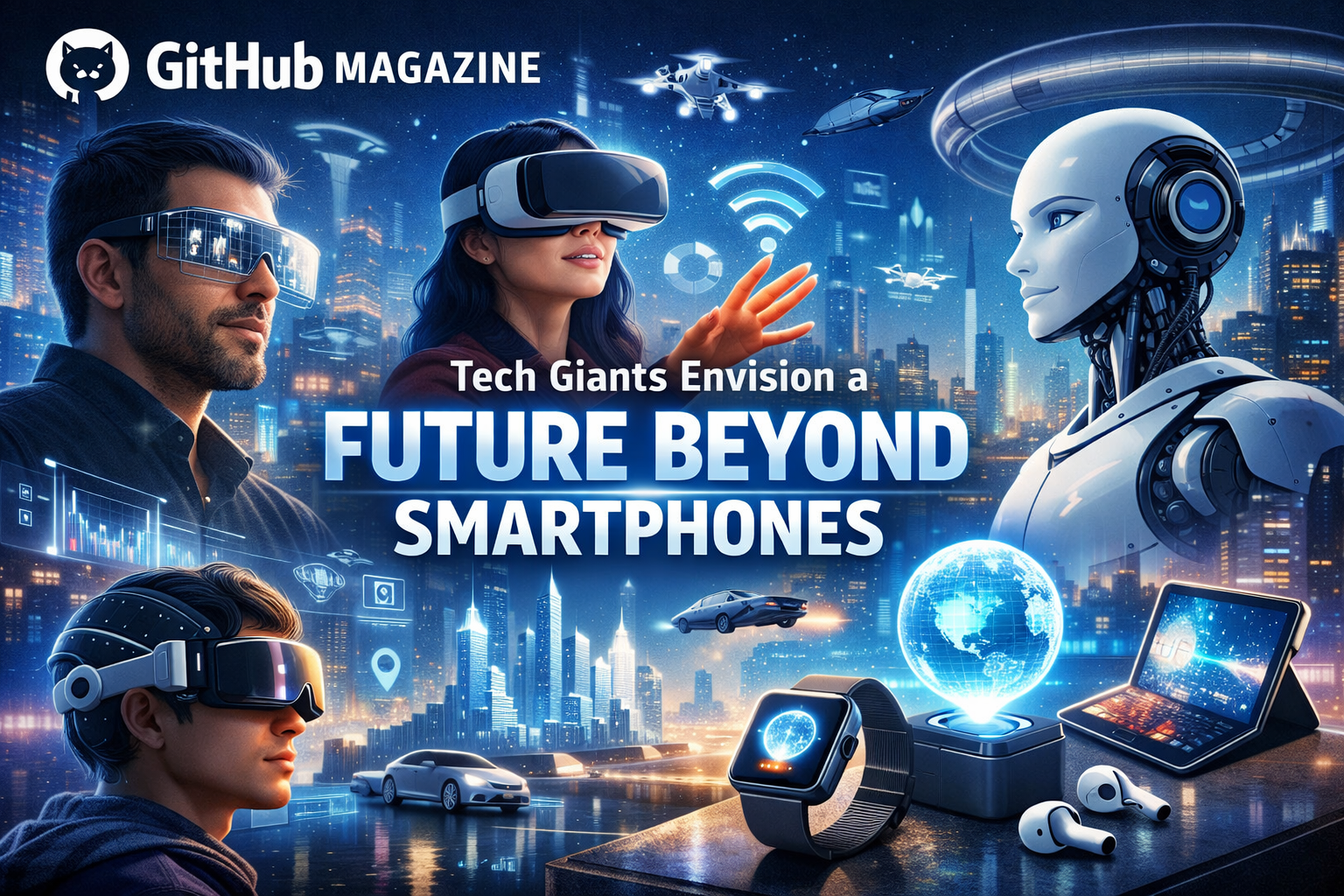
Tech Giants Envision
For nearly two decades, the smartphone has been the defining object of modern life. It is alarm clock, camera, map, office, entertainment center, and social connector, compressed into a rectangle that rarely leaves the human hand. Yet even as smartphones remain indispensable, the technology industry increasingly views them not as the final destination of personal computing, but as a transitional phase.
In the first hundred words of any honest conversation about the future of technology, one truth emerges clearly: the smartphone is not disappearing tomorrow. Instead, it is slowly being surrounded. New devices, interfaces, and systems are taking on pieces of what phones once did alone. Navigation is migrating to glasses, assistance to voice-driven AI, memory to cloud-based systems, and awareness to sensors embedded in environments.
This shift is not driven by consumer boredom alone. Growth in smartphone sales has flattened across much of the world, innovation has become incremental, and screens have reached physical and ergonomic limits. At the same time, breakthroughs in artificial intelligence, miniaturized sensors, spatial computing, and connectivity are opening doors that were previously sealed by battery constraints and processing power.
What tech giants now envision is not a single replacement device but a distributed future. In this world, computing dissolves into everyday experience, appearing when needed and fading when not. It is a future beyond smartphones not because phones fail, but because intelligence finally learns to move with us instead of demanding our attention.
The Smartphone as a Transitional Technology
The idea that smartphones represent a stepping stone rather than an endpoint is not a rejection of their success. On the contrary, smartphones succeeded so completely that they exposed their own limits. Touchscreens are efficient but visually demanding. Notifications are powerful but cognitively exhausting. Apps are flexible but fragmented.
Industry leaders increasingly frame smartphones as the hub around which new technologies orbit. For the foreseeable future, phones remain the control center, authentication device, and fallback interface. Yet many daily interactions no longer require a screen. Asking for directions, translating a conversation, setting reminders, or retrieving information can occur through voice, vision, or contextual inference.
The smartphone era taught billions of people to live with digital companions. The next era aims to make those companions less intrusive. Rather than pulling attention downward into a device, future systems seek to lift information into the natural flow of sight, sound, and movement.
Why Tech Giants Are Looking Beyond the Screen
Three forces push technology companies toward a post-smartphone vision. The first is economic. Hardware margins are tightening, replacement cycles are lengthening, and competition is fierce. New categories promise new revenue streams, ecosystems, and platforms.
The second force is technological readiness. Artificial intelligence systems can now interpret speech, images, and context in real time. Sensors are smaller and cheaper. Connectivity is faster and more reliable. These advances allow devices to understand not just commands, but situations.
The third force is human fatigue. Users are increasingly aware of screen addiction, notification overload, and attention fragmentation. Products that promise to reduce friction rather than increase engagement resonate strongly with consumers, regulators, and designers alike.
Taken together, these pressures create a powerful incentive to imagine computing that feels less like an object and more like an environment.
Augmented Reality and the Return of Vision
Augmented reality has long occupied a mythical place in technology forecasts. Early attempts struggled with bulky hardware, limited battery life, and social resistance. Today’s renewed push is quieter and more pragmatic.
Modern AR glasses aim to look like eyewear rather than gadgets. Their ambition is modest but profound: to place useful information directly into the user’s field of vision at the moment it matters. Directions appear while walking, names surface during introductions, instructions hover over machinery during repairs.
Unlike smartphones, which demand deliberate engagement, AR promises passive assistance. Information appears when relevant and disappears when not. This subtlety is key. The future of AR depends less on spectacle and more on restraint.
Yet challenges remain. Power consumption, privacy concerns, and social norms will determine whether smart glasses become as accepted as earbuds or remain niche tools. The technology is ready, but culture must catch up.
Wearable Artificial Intelligence as Companion
Parallel to visual augmentation is the rise of wearable AI that operates primarily through audio and context. These devices may look like pendants, earbuds, or clips, but their function is less about form and more about presence.
Wearable AI systems listen, interpret, and summarize. They remember conversations, surface reminders, and provide suggestions based on patterns rather than commands. The interaction model shifts from explicit input to continuous understanding.
This model raises profound questions. Constant listening challenges traditional notions of privacy. Delegating memory to machines reshapes how humans recall and prioritize experiences. Yet the appeal is undeniable. A system that quietly supports without interrupting aligns with growing desires for calmer technology.
For tech giants, wearable AI represents an opportunity to redefine personal computing around assistance rather than apps.
Ambient Computing and the Disappearing Interface
Beyond individual devices lies a broader vision: ambient computing. In this model, intelligence is distributed across spaces rather than concentrated in objects. Homes, offices, vehicles, and cities become responsive environments.
Lights adjust automatically based on activity. Schedules adapt to traffic patterns. Information surfaces when context demands it. The interface fades into the background, replaced by systems that anticipate needs.
Ambient computing depends on integration. Devices must share data, understand context, and coordinate seamlessly. This requires robust platforms, standardized protocols, and deep trust from users.
The promise is a world where technology feels less like a tool and more like infrastructure. Invisible, reliable, and taken for granted.
Competing Paths to a Post-Smartphone World
Different companies pursue different routes beyond the smartphone. Some prioritize visual immersion through headsets. Others focus on lightweight wearables or environmental intelligence. Each approach reflects trade-offs between immersion, comfort, social acceptance, and cost.
| Approach | Core Strength | Primary Challenge |
|---|---|---|
| AR Glasses | Hands-free contextual information | Battery life and privacy |
| Mixed Reality Headsets | Deep immersion and spatial interaction | Cost and comfort |
| Wearable AI | Screenless assistance | Trust and social norms |
| Ambient Systems | Seamless background intelligence | Integration complexity |
Rather than converging on a single solution, the industry appears headed toward a hybrid ecosystem where multiple devices coexist, each optimized for specific tasks.
Expert Perspectives on the Transition
Technology analysts consistently emphasize that platform shifts unfold slowly. The smartphone itself took years to move from novelty to necessity. Its successors will follow a similar arc.
One recurring insight is that replacement rarely means elimination. Cameras did not disappear with smartphones; they evolved. Laptops did not vanish; they specialized. Likewise, smartphones may persist as anchors even as their centrality diminishes.
Another expert observation centers on human adaptation. Interfaces succeed when they align with natural behavior. Voice, vision, and gesture feel intuitive, but only when systems respond accurately and respectfully.
The consensus view is evolutionary rather than revolutionary. The future beyond smartphones will arrive through accumulation, not disruption.
The Cultural Implications of Screenless Life
A world with fewer screens is not automatically a calmer one. Screenless technology can still overwhelm if poorly designed. The difference lies in intent.
When information is pulled, users control engagement. When it is pushed, systems must exercise restraint. Designing ethical ambient intelligence requires new norms, regulations, and cultural literacy.
There are also equity concerns. Advanced wearables and spatial systems may initially be expensive, risking a digital divide where enhanced perception becomes a privilege. Tech giants face pressure to ensure accessibility alongside innovation.
Ultimately, the post-smartphone future is as much a social project as a technical one.
Takeaways
- Smartphones remain central but no longer exclusive in personal computing
- Tech giants are investing in multiple parallel paths beyond the screen
- Augmented reality emphasizes vision-based contextual assistance
- Wearable AI shifts interaction toward voice and inference
- Ambient computing dissolves interfaces into environments
- Cultural acceptance and trust will determine adoption speed
Conclusion
The vision of a future beyond smartphones is not a rejection of the device that shaped a generation, but an acknowledgment of its success. Smartphones taught the world to live digitally. Their successors aim to make digital life feel less demanding and more humane.
Tech giants are not betting on a single device to replace the phone. They are building ecosystems where intelligence flows across glasses, wearables, spaces, and systems. In this future, computing becomes quieter, more contextual, and more responsive.
The transition will be uneven and slow, marked by experiments, failures, and unexpected successes. Yet the direction is clear. As intelligence escapes the screen and integrates into daily life, the smartphone may gradually fade from center stage, remembered not as the end of personal computing, but as the bridge that made its next evolution possible.
FAQs
Are smartphones going to disappear completely?
No. Smartphones are expected to remain important for many years, even as new devices take over specific functions.
What is most likely to replace phone screens?
A combination of AR glasses, voice-driven AI, and ambient systems rather than a single replacement device.
Why are tech companies investing now?
Advances in AI, sensors, and connectivity have made alternatives to screens technically and economically viable.
Will wearable AI affect privacy?
Yes. Always-on systems raise new privacy concerns that require careful design, regulation, and user control.
Is this shift inevitable?
While not guaranteed, economic, technological, and cultural forces strongly favor a gradual move beyond screen-centric computing.

Related Posts

ATFBooru Review: Inside a Tag-Driven Imageboard

Streameast.ms Explained: Legality, Risks, Future