
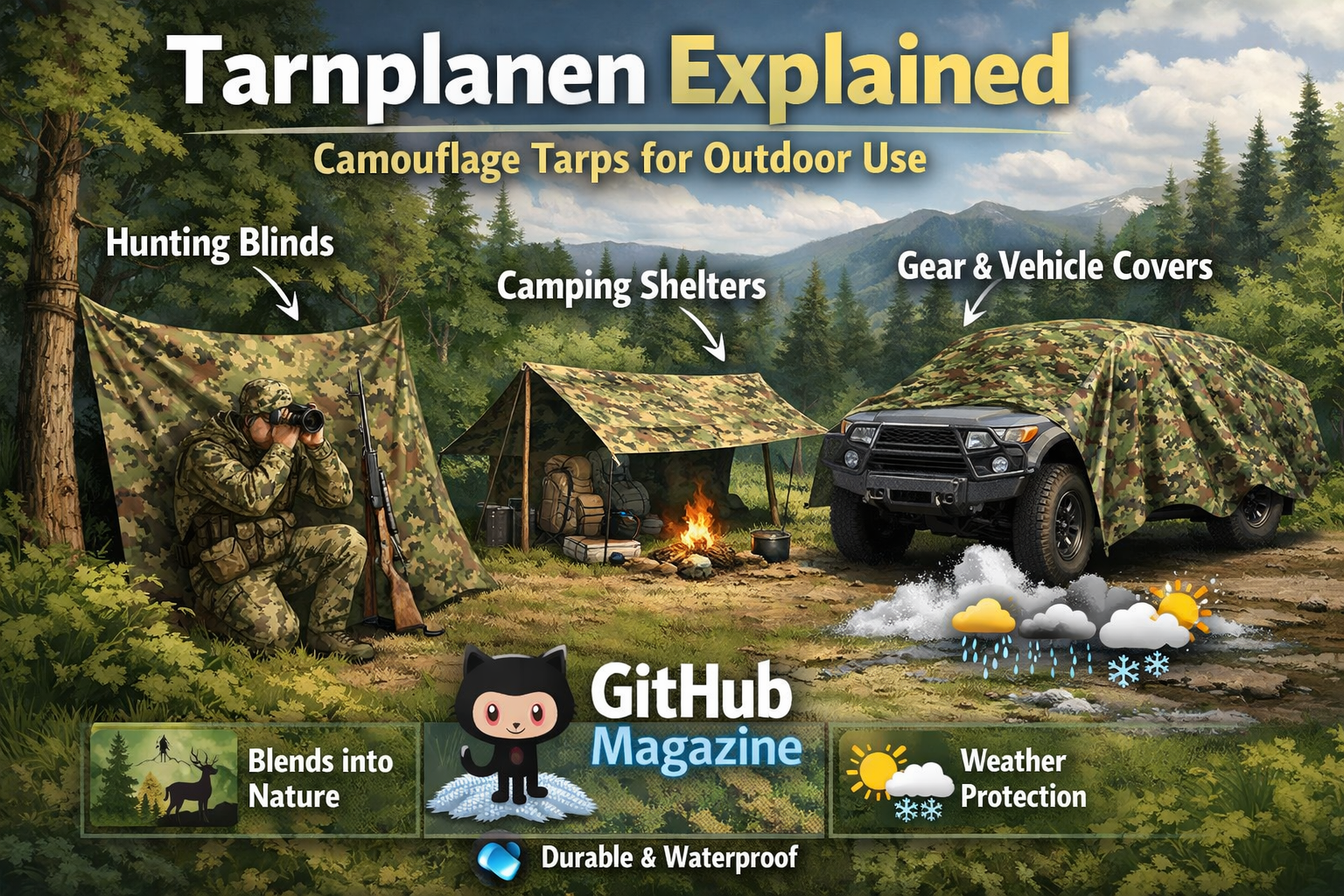
Tarnplanen Explained: Camouflage Tarps for Outdoor Use
Tarnplanen are camouflage tarpaulins engineered to hide people, equipment, and temporary structures while protecting them from rain, wind, sun, and abrasion. Originally designed for military concealment, they are now widely used by campers, hunters, photographers, emergency responders, and survival-minded travelers. In practical terms, a tarnplanen is a lightweight but rugged sheet of synthetic fabric, printed with terrain-specific camouflage patterns and reinforced for repeated outdoor use.
Beyond definition, tarnplanen answer a modern problem: how to remain mobile, protected, and discreet in unpredictable environments. Tents are heavy. Improvised shelters are unreliable. Plain tarps stand out visually. Tarnplanen sit between these extremes, offering a low-profile, adaptable layer that can become a roof, wall, groundsheet, equipment cover, or visual screen within minutes.
Their growing popularity reflects broader changes in outdoor culture. Minimalist camping has replaced bulky expedition gear. Wildlife photographers seek invisibility rather than distance. Disaster preparedness communities value tools that solve multiple problems without electricity or complex assembly. Even design culture has taken notice, borrowing camouflage aesthetics for urban utility products.
What makes tarnplanen notable is not novelty, but refinement. They apply centuries-old principles of concealment to modern materials science, combining durability, flexibility, and visual disruption in a form that folds into a backpack. To understand tarnplanen is to understand how simple objects, engineered carefully, can shape behavior in landscapes where visibility, weather, and mobility decide outcomes.
Origins and Evolution of Tarnplanen
The word tarnplanen comes from German: tarnen meaning “to camouflage” and planen meaning “tarpaulins” or “sheets.” The concept emerged from European military logistics in the twentieth century, when armies realized that hiding equipment was often more effective than armoring it. Vehicles, artillery, and supply depots covered in natural foliage were inconsistent and time-consuming. Camouflage fabric offered speed, repeatability, and portability.
Early tarnplanen were heavy cotton canvases dyed in irregular greens and browns. They absorbed water, froze in winter, and rotted when stored wet. Still, they worked. As aerial reconnaissance expanded during the Second World War, these tarps became standard issue across European forces, later spreading globally through NATO supply chains and military surplus markets.
Civilian adoption followed quietly. Campers discovered that surplus camouflage sheets were stronger than consumer tarps. Hunters learned they could build blinds without cutting branches. Photographers noticed animals tolerated fabric shapes more than human silhouettes. By the late twentieth century, manufacturers began producing dedicated civilian tarnplanen using synthetic fibers, lighter coatings, and environment-specific camouflage designs.
Today, tarnplanen represent a convergence of tactical heritage and recreational engineering. Their lineage is military, but their modern identity is civilian, shaped by hikers, climbers, field researchers, and digital nomads seeking shelter that disappears rather than announces itself.
Materials, Construction, and Design Logic
Modern tarnplanen are typically made from ripstop nylon or polyester coated with polyurethane or PVC. Ripstop weaving introduces thicker reinforcement threads at regular intervals, preventing small tears from spreading across the surface. This single design feature dramatically increases lifespan under stress from wind, branches, and repeated folding.
Water resistance is achieved through layered coatings that repel moisture while allowing minimal vapor transmission, reducing condensation beneath the tarp. Unlike cheap plastic tarps, quality tarnplanen remain flexible in cold temperatures and resist ultraviolet degradation in high sun exposure environments.
Camouflage patterns are scientifically designed. Rather than imitating a single leaf or tree, they use contrasting shapes and color clusters to break continuous outlines, confusing depth perception. Some modern versions employ digital pixelated patterns, while others rely on organic gradients for forests, deserts, snowfields, or urban concrete.
Edge construction matters as much as fabric. Reinforced hems distribute tension evenly. Brass or steel grommets allow rope attachment without tearing. Many models include webbing loops stitched into stress points, enabling modular configurations: lean-to shelters, A-frames, bivouac covers, or vertical screens.
In essence, tarnplanen are not just sheets but structural tools. Their engineering anticipates how humans pull, anchor, crawl under, and pack them repeatedly, often in rain or darkness, often under pressure.
Where Tarnplanen Are Used Today
| Context | Typical Use | Practical Outcome |
|---|---|---|
| Military & security | Vehicle and camp concealment | Reduced visual detection and thermal signature |
| Camping & trekking | Shelter and ground protection | Lightweight alternative to tents |
| Hunting & photography | Temporary blinds | Closer wildlife observation |
| Emergency response | Rapid weather barrier | Immediate protection in disasters |
Military use remains foundational. Tarnplanen are deployed over equipment to disrupt shape recognition, especially against drones and long-range optics. Their matte surfaces minimize light reflection, while layered setups reduce thermal contrast.
In civilian life, outdoor enthusiasts value their flexibility. A single tarp can become a roof at night, a shade canopy at noon, and a pack cover during rain. Unlike tents, tarnplanen adapt to uneven terrain and tight spaces between trees or rocks.
Hunters and photographers rely on the psychological effect of camouflage. Animals respond to motion and silhouette more than color. Tarnplanen dissolve the human form into background texture, buying critical seconds of stillness.
Emergency planners include camouflage tarps in disaster kits because they are fast to deploy and function without poles, electricity, or specialized tools. When infrastructure collapses, simplicity becomes survival technology.
Tarnplanen Compared With Standard Tarps
| Feature | Tarnplanen | Ordinary Tarps |
|---|---|---|
| Visual profile | Camouflaged | High visibility |
| Material quality | Reinforced synthetics | Often thin polyethylene |
| Intended lifespan | Multi-year field use | Short-term |
| Use cases | Tactical, outdoor, survival | Construction, storage |
Ordinary tarps prioritize cost and coverage. Tarnplanen prioritize reliability and discretion. The difference is visible after a season of heavy use: frayed corners versus reinforced seams, faded plastic versus stable coatings, torn grommets versus stitched anchor points.
This distinction explains why tarnplanen cost more and weigh slightly more than disposable tarps. They are not consumables but equipment, expected to perform repeatedly under stress.
Expert Perspectives on Camouflage Tarps
Outdoor gear engineer Lucas Harrow argues that material science changed the category entirely: “Once ripstop weaving became affordable at scale, camouflage tarps stopped being fragile cloth and became structural components of field systems.”
Survival instructor Dana Sterling highlights psychological impact: “People underestimate how much safer they feel when their shelter blends into the environment. It reduces anxiety in exposed landscapes.”
Environmental planner Theo Lyons points to ecological considerations: “Neutral-tone camouflage can reduce visual pollution in protected areas when used responsibly, unlike bright synthetic shelters that dominate the landscape.”
These views converge on a single point: tarnplanen are not aesthetic novelties. They alter how humans occupy space outdoors, influencing both behavior and perception.
How to Use Tarnplanen Effectively
Correct pattern selection matters. Woodland camouflage fails in snowfields. Desert tones stand out in green valleys. Experienced users match color palette to dominant terrain, not to fashion preference.
Anchoring technique defines performance. Tension should be distributed evenly across grommets, never concentrated on a single point. Knots that allow adjustment, such as taut-line hitches, help maintain structural integrity as wind shifts.
Angle controls drainage. A shallow slope collects rainwater. A steeper pitch sheds it. Elevating one side encourages airflow, reducing condensation beneath the tarp.
Longevity depends on care. Drying before storage prevents mold. Rolling instead of crumpling preserves coatings. Avoiding sharp edges prevents micro-tears that expand under tension.
Used properly, a tarnplanen can function reliably for years, developing cosmetic wear but retaining structural strength.
Legal and Ethical Dimensions
In most countries, owning camouflage tarps is legal. However, certain military-specific patterns may be restricted for civilian use, particularly those identical to active service uniforms or classified concealment designs. This is intended to prevent impersonation or misuse in conflict zones.
Ethically, camouflage carries responsibility. In protected wildlife reserves, concealment should never be used to harass animals or bypass conservation rules. In urban spaces, concealing identity or equipment can raise legitimate security concerns.
Responsible use means understanding context. Tarnplanen are tools, not invisibility cloaks. Their value lies in protection and discretion, not deception for harm.
The Cultural Shift Toward Low-Profile Gear
Outdoor culture increasingly favors subtlety. Bright tents once symbolized safety and visibility. Now they signal intrusion. Tarnplanen align with a different philosophy: presence without dominance.
This shift mirrors trends in architecture and product design. Urban spaces favor muted palettes. Technology hides complexity behind minimalist surfaces. Tarnplanen fit this aesthetic, transforming shelter into background.
Survivalism communities amplify this approach, emphasizing preparedness without spectacle. Gear that does not attract attention is considered more resilient than gear that advertises ownership.
In this sense, tarnplanen are cultural artifacts as much as technical products. They reflect how modern individuals negotiate visibility in landscapes shaped by surveillance, crowding, and environmental fragility.
Takeaways
- Tarnplanen are camouflage tarpaulins designed for concealment and weather protection.
- The term originates from German military logistics.
- Modern versions use ripstop synthetic fabrics and reinforced construction.
- They serve military, recreational, and emergency roles.
- Proper pattern selection and anchoring maximize effectiveness.
- Ethical and legal considerations vary by region.
Conclusion
Tarnplanen endure because they solve quiet problems. They shield without enclosing. They protect without announcing. They adapt without demanding specialized tools. In landscapes where weather shifts quickly and visibility shapes safety, such qualities matter more than novelty.
Their evolution from heavy military canvas to lightweight civilian equipment mirrors a broader trend: technology becoming less visible while more capable. What was once a battlefield necessity is now a backpack staple.
For outdoor travelers, tarnplanen offer autonomy. For photographers, patience. For emergency workers, speed. For designers, a lesson in restraint.
In an era of increasingly conspicuous technology, camouflage tarps remind us that progress sometimes means learning how to disappear responsibly.
FAQs
What is a tarnplanen?
A camouflage tarpaulin designed for concealment and environmental protection in outdoor or tactical settings.
Is it suitable for camping?
Yes. Many campers use it as a lightweight shelter or groundsheet.
Is it waterproof?
Most modern versions are water-resistant or fully waterproof.
What materials are used?
Typically ripstop nylon or polyester with protective coatings.
Does it require special skills to set up?
No, basic knot-tying and anchoring knowledge is sufficient.

Related Posts

Directorate of Staff Development Explained

Toro Star: The Complete Guide to El Toro and the Constellation Taurus