
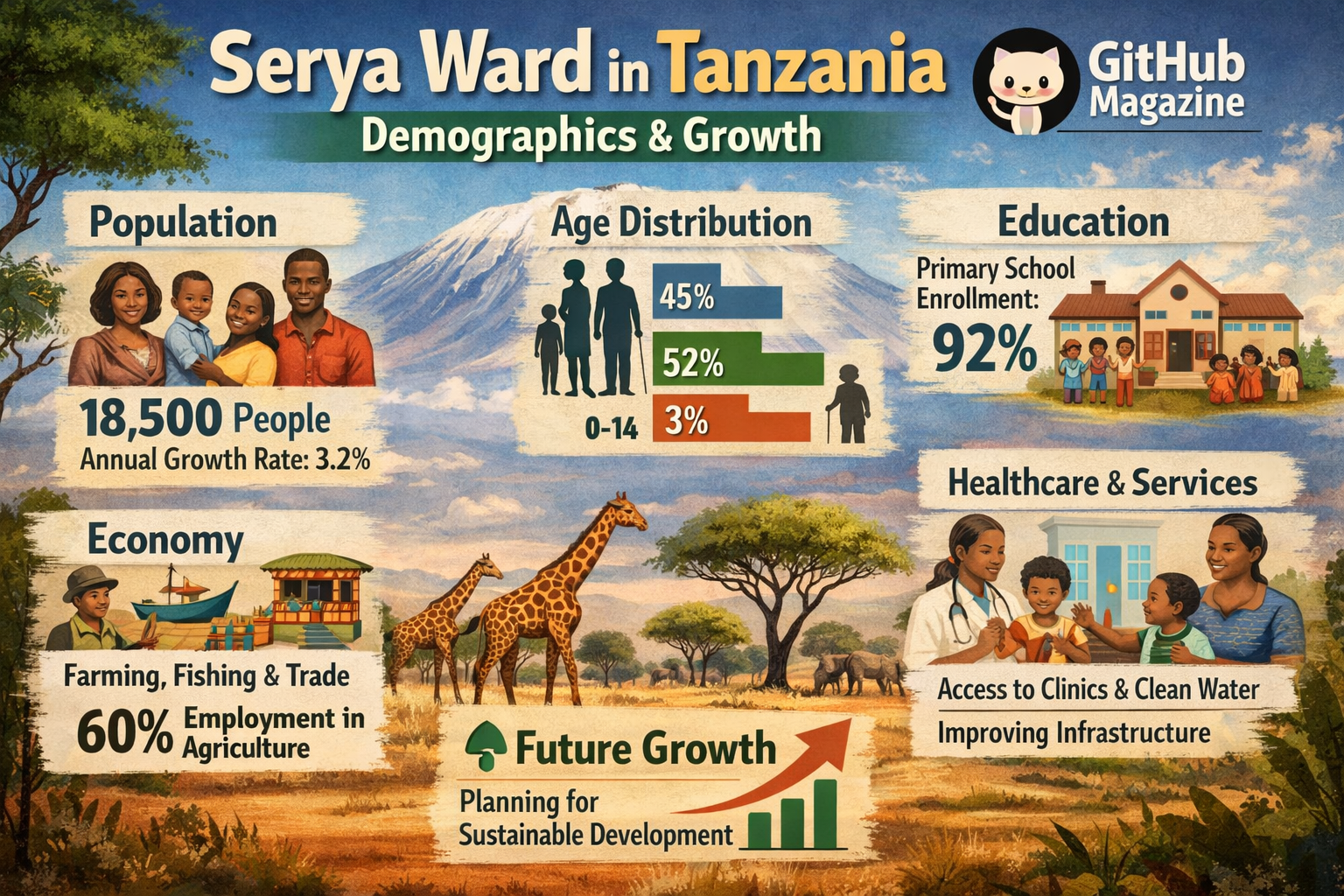
Serya Ward in Tanzania: Population, Life, and Growth
Serya is an urban administrative ward in central Tanzania, located in the Kondoa Town Council of the Dodoma Region. According to the most recent national census, it is home to just under ten thousand residents, a figure that has grown markedly over the last decade. For readers searching for “sérya,” the term does not point to a philosophy, a product, or a distant cultural movement, but to a specific place: a community of households, schools, markets, farms, and public offices embedded in the heart of the country’s political region.
Within the first moments of understanding, Serya emerges as an example of how Tanzania’s urbanization unfolds not only in major cities like Dar es Salaam or Dodoma municipality, but also in modest wards where demographic change is steady and governance is close to the ground. Its population rose from just over six thousand in 2012 to nearly 9,830 in 2022, reflecting migration patterns, natural growth, and the slow pull of regional development toward the interior of the country. That change carries implications for housing, education, healthcare, water access, and local administration.
Yet numbers alone do not define Serya. It is also a lived environment shaped by seasonal rains, market days, the routines of public servants, and the expectations of families who see the ward as both home and opportunity. Understanding Serya means looking at how geography, census data, planning documents, and everyday practices intersect. In doing so, the ward becomes more than a statistical unit. It becomes a lens into how Tanzania’s smaller urban communities absorb national policy decisions and transform them into daily life.
Administrative Identity and Geographic Setting
Serya is formally designated as a ward within Kondoa Town Council, which itself is part of the Dodoma Region. Tanzania’s administrative system divides the country into regions, districts, councils, wards, and then neighborhoods or villages. In this structure, the ward is a crucial layer of governance: close enough to residents to respond to practical needs, yet integrated into regional planning frameworks.
Geographically, Serya sits at an elevation of approximately 1,372 meters above sea level, within a semi-arid ecological zone typical of central Tanzania. The climate alternates between a dry season and a rainy season, shaping agricultural calendars and water management strategies. Most households rely either directly or indirectly on rainfall, whether for crop production, livestock, or market supply chains.
The Dodoma Region became Tanzania’s official capital area in the 1970s, and over the decades government ministries and public institutions have gradually relocated there. Although Serya is not within the core administrative capital, its proximity to regional centers influences patterns of employment, transport, and service provision. Roads connecting Kondoa to Dodoma and other districts facilitate the movement of goods and people, integrating Serya into wider economic networks.
Local governance is overseen by elected ward representatives working with appointed administrative officers. This structure allows residents to raise concerns about infrastructure, sanitation, education facilities, or land use through formal channels. As urbanization advances, these mechanisms become increasingly important for coordinating development and mitigating conflict over limited resources.
Population Growth and Demographic Structure
The most striking feature of Serya in recent years has been its demographic expansion. In 2012, census figures recorded 6,054 residents. A decade later, the count reached 9,830. This represents an increase of more than 60 percent within ten years, a rate consistent with broader urban growth trends across Tanzania’s interior.
The 2022 census also revealed a slight gender imbalance: approximately 5,193 men and 4,637 women. Such differences are common in growing urban wards, where employment opportunities in construction, transport, and informal trade often attract young male migrants from rural areas. Over time, family reunification and permanent settlement typically balance these ratios.
Population density in Serya remains moderate at roughly 20 people per square kilometer, indicating that the ward still contains open land, farms, and low-rise housing rather than dense urban blocks. This spatial distribution influences the cost of service delivery. Extending water pipes, electricity lines, or paved roads over wide areas requires significant investment, often stretching local budgets.
Demographers emphasize that such growth is rarely neutral. Professor Asha Kilonzo, a Tanzanian urban studies scholar, has observed that “ward-level population change is the earliest signal of how national urbanization policies are working on the ground.” Her research highlights that when migration concentrates in small administrative units, pressure on schools and clinics appears long before it becomes visible in regional statistics.
The structure of Serya’s population therefore carries practical consequences. Younger residents increase demand for education and employment, while older residents require healthcare and stable income sources. Balancing these needs is one of the central challenges facing ward leadership.
Population Snapshot
| Indicator | 2012 Census | 2022 Census |
|---|---|---|
| Total population | 6,054 | 9,830 |
| Male | Not specified | 5,193 |
| Female | Not specified | 4,637 |
| Population density (per km²) | Not available | 20.08 |
Everyday Economic Life
Economic activity in Serya reflects the hybrid character of many Tanzanian urban wards. Agriculture remains central, particularly small-scale cultivation of maize, sorghum, and legumes, alongside livestock keeping. These activities provide both subsistence and income, supplying local markets and neighboring wards.
At the same time, non-farm work is expanding. Small shops sell household goods, mobile phone services, and prepared food. Motorcycle taxis connect residents to Kondoa town center. Informal construction crews respond to the growing demand for housing as new families settle in the area. Teachers, healthcare workers, and local administrators form a modest but stable public-sector workforce.
The World Bank has repeatedly noted that in Sub-Saharan Africa, “secondary towns and peri-urban wards are increasingly the engines of employment growth,” particularly where formal industry is limited. This observation applies closely to Serya, where livelihoods are diversified but often vulnerable to weather fluctuations and market prices.
Household income levels remain modest, and many families rely on multiple sources of revenue to manage school fees, medical expenses, and seasonal shortages. Micro-credit groups, savings associations, and cooperative farming arrangements help spread risk, though access to formal banking remains limited for many residents.
Social Infrastructure and Public Services
As Serya’s population has grown, so too has the demand for social services. Primary schools serve most neighborhoods, though classroom crowding is common during enrollment periods. Secondary education often requires travel to other wards or to Kondoa town, creating logistical and financial barriers for some families.
Healthcare is provided mainly through local dispensaries and clinics, which handle routine treatment, maternal care, and vaccination programs. More complex cases are referred to district hospitals. Public health officials have emphasized the importance of ward-level facilities in managing preventable diseases and reducing maternal mortality.
Water access varies by neighborhood. Some households rely on communal taps or wells, while others harvest rainwater during the wet season. Sanitation infrastructure remains uneven, and local councils periodically organize campaigns to promote latrine construction and waste management.
Dr. Emmanuel Mwanga, a public health specialist working in central Tanzania, has argued that “urban wards like Serya sit at the front line of healthcare delivery. Their clinics determine whether national health policies translate into real outcomes for families.” His assessment underscores how small administrative units shape the lived reality of policy decisions.
Comparison Within Kondoa Town Council
Serya’s demographic weight becomes clearer when compared with neighboring wards in Kondoa Town Council.
| Ward | 2022 population | Relative position |
|---|---|---|
| Kondoa Mjini | 26,179 | Largest urban center |
| Kingale | 13,152 | High-growth residential ward |
| Serya | 9,830 | Mid-sized, expanding |
| Kilimani | 9,629 | Similar scale to Serya |
This comparison shows Serya as neither marginal nor dominant. It occupies a middle position, large enough to influence council decisions but small enough to retain strong neighborhood ties. Such wards often act as buffers between dense town centers and rural outskirts, absorbing new residents while maintaining agricultural land.
Governance at the Ward Level
Ward governance in Tanzania combines electoral representation with appointed administrative management. Residents vote for councilors who advocate for local priorities in district meetings. Ward executive officers coordinate day-to-day administration, oversee development projects, and implement national programs.
In Serya, this governance structure shapes decisions about road maintenance, land allocation, school construction, and health campaigns. Public meetings allow residents to voice concerns, though attendance varies depending on work schedules and political engagement.
Transparency and accountability remain ongoing challenges. Limited budgets constrain the pace of development, and competition for regional funds can delay projects. Nevertheless, ward councils provide an accessible platform for community participation, more immediate than distant regional offices.
Urban governance expert Dr. Josephine Nyerere has written that “the ward is where citizens most directly encounter the state.” In Serya, this encounter takes place in modest offices, community halls, and school compounds, where policy becomes tangible in the form of classrooms, boreholes, and graded roads.
Planning for the Future
Population projections prepared for Kondoa Town Council indicate continued growth through 2050. While exact figures vary by model, the trend is clear: Serya will likely expand further as regional mobility increases and household sizes remain relatively high.
Such growth will require careful planning. Housing demand is expected to rise, potentially pushing development into agricultural land. Water systems will need upgrading to avoid shortages during dry seasons. Schools and clinics must expand capacity to prevent overcrowding.
Urban planners increasingly emphasize integrated development, combining land-use regulation, infrastructure investment, and community consultation. Without coordination, growth risks producing informal settlements lacking adequate sanitation and safe roads.
The National Bureau of Statistics has warned that medium-sized urban wards are often overlooked in national strategies focused on large cities. Yet these wards absorb a substantial share of population increase. For Serya, this means that long-term prosperity depends not only on local initiative but also on sustained regional and national support.
Cultural Identity and Community Life
Beyond administration and economics, Serya is a social environment shaped by language, tradition, and shared experience. Swahili serves as the lingua franca, while local ethnic identities remain strong in family networks and ceremonial life. Weddings, funerals, and harvest celebrations structure the social calendar.
Religious institutions, particularly churches and mosques, provide spiritual guidance and social assistance. They organize youth programs, charitable collections, and educational activities, complementing formal public services.
Markets function as social hubs as much as economic centers. News travels quickly through conversations over vegetables, grain, and livestock sales. In these exchanges, residents negotiate prices, marriages, disputes, and political loyalties.
Such everyday interactions reinforce a sense of belonging that statistics alone cannot capture. For long-term residents, Serya represents continuity. For newcomers, it offers the promise of integration into a functioning community.
Takeaways
- Serya is an officially recognized urban ward within Kondoa Town Council in Tanzania’s Dodoma Region.
- Its population grew from about 6,054 in 2012 to 9,830 in 2022, reflecting strong urbanization trends.
- Economic life combines agriculture, small trade, transport services, and public-sector employment.
- Social services, particularly schools and clinics, face increasing pressure as the population expands.
- Ward-level governance plays a decisive role in how national development policies affect daily life.
- Long-term planning will be essential to manage housing, water supply, and infrastructure needs.
Conclusion
Serya’s significance does not lie in global fame or political power, but in its quiet illustration of how demographic change reshapes ordinary places. As Tanzania continues its transition from a predominantly rural society to a more urban one, wards like Serya become the primary theaters of that transformation. They absorb migrants, educate children, provide healthcare, and translate policy into lived experience.
The figures recorded in census tables tell only part of the story. Behind them stand households adapting to new economic realities, administrators balancing limited resources, and communities negotiating continuity amid growth. Serya shows how development unfolds incrementally, through classrooms added to schools, new shops opening along dusty roads, and families building homes on the edge of town.
In this sense, Serya is both particular and representative. It is one ward among many, yet its trajectory mirrors the broader direction of central Tanzania. Understanding it offers insight not only into a single locality, but into the processes shaping the country’s urban future.
FAQs
What exactly is Serya?
Serya is an urban administrative ward located in Kondoa Town Council, within Tanzania’s Dodoma Region.
How many people live there?
According to the 2022 census, Serya has a population of about 9,830 residents.
Why has the population grown so quickly?
Growth is driven by natural increase and migration from surrounding rural areas seeking work and services.
What do most residents do for a living?
Livelihoods combine small-scale farming, trade, transport services, construction, and public-sector employment.
What challenges does Serya face?
Key challenges include expanding social services, securing reliable water supply, and managing land use as housing demand rises.

Related Posts

Virtual Airline News and Digital Aviation Growth

Shoshone County Eviction Rate 2020 Analysis