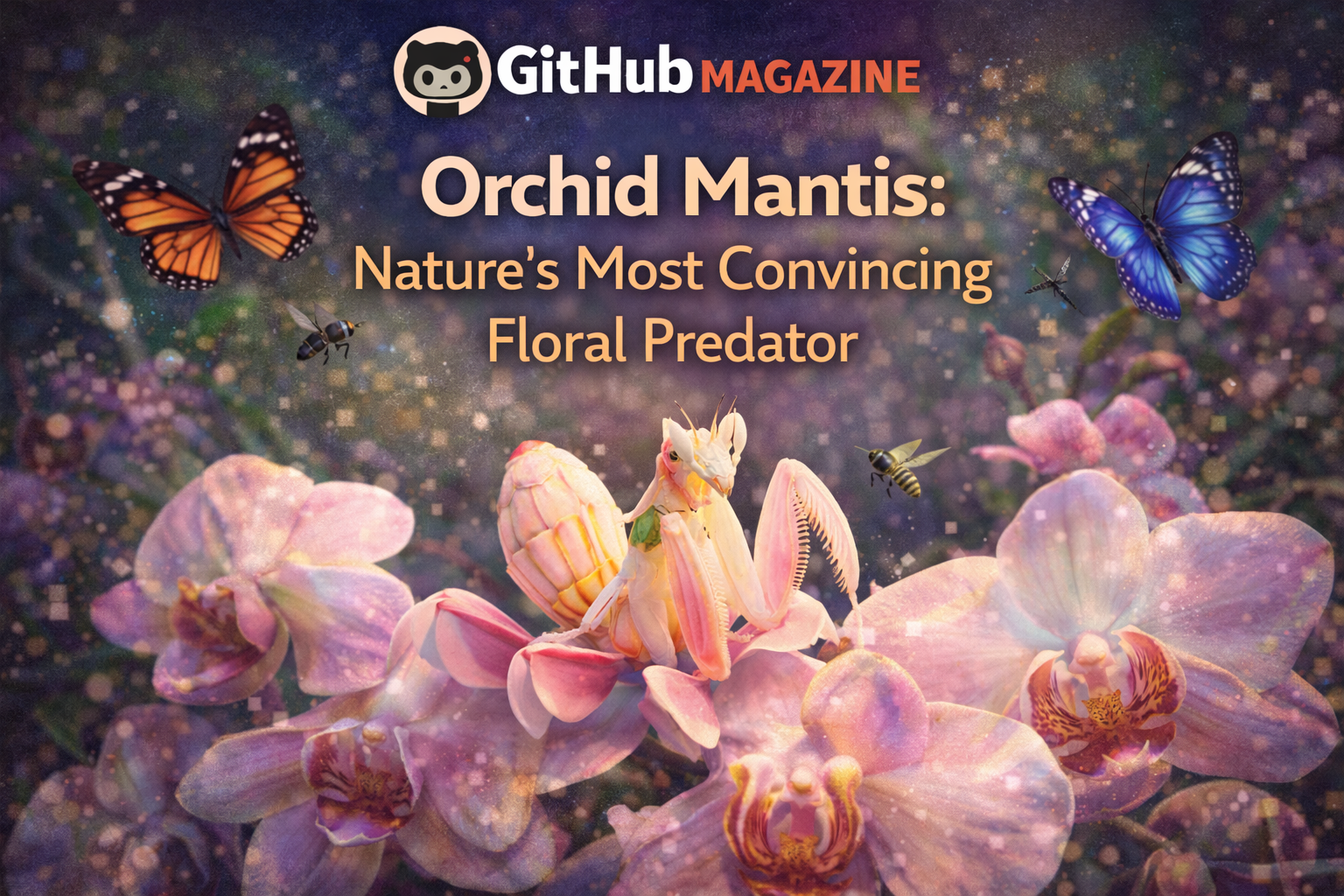
Orchid Mantis: Nature’s Most Convincing Floral Predator
The orchid mantis is one of nature’s most persuasive illusions: an insect that appears to be a flower and behaves like a patient assassin. Known scientifically as Hymenopus coronatus, this mantis is native to the tropical forests of Southeast Asia and has evolved a body plan that closely resembles orchid petals in both color and shape. For curious readers, the essential answer is simple and startling at once. The orchid mantis survives by pretending to be a flower, attracting pollinating insects that approach it willingly, only to be captured in a sudden burst of speed.
Yet that simplicity masks a deeper biological story. The orchid mantis is not merely camouflaged; it is actively deceptive. Unlike animals that hide to avoid predators, this mantis advertises itself, exploiting the visual expectations of insects searching for nectar. Its pale whites and soft pinks are not random beauty but evolutionary tools shaped by countless generations of success and failure.
Within rainforest ecosystems, the orchid mantis occupies a precise niche where flowering plants, insect vision, and predatory timing intersect. Its extreme sexual dimorphism, unusual life cycle, and reliance on intact habitats make it both a scientific marvel and a quiet indicator of ecological health. To understand the orchid mantis is to understand how evolution rewards patience, illusion, and ruthless efficiency.
Evolutionary Identity and Physical Design
The orchid mantis belongs to the family Hymenopodidae, a group known for flower-mimicking mantises, yet it stands apart as the most visually convincing example. Adult females grow significantly larger than males and possess broad, petal-like lobes on their legs that exaggerate the illusion of a flower in bloom. Their coloration ranges from bright white to blush pink, sometimes shifting subtly depending on humidity, light exposure, and developmental stage.
Males, by contrast, are smaller, slimmer, and far less ornate. This difference is not decorative but functional. Females are ambush predators that rely on deception and stillness, while males are built for movement, locating mates across dense vegetation. Sexual dimorphism in orchid mantises is among the most extreme in the insect world, reflecting sharply diverging evolutionary pressures.
What makes this morphology remarkable is not resemblance alone but precision. The mantis does not copy a single flower species. Instead, it approximates a generalized floral form that pollinators instinctively recognize as rewarding. This evolutionary shortcut allows it to remain effective across varied forest environments where specific flower species change with season and location.
Aggressive Mimicry and Predatory Strategy
The orchid mantis exemplifies aggressive mimicry, a strategy in which predators resemble something beneficial to their prey. In this case, the prey is drawn toward the mantis rather than accidentally encountering it. Pollinating insects such as bees, butterflies, and flies approach the mantis expecting nectar and pollen, guided by visual cues refined over millions of years.
From the insect’s perspective, the deception is nearly perfect. The mantis remains motionless, swaying gently as vegetation moves in the breeze. When prey comes within reach, the mantis strikes with raptorial forelegs adapted for speed and grip. The attack is instantaneous, leaving no opportunity for escape.
What distinguishes this behavior is that the mantis does not need to hide among flowers. Research discussed in the earlier material shows that orchid mantises can attract more pollinators than nearby real flowers, effectively functioning as supernormal stimuli. This means the mantis exploits exaggerated cues that insects find irresistible, turning their evolutionary preferences into vulnerabilities.
Habitat and Ecological Placement
Orchid mantises inhabit lowland tropical rainforests across Malaysia, Indonesia, Thailand, and neighboring regions. These environments are defined by dense plant growth, high humidity, and an abundance of flowering vegetation throughout the year. The mantis positions itself on branches, leaves, and shrubs where floral density is high, maximizing its chances of encountering prey.
Within these ecosystems, the orchid mantis plays a subtle but important role. By preying on pollinating insects, it participates in population regulation while also serving as prey for birds, reptiles, and larger arthropods. Its survival depends on a balanced ecosystem where flowers bloom, insects forage, and predators remain in check.
The mantis’s reliance on intact rainforest structure makes it sensitive to environmental disruption. When forests are fragmented or cleared, the complex visual background that supports its mimicry disappears, reducing both hunting success and protection from predators.
Life Cycle and Development
Like other mantises, the orchid mantis undergoes incomplete metamorphosis, progressing through egg, nymph, and adult stages. Females deposit eggs in foamy structures called oothecae, attaching them to vegetation. Each ootheca can contain dozens to over a hundred eggs, offering protection from dehydration and some predators.
Newly hatched nymphs look nothing like flowers. Instead, they are dark-colored and resemble small, aggressive insects, a likely form of early defensive mimicry. As they molt through successive instars, their coloration lightens, and their bodies broaden, gradually acquiring the floral appearance that defines adulthood.
Females typically live longer than males, often reaching eight or nine months under favorable conditions. Males mature more quickly and die sooner, reflecting their primary role in reproduction rather than long-term predation. Cannibalism can occur, especially among juveniles or during mating, providing nutritional advantages that increase reproductive success.
Table: Female and Male Orchid Mantis Comparison
| Trait | Female | Male |
|---|---|---|
| Average size | Large, robust | Small, slender |
| Coloration | White and pink, petal-like | Pale, minimal ornamentation |
| Primary role | Ambush predator | Mate seeker |
| Lifespan | Longer | Shorter |
| Mimicry effectiveness | Very high | Limited |
Diet and Feeding Behavior
The orchid mantis feeds primarily on flying insects, especially pollinators attracted by its appearance. Bees, butterflies, moths, flies, and small beetles make up the bulk of its diet. The mantis relies on patience rather than pursuit, conserving energy while waiting for prey to approach.
Once captured, prey is consumed methodically, often starting with the head. This feeding efficiency allows the mantis to survive long intervals between meals. In environments where food is scarce, larger individuals may prey on smaller mantises, including siblings, reinforcing survival of the fittest within each generation.
Table: Common Prey Categories
| Prey Group | Role in Diet |
|---|---|
| Bees and butterflies | Primary food source |
| Flies | Frequent opportunistic prey |
| Small beetles | Supplemental nutrition |
| Other mantises | Rare, resource-driven cannibalism |
Scientific and Expert Perspectives
Entomologists have long viewed the orchid mantis as a textbook example of evolutionary innovation. Experts emphasize that its success lies not in passive disguise but in active exploitation of sensory systems shaped by co-evolution. Evolutionary biologists note that such strategies arise only when environmental conditions remain stable enough for fine-tuned adaptations to persist.
Ecologists caution that habitat loss threatens not just individual species but the intricate relationships that make behaviors like aggressive mimicry viable. When flowering plants decline or insect populations shift, the mantis’s evolutionary advantages can quickly become liabilities.
Conservation Context
While the orchid mantis is not formally classified as endangered, it depends heavily on rainforest integrity. Deforestation, agricultural expansion, and habitat fragmentation reduce the diversity of flowers and insects required for its survival. Conservation efforts that protect tropical forests indirectly safeguard the orchid mantis and countless other species that share its environment.
Protecting such organisms matters beyond aesthetics. The orchid mantis represents a rare evolutionary solution, one that reveals how deeply interconnected life systems can be. Losing it would mean losing a living demonstration of evolutionary creativity.
Takeaways
• The orchid mantis uses aggressive mimicry rather than concealment.
• Extreme sexual dimorphism reflects distinct survival strategies.
• Its life cycle reveals shifting defensive and predatory adaptations.
• Healthy rainforests are essential to its survival.
• The species illustrates how evolution exploits sensory bias.
Conclusion
The orchid mantis challenges how humans define beauty and danger in nature. What appears delicate and ornamental is, in reality, a refined predator shaped by evolutionary pressure and ecological opportunity. Its floral disguise is not accidental but the product of a long conversation between predator and prey, vision and deception, survival and chance.
As rainforests shrink and ecological relationships fray, the orchid mantis stands as both marvel and warning. Its continued existence depends on preserving the environments that allow such extraordinary adaptations to flourish. In studying this living flower, we glimpse the elegance and severity of evolution itself.
FAQs
What makes the orchid mantis unique?
It uses aggressive mimicry, resembling a flower to attract prey instead of hiding from it.
Where is the orchid mantis found?
In tropical rainforests of Southeast Asia, including Malaysia and Indonesia.
Do orchid mantises change color?
Their coloration can shift subtly with age, environment, and conditions.
Are orchid mantises dangerous to humans?
No, they pose no threat to humans.
Why are females larger than males?
Females evolved for predation and reproduction, while males evolved for mobility.

Related Posts

Rowdy Oxford Lawsuit Explained

Stevens Disposal and Waste Management Systems