
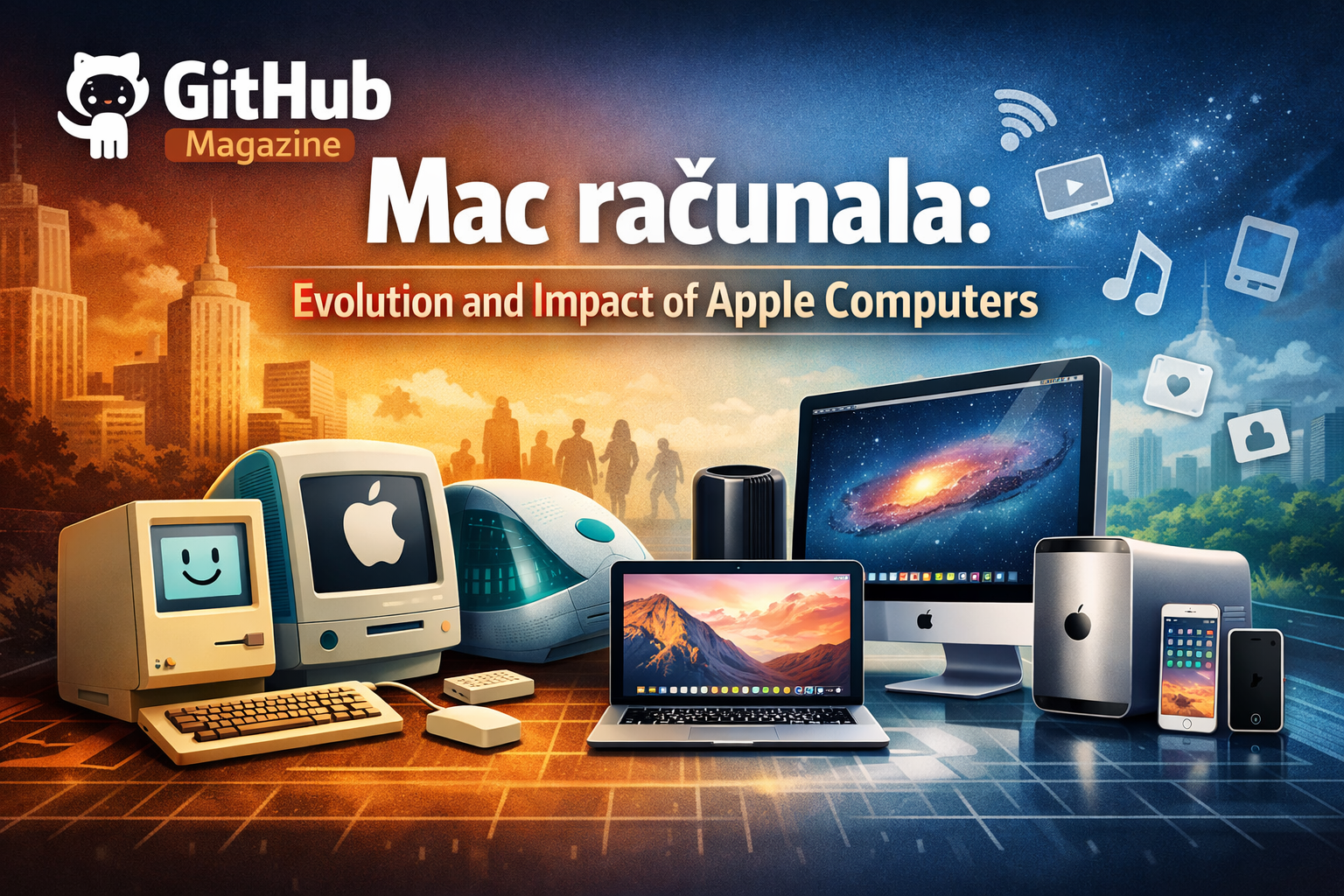
Mac računala: Evolution of Apple’s Computers
Mac računala—literally “Mac computers” in much of Southeast Europe—refer to Apple’s family of personal computers built around macOS and a tightly integrated hardware–software philosophy. In practical terms, they are laptops and desktops designed, engineered, and controlled end-to-end by Apple, distinguished by long battery life, industrial design, and close integration with iPhones and iPads. For students, they are lightweight notebooks for writing and research. For designers and filmmakers, they are production studios in aluminum shells. For businesses, they are secure workstations increasingly favored in software development and media.
The first hundred words of the Mac story are simple: Apple introduced the Macintosh in 1984 to make computers usable by ordinary people. Instead of cryptic commands, users saw windows, icons, and a mouse pointer. That decision reshaped the industry. Over the decades, the machines changed processors—from Motorola chips to PowerPC, then Intel, and now Apple’s own silicon—but the central promise remained consistent: computing should feel intuitive, stable, and personal.
Today’s Mac lineup spans ultraportable MacBook Air models, performance-driven MacBook Pro machines, all-in-one iMac desktops, and modular systems like Mac mini and Mac Studio. All run macOS, a Unix-based operating system refined annually. Together they form an ecosystem rather than a single product category.
Yet mac računala are not only tools. They are cultural artifacts. They appear in film studios, classrooms, coffee shops, and courtrooms, often symbolizing creative independence or technical professionalism. Their history mirrors broader technological shifts: the rise of graphical interfaces, the globalization of software development, the return of custom chip design, and the growing expectation that technology should be both powerful and humane. Understanding Macs is therefore less about memorizing specifications and more about tracing how one company’s design philosophy quietly influenced the way millions of people work, learn, and create.
Origins: the Macintosh revolution
The Macintosh project began in 1979 inside Apple as a modest attempt to design an affordable, user-friendly computer. Led initially by Jef Raskin and later reshaped by Steve Jobs, the project adopted ideas from Xerox PARC: graphical windows, icons, and a mouse. These concepts existed in laboratories but not in mass-market products.
When the Macintosh launched in January 1984, it arrived as a compact beige machine with a nine-inch screen and a single floppy drive. Its memory was tiny by modern standards, yet its interface felt radical. Users could point, click, drag, and drop. Text could be edited visually. Files appeared as icons instead of directory listings.
Sales in the first years were uneven, but the cultural impact was immediate. Competing systems soon adopted similar interfaces. Software developers began building applications around visual interaction rather than typed commands. Desktop publishing emerged as an industry when Macs paired with the LaserWriter printer and Aldus PageMaker software.
The Macintosh reframed expectations. Computers were no longer only for engineers or accountants. They became household objects, educational tools, and creative instruments. That shift laid the psychological foundation for everything that followed in personal computing.
PowerPC years and the search for performance
By the early 1990s, Apple faced technical pressure. Intel processors were advancing quickly, and Macintosh systems built on Motorola chips struggled to keep pace. In 1994, Apple joined IBM and Motorola to develop the PowerPC architecture.
The transition was risky. Software had to be rewritten or compiled for two architectures at once. Apple encouraged developers to create “fat binaries,” applications containing code for both old and new processors. The strategy worked, allowing users to upgrade hardware without losing access to existing programs.
During this era, Apple experimented heavily with form factors and design. Laptops grew thinner. Desktops diversified into consumer and professional lines. Color displays became standard. Yet the company also stumbled financially, releasing too many overlapping models and confusing customers.
Still, PowerPC Macs gained a loyal professional base, particularly in graphic design and publishing. Their reputation for stable performance and accurate color reproduction reinforced Apple’s connection to creative industries—a relationship that continues today.
The Intel transition and a broader audience
In 2005, Apple announced another architectural shift: the move from PowerPC to Intel processors. This time, the motivation centered on performance per watt and manufacturing reliability. Intel chips promised faster speeds and lower energy consumption, crucial for laptops.
The first Intel-based Macs appeared in 2006. They immediately benefited from a larger software ecosystem and the ability to run Microsoft Windows through dual-booting or virtualization. For the first time, users could purchase a Mac without abandoning Windows-only applications.
This period expanded Apple’s market. Developers, engineers, and corporate users began adopting Macs for daily work. The MacBook line, especially, grew into a mainstream alternative to Windows laptops.
The Intel years also coincided with Apple’s growing confidence in minimalist design. White plastic gradually gave way to precision-milled aluminum. Keyboards flattened. Screens sharpened. Ports disappeared and reappeared in cycles of controversial redesign.
By the late 2010s, however, Apple once again confronted limitations imposed by reliance on external chip manufacturers. Battery life plateaued. Thermal constraints shaped designs. The company looked inward for solutions.
Apple Silicon and the return to vertical integration
In 2020, Apple introduced its first Mac processor designed entirely in-house: the M1. Built on ARM architecture, the chip borrowed ideas from the company’s iPhone and iPad processors but scaled them for desktop performance.
The results surprised many in the industry. MacBooks ran cooler and quieter. Battery life doubled in some models. Performance matched or exceeded Intel systems while consuming far less power.
Subsequent generations—the M2, M3, and newer chips—extended these gains. Apple Silicon unified memory architecture, allowing the CPU and GPU to share a common pool of fast memory. Tasks like video editing, software compilation, and machine-learning inference accelerated dramatically.
For users, the transition felt almost invisible. macOS translated older Intel applications automatically while developers recompiled software for native performance. Once again, Apple demonstrated its ability to manage architectural change without fracturing its user base.
The return to custom silicon marked a philosophical full circle: Apple controlling not only the software and industrial design of its computers, but the fundamental logic that powers them.
macOS and the ecosystem effect
Mac hardware cannot be separated from macOS. Originally known as “System Software,” the operating system evolved through classic Mac OS and, in 2001, into Mac OS X—a Unix-based platform derived from NeXTSTEP.
Today’s macOS blends technical rigor with visual restraint. Beneath its polished interface lie features familiar to programmers: command-line tools, process isolation, and strong permission models. Above them sit conveniences like Spotlight search, Time Machine backups, and continuity tools that copy text from an iPhone and paste it instantly onto a Mac.
This integration creates what analysts often call the “Apple ecosystem.” Messages sync across devices. Photos appear simultaneously on laptops and phones. AirPods connect without configuration. For many users, this cohesion outweighs the advantages of cheaper hardware alternatives.
The system also emphasizes security. Sandboxing, encryption, and controlled software distribution reduce exposure to malware. Corporate IT departments increasingly support Macs for this reason alone.
Design as identity
Apple’s computers have always communicated values through physical form. The translucent iMac G3 in 1998 replaced anonymous beige boxes with playful color. Later models adopted brushed aluminum and near-invisible seams.
Design is not cosmetic in Apple’s worldview. It signals how a device should be approached: quietly, confidently, without fear. The thinness of a MacBook suggests portability. The absence of screws on an iMac implies appliance-like simplicity.
This aesthetic influence spread beyond Apple. Competing laptops adopted metal bodies, minimal branding, and high-resolution displays. Even smartphones and tablets absorbed the same visual language.
For many owners, mac računala become personal artifacts, covered in stickers or carried between offices and cafes. They function as social signals—markers of profession, taste, or aspiration—as much as tools.
Mac and PC: two philosophies
Technical comparisons between Macs and Windows PCs often miss the deeper distinction: philosophy.
| Aspect | Mac računala | Windows PCs |
|---|---|---|
| Hardware control | Designed exclusively by Apple | Built by many manufacturers |
| Operating system | macOS, tightly integrated | Windows, widely licensed |
| Customization | Limited by design | Extensive |
| Ecosystem | Strong integration with Apple devices | Fragmented |
| Typical users | Creatives, developers, professionals | Broad consumer and enterprise base |
Where PCs prioritize choice and modularity, Macs emphasize coherence. One approach favors freedom to modify. The other favors predictability and refinement.
Neither is inherently superior. Gamers often prefer PCs for hardware flexibility. Architects and musicians frequently choose Macs for software stability and color-accurate displays. The market accommodates both visions.
A timeline of transformation
| Year | Event | Significance |
|---|---|---|
| 1984 | First Macintosh released | Popularized the graphical interface |
| 1994 | PowerPC transition | Improved performance competitiveness |
| 2006 | Intel transition | Expanded software compatibility |
| 2020 | Apple Silicon debut | Redefined efficiency and laptop performance |
Each shift involved risk. Each preserved continuity. Few technology companies have executed architectural change four times without alienating their customers.
Expert perspectives
Technology historian Owen Linzmayer has argued that the Macintosh “redefined how ordinary people interact with personal computers,” emphasizing that its success lay less in raw processing power than in psychological accessibility.
A professor of human–computer interaction describes macOS as “a rare marriage of Unix stability and consumer-grade design,” allowing developers and non-technical users to share the same platform without compromise.
A senior product designer at a European creative studio notes that Macs remain dominant in visual production because “color management, typography rendering, and audio latency are solved problems on this platform,” reducing technical friction during creative work.
Together, these views converge on a theme: Macs reduce cognitive overhead. They attempt to make the computer fade into the background, leaving attention for the task itself.
Global reach and regional meaning
In Croatia, Serbia, Bosnia and Herzegovina, and neighboring countries, the phrase “mac računala” has entered everyday vocabulary. Universities increasingly equip labs with iMacs. Software companies hire developers who work primarily on MacBooks. Freelancers view a Mac as an investment in credibility.
Prices remain higher than many local alternatives, yet resale value and longevity offset initial costs. A five-year-old MacBook often continues to receive system updates and perform reliably, an important consideration in regions where electronics represent significant personal expenditure.
The Mac’s symbolism also resonates. It suggests participation in a global digital culture, alignment with international design standards, and connection to industries beyond local borders.
Takeaways
- Mac računala combine hardware and software into a unified system.
- The original Macintosh popularized graphical user interfaces.
- PowerPC and Intel transitions preserved compatibility while chasing performance.
- Apple Silicon redefined laptop efficiency and battery life.
- macOS balances Unix stability with consumer usability.
- Design philosophy remains central to Apple’s identity.
- Choosing Mac or PC reflects workflow and values more than specifications.
Conclusion
The history of mac računala is not a straight line of technological upgrades but a series of carefully managed transformations. Each generation replaced invisible machinery while protecting familiar rituals: opening a lid, dragging a file, typing a sentence, exporting a video.
From the small monochrome screen of 1984 to today’s high-resolution, silent machines, Macs have insisted that computing should feel approachable. They have treated design as a moral choice and integration as a form of respect for the user’s time.
Critics rightly point to limitations: high prices, closed ecosystems, reduced repairability. Yet even these criticisms acknowledge Apple’s influence. They argue not about irrelevance, but about power.
In classrooms, studios, and offices across the world, Macs continue to shape how people imagine their relationship with technology—not as confrontation, but as collaboration. That quiet ambition may be their most enduring legacy.
FAQs
What does “Mac računala” mean?
It means “Mac computers,” referring to Apple’s desktop and laptop computers running macOS.
What operating system do Macs use?
They use macOS, a Unix-based operating system developed by Apple.
Are Macs better than PCs?
They are different. Macs emphasize integration and stability; PCs emphasize choice and customization.
What is Apple Silicon?
Apple Silicon refers to Apple-designed processors (M-series chips) used in modern Macs.
Why are Macs popular with creatives?
They offer stable performance, accurate displays, and optimized professional software.
SEO Metadata
SEO Title: Mac računala: Evolution of Apple’s Computers
Meta Description: Discover how Mac računala evolved from early Macintosh computers into modern Apple Silicon devices shaping design, creativity, productivity, and everyday digital life worldwide.