
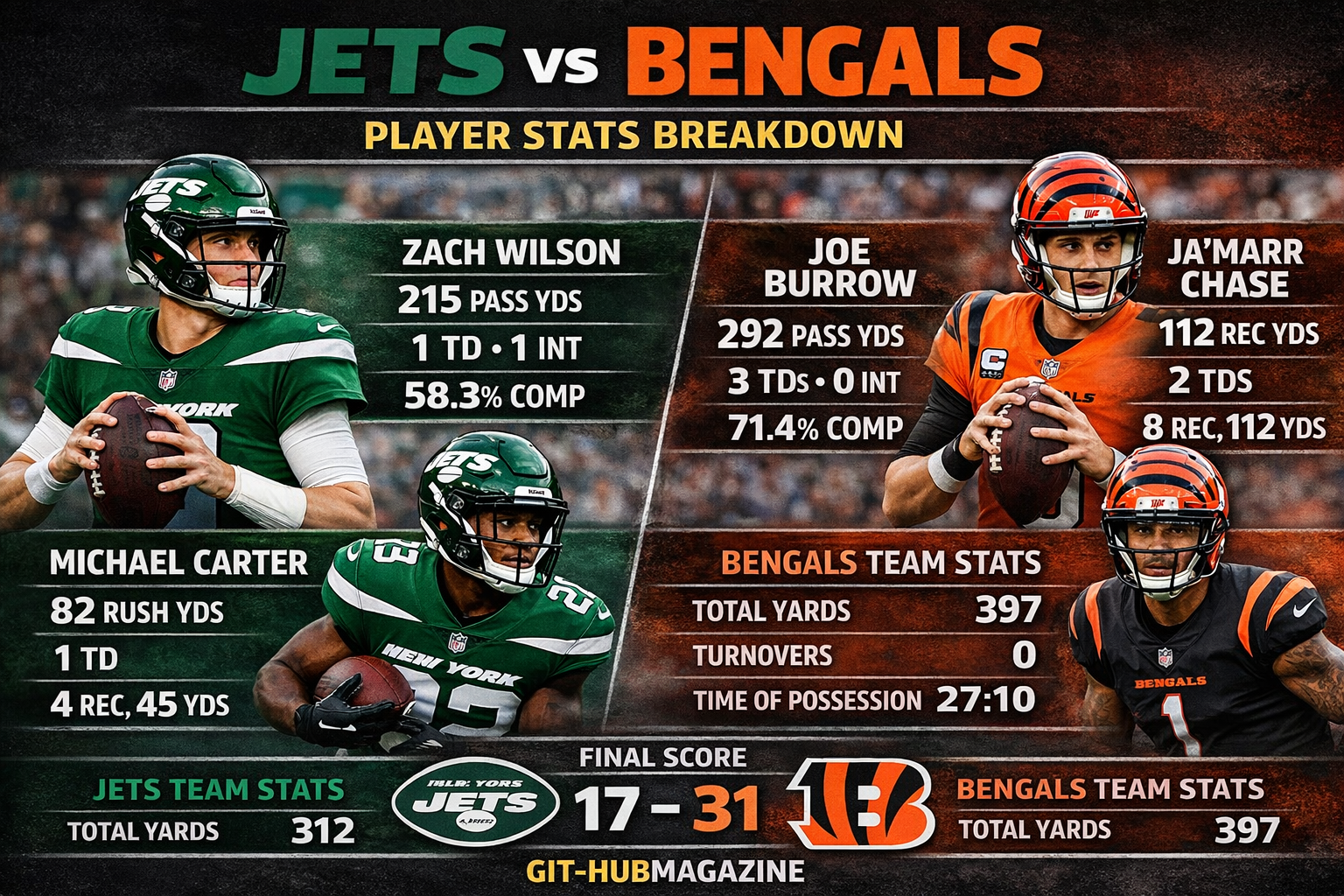
Jets vs Bengals Player Stats Analysis
I remember watching the numbers accumulate during the Jets vs Bengals matchup and realizing quickly that this was not going to be an ordinary NFL game. Anyone searching for New York Jets vs Bengals match player stats will find that the numbers alone reveal a story of momentum swings, explosive individual performances, and a late comeback that ultimately decided the contest.
The Jets secured a dramatic 39–38 victory, producing 502 total offensive yards compared with Cincinnati’s 398. The statistical contrast that defined the afternoon came from New York’s rushing attack. The Jets generated 254 rushing yards, consistently controlling the pace of the game and keeping the Bengals’ offense off the field for extended stretches.
Cincinnati, on the other hand, relied heavily on efficient passing plays and explosive drives to build an early lead. Their offensive strategy worked early, helping them establish a 24–13 halftime advantage. Yet football games are rarely decided in the first half, and the Jets’ commitment to their ground game slowly began to reshape the momentum.
Running back Breece Hall delivered the most memorable statistical performance of the afternoon, finishing with 133 rushing yards, two rushing touchdowns, and even a touchdown pass on a trick play that ultimately secured the win. Meanwhile, quarterback Justin Fields quietly produced an efficient and mistake-free passing performance that stabilized the offense when it mattered most.
When all the statistics are viewed together, the matchup becomes a fascinating case study in how different offensive philosophies collide. The Bengals favored explosive passing sequences, while the Jets leaned on sustained rushing drives and time-of-possession control. In the end, the numbers show how those strategies unfolded over sixty minutes of football.
Statistical Overview of the Match
I often find that the quickest way to understand a football game is to examine the core team statistics. In this matchup, those numbers reveal exactly why the Jets were able to mount a comeback despite trailing earlier in the game.
The Jets’ ability to dominate rushing yardage and control the clock proved decisive. With over 33 minutes of possession, New York limited the Bengals’ opportunities to extend their early lead.
| Team | Total Yards | Passing Yards | Rushing Yards | First Downs | Time of Possession |
|---|---|---|---|---|---|
| New York Jets | 502 | 248 | 254 | 25 | 33:40 |
| Cincinnati Bengals | 398 | 217 | 181 | 24 | 26:20 |
These numbers highlight two key differences between the teams. First, the Jets produced more balanced offense by combining effective passing with a powerful rushing attack. Second, their longer possessions gradually wore down the Bengals’ defensive front.
NFL analytics specialists frequently point out that time of possession alone does not guarantee victory. However, when paired with efficient rushing production, it can significantly increase a team’s chances of sustaining drives and controlling game tempo.
The Jets demonstrated exactly how that formula works.
Quarterback Performances and Passing Efficiency
From my perspective, quarterback play in this matchup was less about highlight passes and more about efficiency and decision-making. Both teams received steady performances from their quarterbacks, though the Jets’ approach proved slightly more effective late in the game.
Justin Fields delivered a composed and disciplined performance for New York. He completed 21 of 32 passes for 244 yards and one touchdown, avoiding turnovers and extending drives when needed.
Cincinnati’s quarterback also performed efficiently, throwing three touchdown passes and 217 yards through the air. The Bengals used short, quick passes and vertical routes to generate scoring drives early in the game.
| Quarterback | Team | Completions / Attempts | Passing Yards | TD | INT |
|---|---|---|---|---|---|
| Justin Fields | Jets | 21 / 32 | 244 | 1 | 0 |
| Joe Flacco | Bengals | 21 / 34 | 217 | 3 | 0 |
While the Bengals quarterback produced more touchdown passes, Fields’ efficiency and ball security proved crucial during the Jets’ comeback. His ability to maintain composure under pressure helped keep drives alive in the fourth quarter.
Many analysts emphasize that quarterback success cannot be measured purely by yardage totals. Instead, situational efficiency such as third-down conversions and late-game execution often determines the final outcome.
This game offered a clear example of that principle.
Breece Hall’s Game-Changing Performance
I found Breece Hall’s performance to be the defining statistical storyline of the entire game. Running backs rarely dominate modern NFL games the way Hall did in this matchup.
Hall finished the game with:
- 133 rushing yards
- Two rushing touchdowns
- One touchdown pass
- 18 rushing attempts
His explosive runs repeatedly shifted field position and forced the Bengals’ defense to adjust its alignment. The Jets took advantage of those adjustments by mixing in play-action passes and misdirection plays.
The most memorable moment came late in the fourth quarter. After the Jets had already narrowed the score, Hall executed a designed trick play by throwing a touchdown pass to tight end Mason Taylor. The play surprised Cincinnati’s defense and ultimately provided the decisive points.
Football analysts frequently describe versatile offensive players as “game-plan disruptors.” Hall perfectly embodied that description in this contest. His ability to contribute as both a runner and passer forced the Bengals’ defense to account for multiple threats at once.
Performances like this illustrate why elite running backs remain valuable even in an era dominated by passing offenses.
Bengals Offensive Contributors
While the Bengals ultimately lost by a single point, their offensive production throughout the game remained impressive. Cincinnati’s passing attack generated quick scoring drives that allowed the team to build its early lead.
Wide receiver Tee Higgins played a key role in the offense, catching a touchdown pass and consistently stretching the Jets’ secondary. His route running created opportunities for the Bengals’ quarterback to attack downfield.
Running back Chase Brown also contributed with a touchdown reception and several productive rushing attempts. Cincinnati’s offense combined short passes with explosive plays, producing points rapidly during the first half.
However, the Bengals’ offensive strategy had a hidden downside. Because their drives often relied on quick scoring plays, the Jets regained possession quickly and continued to run the ball effectively. Over time, this pattern allowed New York to dominate possession.
Offensive efficiency remained high for Cincinnati, but the inability to control the clock ultimately limited their chances to protect the lead.
Defensive Contributions and Hidden Statistics
When reviewing the player statistics from this matchup, it becomes clear that defense also played a meaningful role in shaping the outcome. While the game was largely driven by offensive production, several defensive contributions deserve attention.
Jets linebacker Quincy Williams returned from injury and recorded seven tackles, providing stability to the defense during critical moments. His presence helped slow the Bengals’ rushing attack in the second half.
Cincinnati’s defense initially performed well, stopping the Jets on early drives and forcing field-goal attempts rather than touchdowns. Rookie linebacker Barrett Carter produced a key fourth-down stop that energized the Bengals early in the game.
Special teams also influenced the statistical outcome. Jets kicker Nick Folk converted multiple field goals, ensuring that the Jets remained within reach while their offense searched for momentum.
Another overlooked statistic was discipline. The Jets committed only four penalties for 25 yards, avoiding costly mistakes that might have halted their comeback.
In close games, these hidden numbers often become the difference between victory and defeat.
Historical Context of Jets vs Bengals Games
I have always found it interesting how certain NFL matchups produce memorable games even without being traditional rivalries. The Jets and Bengals have faced each other periodically for decades, and their meetings often produce surprising outcomes.
Historically, the Jets hold the advantage in the all-time series with 19 wins compared with the Bengals’ 11 victories.
Several past matchups stand out:
- The Jets’ dominant 37–0 playoff victory in 2010
- A dramatic 34–31 Jets upset in 2021
- Cincinnati’s 27–12 victory in 2022
The 2025 contest now joins this list as one of the most exciting games between the two franchises. The one-point margin and high offensive output ensured that it will be remembered by fans of both teams.
Historical statistics often show patterns that extend across decades. In the Jets-Bengals series, close games and unexpected results appear frequently.
This matchup continued that trend.
Tactical Turning Points of the Game
From an analytical perspective, the Jets’ second-half strategy represented the most important turning point of the entire game. After trailing at halftime, New York shifted its offensive approach toward an even heavier emphasis on rushing.
This adjustment produced several immediate effects.
First, it allowed the Jets to sustain longer drives. By repeatedly running the ball, they forced the Bengals’ defense to remain on the field for extended periods.
Second, the running game opened opportunities for play-action passes. Cincinnati’s defense began to anticipate rushing plays, which created space for short completions and occasional deep throws.
Finally, the Jets used creative play design to surprise the Bengals’ defense. The trick play touchdown pass thrown by Breece Hall represented the culmination of this strategy.
Football strategy often revolves around adapting to defensive weaknesses as the game progresses. The Jets identified Cincinnati’s vulnerability to sustained rushing pressure and exploited it effectively.
By the final minutes of the game, the statistical momentum had completely shifted in New York’s favor.
Takeaways
- The Jets accumulated 502 total yards, significantly more than Cincinnati’s 398.
- New York’s rushing attack generated 254 yards, controlling the tempo of the game.
- Breece Hall produced the most impactful performance with 133 rushing yards and three total touchdowns.
- Justin Fields delivered an efficient passing performance without committing turnovers.
- Cincinnati built an early lead through explosive passing plays but struggled to maintain possession late.
- The Jets’ disciplined play, including minimal penalties, helped sustain their comeback.
- Tactical adjustments in the second half allowed New York to shift momentum and secure victory.
Conclusion
Looking back at the numbers from this game, I see a clear example of how statistical trends can reveal the deeper narrative of a football contest. The Jets’ 39–38 victory over the Bengals was not simply a dramatic comeback. It was the result of specific strategic decisions, disciplined execution, and one extraordinary individual performance.
The Jets demonstrated that a strong rushing attack can still dominate an NFL game even in an era defined by passing offenses. By controlling possession and gradually wearing down the Bengals’ defense, they created the conditions necessary for a late scoring drive.
For Cincinnati, the game illustrated both the power and limitations of explosive offensive play. Quick scoring drives helped them establish an early advantage, but the lack of sustained possessions ultimately left the door open for a comeback.
In the end, the player statistics from this matchup capture something fundamental about football. Every yard gained, every tackle made, and every strategic adjustment contributes to the larger story of the game. When those numbers align at the right moment, they can transform an ordinary Sunday matchup into a memorable chapter of NFL history.
FAQs
What was the final score of the Jets vs Bengals game?
The New York Jets defeated the Cincinnati Bengals 39–38 in a dramatic matchup decided by a late fourth-quarter touchdown.
Who had the best stats in the Jets vs Bengals game?
Running back Breece Hall delivered the standout performance with 133 rushing yards, two rushing touchdowns, and one touchdown pass.
How many total yards did the Jets record?
The Jets produced 502 total offensive yards, including 254 rushing yards and 248 passing yards.
Who was the Jets quarterback in the matchup?
Justin Fields started at quarterback and completed 21 of 32 passes for 244 yards and one touchdown.
What is the historical record between the Jets and Bengals?
The New York Jets hold the all-time advantage with 19 wins compared with 11 for the Cincinnati Bengals.

Related Posts

Tiffany Pesci: A Private Life Beyond Fame

Lake Texoma History Ecology Travel Guide