
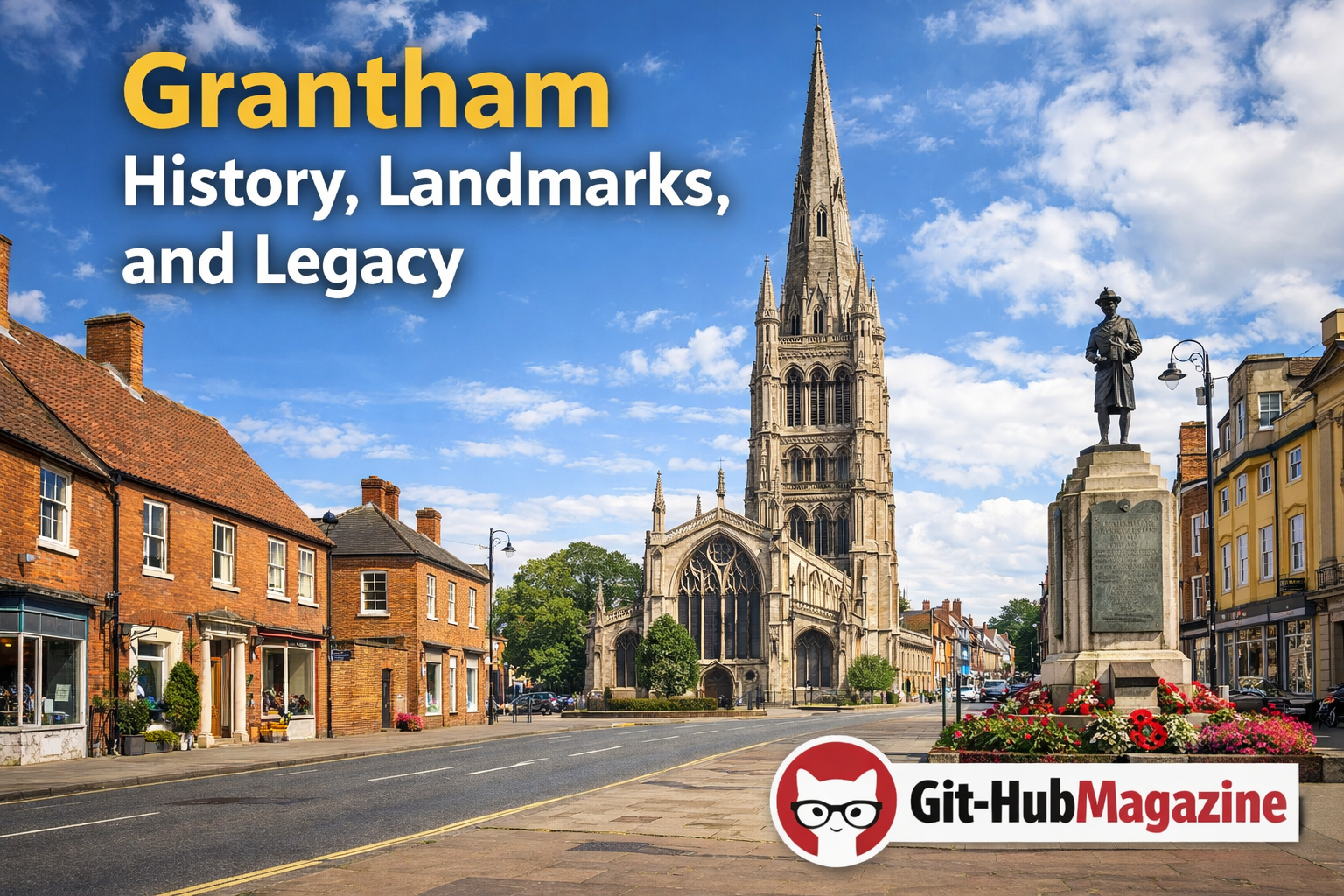
Grantham History, Landmarks, and Legacy
When I first arrived in Grantham, I expected a quiet English market town and found instead a place layered with Roman roads, medieval guild halls, industrial ambition, and political legacy. For readers searching what Grantham is known for, the answer is both simple and expansive: it is a historic town in Lincolnshire, England, famous as the birthplace of former Prime Minister Margaret Thatcher, closely linked to Sir Isaac Newton’s education at The King’s School, and shaped profoundly by the arrival of the railway in the 19th century. With a population of just over 40,000 according to the 2021 UK census, Grantham sits along the East Coast Main Line between London and Edinburgh, positioned both geographically and symbolically between tradition and transition. Its skyline is dominated by the tower of St Wulfram’s Church, one of the finest examples of medieval architecture in England. Yet beyond its landmarks lies a town negotiating identity in the post industrial era. As I walked its streets, spoke with residents, and traced its history, Grantham revealed itself not as a footnote in British history but as a living chronicle of continuity and change.
Roman Foundations and Medieval Growth
Grantham’s origins stretch back to Roman Britain. Archaeological evidence indicates settlement near the Roman road known as Ermine Street, which connected London to York. This strategic positioning ensured early commercial significance. By the time of the Domesday Book in 1086, Grantham was recorded as a market town with established value.
The medieval period shaped much of the town’s enduring character. St Wulfram’s Church, begun in the 13th century, stands as one of England’s finest parish churches, renowned for its 282 foot spire and intricate carvings. Architectural historian Nikolaus Pevsner described it as “one of the most interesting parish churches in England,” a testament to the town’s former wealth and civic pride.
Markets flourished under royal charter, and wool trade contributed to prosperity. The street layout that persists today reflects medieval planning, with narrow lanes converging toward the marketplace. Grantham’s built environment remains a visible archive of centuries layered upon one another.
The King’s School and the Newton Connection
Education has long defined Grantham’s reputation. The King’s School, founded in 1329 by royal charter from Edward III, is among the oldest schools in England. Its most famous pupil, Sir Isaac Newton, attended between 1655 and 1660. Newton lodged in the town during his formative years, developing intellectual habits that would later revolutionize science.
While Newton was born in nearby Woolsthorpe Manor, Grantham played a crucial role in his education. Historians have noted that his early schooling exposed him to classical texts and mathematical foundations that shaped his later discoveries in physics and calculus.
Today, visitors can explore exhibits celebrating Newton’s legacy. The town embraces this association not merely as a historical curiosity but as part of its civic identity. Education remains central to Grantham’s narrative, linking medieval origins with Enlightenment achievement.
Historical Milestones in Grantham
| Year | Event |
|---|---|
| 1086 | Recorded in Domesday Book |
| 1329 | Founding charter of The King’s School |
| 1655 | Isaac Newton begins schooling in Grantham |
| 1852 | Railway arrives, transforming commerce |
| 1925 | Birth of Margaret Thatcher |
| 2021 | Population recorded at over 40,000 |
This timeline illustrates how Grantham’s local history intersects repeatedly with national narratives.
The Railway Revolution
If medieval trade established Grantham, the railway accelerated it. The Great Northern Railway reached the town in 1852, connecting it directly to London. The East Coast Main Line remains a central artery, placing Grantham within commuting distance of the capital.
Rail infrastructure spurred industrial growth. Engineering works and iron production expanded, and the town became known for manufacturing agricultural machinery. The arrival of the railway also facilitated mobility, drawing new residents and linking Grantham to national markets.
Transport historian Christian Wolmar has argued that railways reshaped Britain’s economic geography in the 19th century. Grantham exemplifies this transformation. The station became a gateway, enabling both outward migration and inward opportunity.
Yet as industrial patterns shifted in the late 20th century, the town faced the challenges common to many regional centers. Factories closed or downsized, prompting economic recalibration. The railway remains vital, but its symbolic meaning has evolved from industrial triumph to commuter convenience.
Margaret Thatcher’s Birthplace
Few towns are as closely associated with a political figure as Grantham is with Margaret Thatcher. Born in 1925 above her father’s grocery shop on North Parade, Thatcher grew up immersed in local commerce and Methodist discipline. Her upbringing in Grantham influenced her political philosophy, emphasizing self reliance and fiscal prudence.
Thatcher attended Kesteven and Grantham Girls’ School before studying chemistry at Oxford. Her ascent to become the United Kingdom’s first female Prime Minister in 1979 cast Grantham into global awareness.
Political historian Charles Moore, author of Thatcher’s authorized biography, has written that her early life in Grantham shaped her sense of duty and resilience. The town reflects on this legacy with mixed sentiment. Some residents celebrate her achievements; others remain critical of her policies.
The house where she was born was demolished in the 1960s, yet plaques and local memory sustain the connection. Grantham’s political identity remains intertwined with her story.
Architectural Character and Civic Pride
Strolling through Grantham’s town center reveals architectural contrasts. Georgian facades line the High Street, while Victorian red brick buildings hint at industrial prosperity. St Wulfram’s Church anchors the skyline, its spire visible for miles across the flat Lincolnshire landscape.
The Guildhall, completed in 1869, represents Victorian civic ambition. Designed in a classical style, it underscores the town’s 19th century confidence. Restoration projects in recent decades reflect ongoing investment in heritage preservation.
Architectural conservationist Emma Hardy once noted that small English towns often carry architectural narratives equal to larger cities but with greater intimacy. Grantham embodies that intimacy. Buildings stand close together, histories overlap, and preservation efforts reveal community commitment.
Balancing heritage with modernization remains an ongoing task. Retail shifts and economic pressures challenge the traditional high street model. Yet adaptive reuse initiatives demonstrate resilience.
Economic Landscape Today
Grantham’s contemporary economy blends manufacturing, retail, and services. Companies such as Gonerby Moor industrial estates provide employment, while proximity to larger cities supports commuter lifestyles.
According to Office for National Statistics data, Lincolnshire has experienced population growth driven partly by migration from urban centers seeking affordability. Grantham benefits from this trend due to rail connectivity.
Agriculture continues to influence the surrounding region, with arable farming dominant across Lincolnshire’s fertile fields. The town functions as a service hub for rural communities, maintaining its historical role as a market center.
Economic development strategies focus on infrastructure improvement and business investment. The town council has emphasized regeneration projects aimed at revitalizing public spaces and attracting tourism.
Culture, Festivals, and Community Life
Beyond politics and railways, Grantham sustains a vibrant community culture. Annual events such as the Grantham Canal Society gatherings and local arts festivals foster civic engagement. Amateur theatre groups and sports clubs contribute to social cohesion.
The nearby Grantham Canal, opened in 1797, once transported coal and agricultural goods. Today it serves recreational walkers and conservation volunteers. The canal’s restoration reflects grassroots activism.
Sociologist Ray Oldenburg described “third places” as essential to community vitality. In Grantham, cafes, pubs, and community halls function as such spaces. Conversations unfold beneath centuries old stonework, blending continuity and change.
Cultural life may not command national headlines, yet it shapes daily experience. Residents express pride in local institutions and volunteer networks that sustain communal bonds.
Demographic Snapshot
| Category | Data |
|---|---|
| Population (2021) | Approximately 44,000 |
| County | Lincolnshire |
| Region | East Midlands |
| Main Transport Link | East Coast Main Line |
| Notable Figures | Isaac Newton, Margaret Thatcher |
These metrics situate Grantham within broader regional and national frameworks.
Environmental Setting and Landscape
Lincolnshire’s landscape frames Grantham’s identity. The surrounding countryside consists of gently rolling farmland and open skies. Nearby Belton House, a 17th century country estate managed by the National Trust, attracts visitors and offers expansive parkland.
Environmental historian Richard Mabey has written about the emotional resonance of English rural landscapes. Grantham’s outskirts provide such resonance, balancing agricultural productivity with aesthetic calm.
The town’s environmental initiatives include canal restoration and green space development. These efforts align with broader sustainability conversations occurring across the United Kingdom.
Nature and heritage coexist here. Fields that once supplied medieval markets now coexist with commuter trains rushing south toward London.
Takeaways
• Grantham is a historic market town in Lincolnshire with Roman and medieval roots.
• It educated Isaac Newton and birthed Margaret Thatcher.
• The railway transformed its economy in the 19th century.
• Architectural landmarks such as St Wulfram’s Church define its skyline.
• Modern Grantham balances heritage preservation with economic regeneration.
• Its identity reflects both national history and local resilience.
Conclusion
As I left Grantham, I felt the quiet persistence of a town that has witnessed empire, industry, political upheaval, and cultural change. Its medieval church towers above railway tracks that once symbolized industrial might. Its schools recall Newton’s intellectual awakening, while plaques honor a Prime Minister who reshaped Britain’s economic trajectory. Yet beyond famous names, Grantham’s story belongs to shopkeepers, commuters, teachers, and volunteers who sustain its rhythm. It stands neither frozen in nostalgia nor fully remade by modernity. Instead, Grantham embodies continuity, carrying centuries of memory into an evolving present. In its streets, history does not shout. It lingers in stone, in rail lines, and in conversations at market stalls. For travelers and historians alike, Grantham offers more than biography. It offers perspective on how ordinary towns anchor extraordinary narratives.
FAQs
What is Grantham best known for
Grantham is known as the birthplace of Margaret Thatcher and for its association with Sir Isaac Newton’s education.
Where is Grantham located
It is in Lincolnshire, England, along the East Coast Main Line between London and Edinburgh.
How old is Grantham
The town dates back to Roman times and was recorded in the Domesday Book in 1086.
Is Grantham a good place to visit
Yes, visitors explore St Wulfram’s Church, Belton House, and historical landmarks linked to Newton and Thatcher.
What is the population of Grantham
The 2021 census records a population of just over 40,000 residents.