
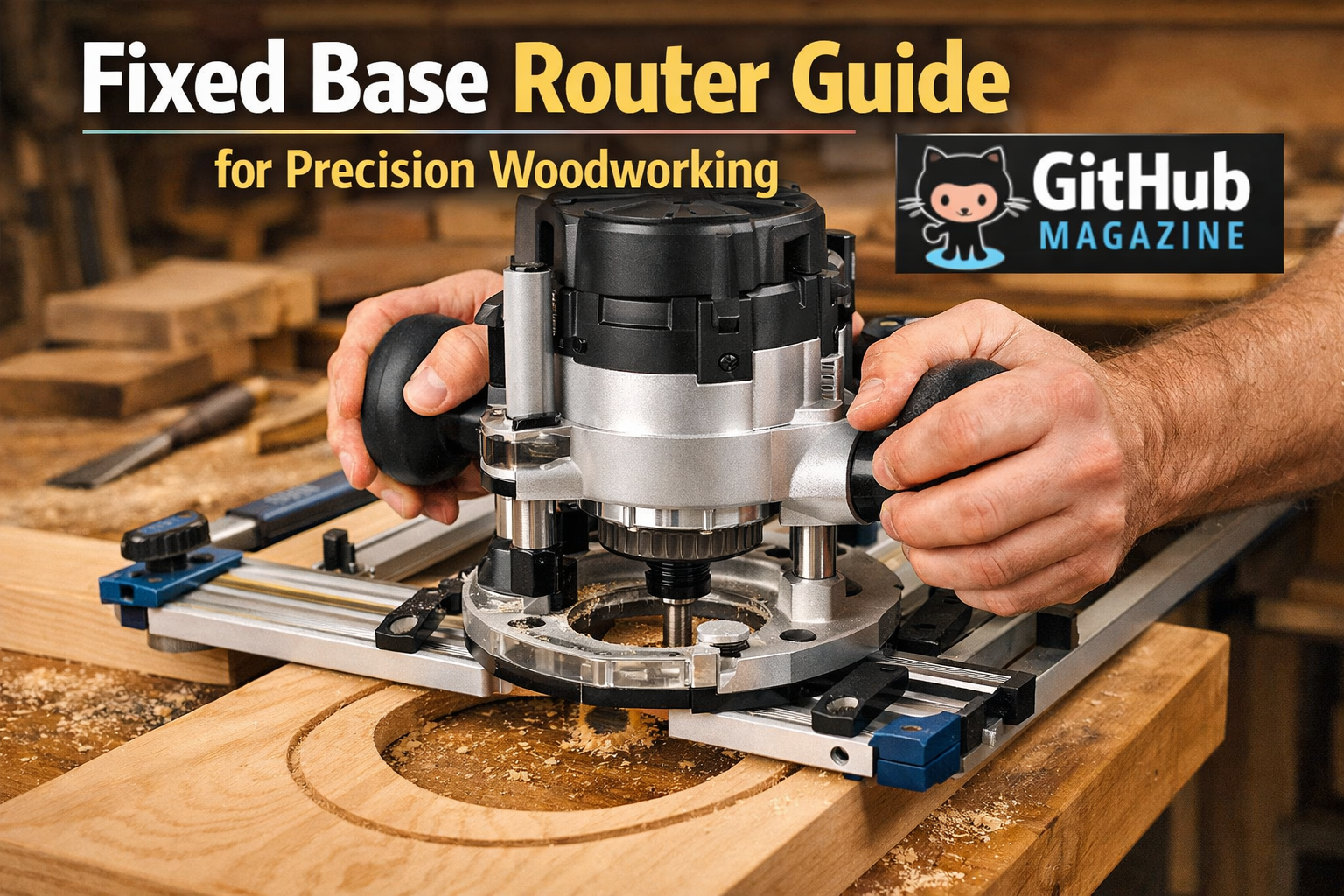
Fixed Base Router Guide for Precision Work
When I talk about woodworking tools, I often start with one main point: quality is defined by precision, and the fixed base router is one of the best examples of this. This tool is perfect for anyone who wants clean edges, consistent cuts, or fine details right away. Its purpose is clear within seconds of use: it gives you control without doubt and results without compromise.
A fixed base router is a handheld power tool that keeps the cutting bit at the same depth. It doesn’t move up and down while cutting like plunge routers do, which makes it possible to do the same thing over and over again. This makes it very useful for edge profiling, trimming, and joinery where things need to be the same.
The fixed base router has changed a lot over the years and is no longer just a workshop tool. It has become an essential tool for both professional woodworkers and serious hobbyists. One of its strengths is how simple it is. It does its job clearly and reliably.
Even though machines are taking over production these days, the fixed base router is still important. I don’t think it’s old-fashioned; I think it’s an important tool that connects craftsmanship and precision in a way that is still very useful today.
The Anatomy of Precision
To understand the fixed base router, I think it’s best to start by looking at how it works. At its core, it has a strong motor inside a solid base that keeps the cutting bit in place. This stability is what makes it work.
Most of the time, the base is made of strong materials like aluminum or reinforced composites. These materials help keep strength while lowering vibration. The motor spins very fast, often more than 20,000 times per minute, which makes it easy and accurate to cut through hardwoods.
The depth adjustment system is one of the most important parts. Fine-tuning mechanisms let users set the depth of the cut with amazing accuracy. This is especially important when making joints or decorative edges, where even small differences can change the final result.
The collet, which holds the router bit in place, is also very important. A well-made collet makes sure that the bit spins evenly and doesn’t wobble. This directly affects how smooth and accurate each cut is.
The only thing that matters when designing a fixed base router is stability. That stability is what turns a simple cutting tool into a precise tool.
Fixed Base vs. Plunge Router
I often compare plunge routers and fixed base routers because knowing the difference makes it easier to see what each one is good at. You should pick the right tool for the job because each one has a different purpose.
| Feature | Fixed Base Router | Plunge Router |
|---|---|---|
| Depth Control | Set before cutting | Adjustable during cutting |
| Stability | Very high | Moderate |
| Best Use | Edge work, trimming | Internal cuts, grooves |
| Ease of Use | Beginner-friendly | Requires more skill |
| Weight | Lighter | Heavier |
The fixed base router is great for jobs where consistency is very important. It is great for shaping edges and doing the same thing over and over again because the cutting depth stays the same. It is also easier to control, which is why beginners like it better.
Plunge routers, on the other hand, are better for cuts that start in the middle of a surface. They can move up and down, which makes them useful for more things. But that flexibility makes things more complicated.
I don’t see the choice as one being better than the other; I see it as picking the right tool for the job.
A Tool Rooted in History
I see the fixed base router as part of a long history of new ideas in woodworking. It started when people tried to automate jobs that used to be done by hand.
Electric routers started to take the place of manual chisels for repetitive work in the early 1900s. This change was a turning point in woodworking because it made it easier for craftsmen to be more consistent and efficient.
As manufacturing changed, routers became necessary for making furniture and cabinets. They were very useful in both small shops and big factories because they could make the same results every time.
Even though more advanced machines are becoming more common, the fixed base router is still important. It strikes a balance between old-fashioned craftsmanship and modern efficiency. I often think of it as a link between the past and the present, a tool that keeps the ideas of accuracy and dependability alive.
Uses in both craft and industry
I have seen fixed base routers used in many different ways, which shows how flexible they are. The tool easily adapts to different needs, from small home projects to large-scale production.
It is used to cut grooves and joints in cabinets. It shapes edges and adds decorative detail to furniture. It helps trim materials and smooth out surfaces in construction.
| Application | Description | Common Bit |
|---|---|---|
| Edge Profiling | Creating decorative edges | Round-over bit |
| Dado Cutting | Cutting grooves for shelves | Straight bit |
| Rabbeting | Forming recessed edges | Rabbeting bit |
| Flush Trimming | Trimming excess material | Flush trim bit |
| Inlay Work | Detailed decorative inserts | Spiral bit |
What strikes me is how one tool can do so many things just by changing the bit. Because it can be used in so many different ways, the fixed base router is an important tool for woodworking.
What Router Bits Do
I often stress that the router is only one part of the whole. The parts you use with it are what really make it versatile.
Router bits control the shape, depth, and finish of each cut. There are many different kinds, from simple straight bits to more complicated decorative profiles. The router can do a lot of different things because each bit has a different job.
The materials also matter. People know that carbide-tipped bits last a long time and stay sharp over time. This makes them a popular choice among professionals who need things to work the same way every time.
To choose the right bit, you need to know what you’re working with and what you want to happen. When the router and bit are used together correctly, they can be very useful for both functional and artistic work.
Safety and Control
I approach the fixed base router with a strong awareness of safety. Its speed and cutting power demand careful handling.
Proper setup is essential. The bit must be securely fastened, and the depth must be accurately set before beginning any operation. Maintaining a firm grip with both hands helps ensure control throughout the cut.
Dust management is another important consideration. Routers produce fine particles that can affect both visibility and health. Using dust collection systems helps maintain a safer working environment.
Control is just as important as safety. Smooth, steady movements produce the best results. Rushing can lead to mistakes and increase the risk of accidents. I see patience as a key part of using this tool effectively.
The Modern Evolution
I find it interesting how the fixed base router has evolved while maintaining its core design. Modern versions include features that improve performance and usability.
Variable speed controls allow users to adjust the tool based on the material being cut. This helps prevent burning and improves the overall finish. Soft-start motors reduce sudden movement when the tool is turned on, making it easier to handle.
Ergonomic improvements have also made a difference. Better grips, lighter materials, and improved balance reduce fatigue during extended use. These changes enhance comfort without altering the fundamental function of the tool.
What stands out to me is that these innovations do not replace the original design. Instead, they refine it, ensuring that the fixed base router continues to meet modern expectations.
Economic Accessibility and Market Trends
I notice that one of the strengths of the fixed base router is its accessibility. It is a tool that can be used by both beginners and professionals.
Entry-level models are affordable, making them a practical choice for those starting out. At the same time, advanced models offer features that meet professional standards. This range allows users to choose a tool that fits their needs and budget.
The growing interest in DIY projects and home improvement has also contributed to the popularity of routers. More people are exploring woodworking, and the fixed base router often becomes one of their first major tools.
Its combination of affordability, versatility, and performance ensures that it remains a valuable part of the market.
Expert Perspectives
I often reflect on how experts describe the importance of routers in woodworking. Their insights reinforce the value of this tool.
Chris Marshall once described routers as one of the most versatile tools in woodworking, capable of replacing several specialized tools. This highlights their efficiency and adaptability.
Paul Sellers emphasized that tools like routers should enhance skill rather than replace it. This perspective underscores the importance of craftsmanship alongside technology.
Another widely accepted view in woodworking education is that consistent depth control is essential for professional-quality results. The fixed base router excels in this area, making it a reliable choice for precision work.
These perspectives help explain why the tool continues to be widely used across different levels of expertise.
Takeaways
- Fixed base routers provide exceptional stability for precise cuts
- They are ideal for edge work, trimming, and consistent joinery
- Their simple design makes them accessible to beginners
- Router bits expand their functionality significantly
- Modern features improve comfort and performance
- The tool remains relevant despite technological advancements
Conclusion
I return to the idea that defines the fixed base router: precision. It is not the most complex tool in a workshop, but it is one of the most dependable. Its strength lies in its ability to deliver consistent results without unnecessary complication.
In a time when automation continues to shape industries, the fixed base router offers something different. It provides direct control, allowing the user to guide the process and shape the outcome.
Its continued presence in workshops speaks to its value. It is not simply a tool but a companion in craftsmanship, one that supports both function and creativity.
I see it as a reminder that even as technology advances, there is still a place for tools that prioritize clarity, reliability, and human skill.
FAQs
What is a fixed base router primarily used for?
It is mainly used for edge shaping, trimming, and creating precise cuts with consistent depth in woodworking projects.
Is it suitable for beginners?
Yes, its stable design and ease of control make it a good choice for beginners learning woodworking techniques.
What makes it different from a plunge router?
A fixed base router maintains a constant cutting depth, while a plunge router allows vertical movement during cutting.
Can it handle hardwood materials?
Yes, with the right bit and speed settings, it can cut hardwood efficiently and cleanly.
How important are router bits?
Router bits are essential because they determine the shape and quality of the cut, greatly expanding the tool’s capabilities.