
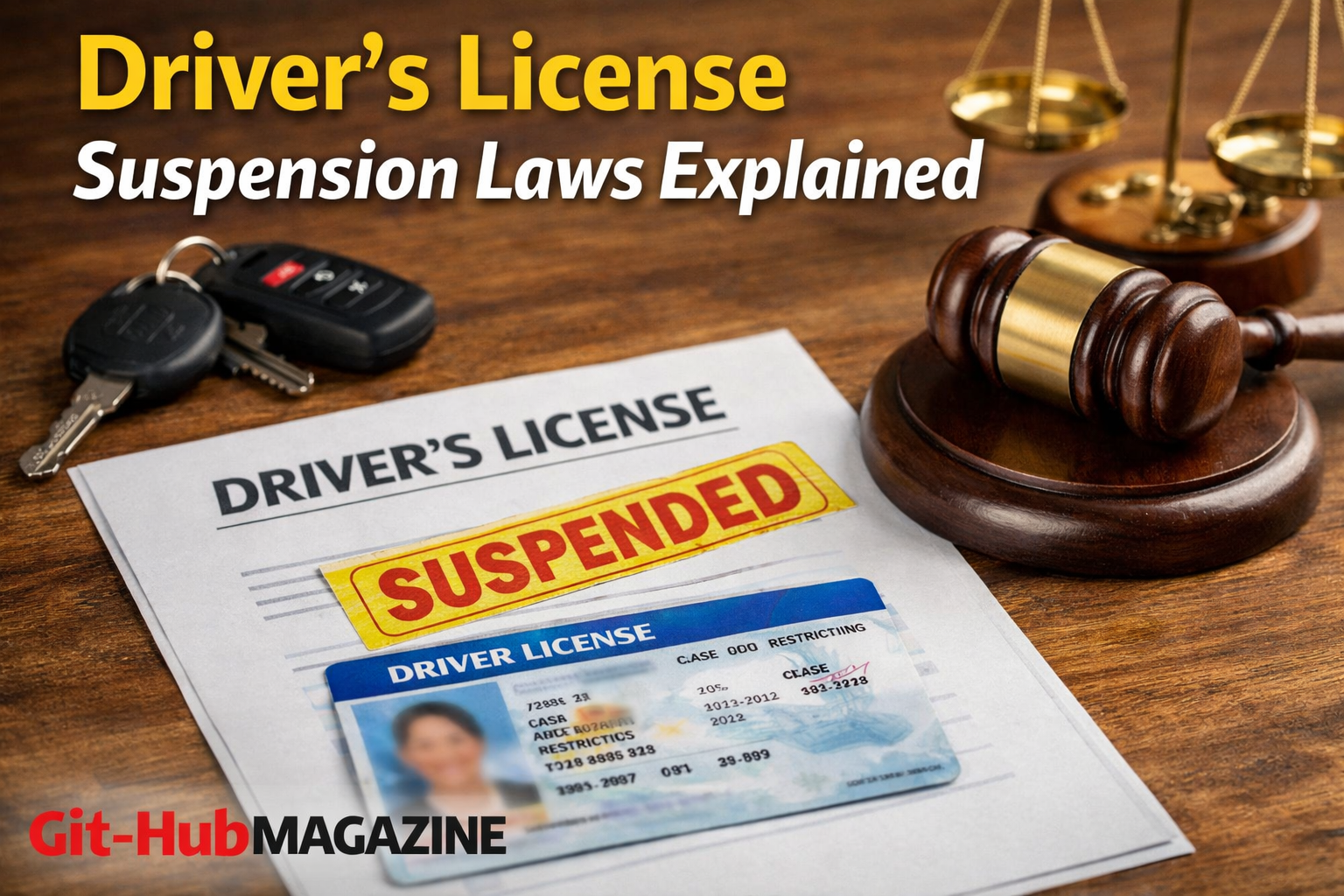
Driver’s License Suspension Laws Explained
I begin with a reality most drivers rarely think about until it happens: a driver’s license suspension can instantly change a person’s ability to work, travel, or manage daily life. Governments suspend licenses to protect road safety and enforce traffic laws, yet the consequences often reach far beyond the highway.
Driver’s license suspension occurs when authorities temporarily remove a person’s legal right to operate a motor vehicle. The decision usually follows serious traffic violations such as driving under the influence, reckless driving, or repeated offenses. In many places, administrative issues like unpaid fines, missing court dates, or insurance violations may also lead to suspension.
In the first moments after a suspension notice arrives, the legal explanation may seem straightforward: the driver broke a rule and must face consequences. But the real effects often ripple outward. For someone who depends on a car to reach work or school, losing driving privileges can disrupt an entire routine.
The legal system treats a driver’s license as a privilege granted by the state rather than a guaranteed right. That distinction gives governments broad authority to suspend or revoke licenses when drivers violate certain laws or fail to comply with court requirements.
As transportation systems evolve and policymakers rethink enforcement strategies, license suspension laws have become part of a larger debate about safety, fairness, and economic opportunity. Understanding how these laws work helps explain why such a common administrative penalty can carry profound consequences.
The Legal Foundation of Driver’s License Suspension
When governments issue driver’s licenses, they grant permission for individuals to operate vehicles on public roads under specific conditions. This permission carries responsibilities that drivers must follow, including obeying traffic laws, maintaining insurance coverage, and complying with court orders.
Because a license is legally defined as a privilege rather than a constitutional right, authorities have the power to suspend it when those responsibilities are violated. Courts and departments of motor vehicles typically administer suspensions through administrative procedures connected to traffic laws.
Historically, suspension policies focused primarily on road safety. Legislators designed these rules to remove dangerous drivers from public roads and reduce accidents caused by reckless behavior. Offenses such as intoxicated driving, aggressive speeding, or fleeing accident scenes often trigger automatic suspensions.
Over time, however, lawmakers expanded suspension policies to enforce compliance with broader legal obligations. Missing court dates, failing to pay traffic fines, or driving without insurance can all lead to administrative suspensions in many jurisdictions.
This expansion reflects a wider philosophy in public policy: driving privileges can be used as leverage to encourage citizens to follow legal requirements. The result is a legal framework where suspension serves both as a safety tool and an enforcement mechanism.
Understanding that dual purpose helps explain why license suspensions remain both widely used and frequently debated in modern transportation policy.
The Most Common Reasons Licenses Are Suspended
Driver’s license suspensions occur for a variety of reasons, but most cases fall into several consistent categories related to safety, administrative compliance, and legal enforcement.
Major Safety Violations
The most widely recognized cause of license suspension involves dangerous driving behavior. Governments prioritize these offenses because they directly threaten public safety.
Driving under the influence of alcohol or drugs is among the most serious violations. In many jurisdictions, a DUI conviction leads to immediate license suspension. Other serious violations include reckless driving, street racing, leaving the scene of an accident, and repeated high-speed violations.
These penalties are designed not only to punish the offending driver but also to prevent future harm by temporarily removing risky drivers from the road.
Administrative Violations
Not all suspensions involve dangerous driving. Administrative violations frequently lead to suspension when drivers fail to comply with legal or procedural requirements.
Common examples include failure to pay traffic tickets, failure to appear in court, or failure to maintain valid auto insurance. These suspensions remain in effect until the driver resolves the issue.
Although these violations may seem minor compared with reckless driving, authorities often rely on suspension as a strong incentive for compliance.
Non-Driving Offenses
Some jurisdictions historically allowed license suspensions for offenses unrelated to driving. Drug convictions, unpaid child support, or other legal obligations have sometimes triggered suspension policies.
These rules have generated controversy because critics argue that suspending driving privileges for unrelated offenses may punish individuals in ways that extend beyond the original violation.
Common Causes of Driver’s License Suspension
| Category | Example Violations | Typical Consequences |
|---|---|---|
| Dangerous Driving | DUI, reckless driving, hit-and-run | Immediate suspension or revocation |
| Traffic Violations | Repeated speeding or violations | Point accumulation leading to suspension |
| Administrative Issues | Failure to pay fines or appear in court | Temporary suspension until compliance |
| Insurance Violations | Driving without valid insurance | Suspension until proof of coverage |
| Non-Driving Offenses | Certain legal or financial obligations | Suspension depending on jurisdiction |
The Point System and Repeat Offenses
Many transportation authorities use a point system to track driver behavior over time. Each traffic violation carries a certain number of points that are added to the driver’s record.
For example, minor speeding violations may add a small number of points, while serious offenses such as reckless driving carry heavier penalties. When a driver accumulates too many points within a specific period, the system automatically triggers license suspension.
Point systems aim to create consistent enforcement standards while also providing a warning mechanism for drivers approaching suspension thresholds.
Drivers often receive notices when their point totals approach critical limits. These warnings give them an opportunity to correct behavior before suspension occurs.
Despite their usefulness, point systems are sometimes criticized for failing to consider how frequently different drivers use their vehicles. Individuals who drive professionally or commute long distances may accumulate violations simply due to increased time on the road.
Nevertheless, point systems remain one of the most widely used regulatory tools in traffic enforcement.
Economic Consequences of License Suspension
I have always found it striking how quickly a license suspension can transform a person’s daily life. For millions of workers, driving is not merely convenient but essential.
In many regions, especially suburban and rural areas, public transportation options remain limited. When a license is suspended, reaching work, school, medical appointments, or grocery stores can become extremely difficult.
Employers may hesitate to hire workers who cannot legally drive, particularly when jobs require commuting or occasional travel. As a result, some individuals experience job loss or reduced employment opportunities after suspension.
Financial consequences often compound the problem. When drivers cannot work, they may struggle to pay fines or fees required to restore their license. This situation can create a cycle where suspension makes it harder to resolve the very issue that caused it.
These economic realities have prompted policymakers to reconsider whether certain suspension policies produce unintended consequences that extend far beyond traffic safety.
Public Safety and Enforcement Goals
Supporters of license suspension laws emphasize their importance in protecting public safety. Removing dangerous drivers from the road can reduce accidents and prevent injuries or fatalities.
Traffic enforcement agencies frequently highlight the deterrent effect of suspension penalties. Knowing that reckless driving could lead to the loss of driving privileges may discourage risky behavior.
Suspension policies also help identify repeat offenders. Drivers who accumulate multiple violations within a short period may represent a higher risk to other road users.
From a public safety perspective, suspension functions as both punishment and prevention. It sends a clear message that certain behaviors will not be tolerated while also physically preventing offenders from driving during the suspension period.
However, balancing safety goals with fairness concerns remains one of the central challenges in modern transportation law.
Policy Reforms and Legislative Changes
In recent years, lawmakers in several regions have begun reconsidering how license suspension policies are applied. Many reform efforts focus on separating safety-related suspensions from administrative penalties.
Some states have reduced or eliminated suspensions related to unpaid traffic fines or court fees. Instead of suspending licenses, authorities may offer payment plans, community service options, or alternative penalties.
These reforms aim to ensure that suspensions primarily target drivers who pose genuine safety risks rather than individuals facing financial hardship.
At the same time, legislators continue exploring new safety-focused rules. Some proposals introduce stricter penalties for extreme speeding, distracted driving, or repeat DUI offenses.
Policy debates now center on how to design suspension laws that maintain strong safety protections while minimizing unintended economic or social harm.
Timeline of Policy Trends in License Suspension Laws
| Period | Policy Direction | Impact |
|---|---|---|
| Late 20th Century | Expansion of administrative suspensions | Increase in license suspensions |
| Early 2000s | Widespread adoption of point systems | Standardized enforcement |
| Late 2010s | Growing criticism of debt-based suspensions | Policy reform discussions |
| 2020s | Reforms focusing on safety-related offenses | Restoration of driving privileges in many cases |
Key Takeaways
• Driver’s license suspension removes a person’s legal right to operate a motor vehicle for a specific period.
• Serious traffic violations such as DUI and reckless driving remain the primary reasons for suspension.
• Administrative issues like unpaid fines or missed court appearances can also trigger suspension in many places.
• Losing driving privileges can affect employment, mobility, and daily life.
• Point systems are commonly used to track violations and trigger suspension thresholds.
• Modern policy debates focus on balancing road safety with fairness and economic consequences.
Conclusion
When I reflect on the role of license suspension laws, I see a policy tool that sits at the intersection of safety, law enforcement, and everyday life. What began as a straightforward mechanism for removing dangerous drivers from the road has gradually evolved into a broader system that influences mobility, employment, and legal compliance.
For transportation authorities, suspensions remain a powerful deterrent against reckless behavior. Few penalties send a clearer message than the loss of the legal ability to drive.
Yet the social impact of these policies has become increasingly visible. For individuals who rely on driving for work or family responsibilities, suspension can create challenges that extend well beyond the original violation.
Recent legislative reforms suggest that policymakers are beginning to reconsider how and when suspensions should be applied. By focusing more closely on safety-related offenses, governments may be able to maintain strong road protections while reducing unintended economic harm.
The future of license suspension laws will likely depend on finding that balance. Road safety will always remain the central goal, but the way societies enforce that goal continues to evolve alongside broader conversations about fairness, opportunity, and access to transportation.
FAQs
What is a driver’s license suspension
A driver’s license suspension is a temporary removal of the legal right to operate a motor vehicle. Drivers must resolve specific issues or wait a designated period before reinstatement.
How long can a license suspension last
The duration varies depending on the offense. Minor violations may result in short suspensions, while serious offenses like DUI may lead to longer periods.
What happens if someone drives with a suspended license
Driving with a suspended license is illegal and may lead to additional fines, extended suspension periods, or criminal charges.
Can a suspended license be reinstated
Yes. Drivers usually must pay reinstatement fees, resolve legal obligations, or complete required programs before regaining driving privileges.
What is the difference between suspension and revocation
Suspension is temporary and allows reinstatement after certain conditions are met. Revocation cancels the license entirely and usually requires reapplying and retesting.

Related Posts
UKPunting and the Digital Sex Work Debate

Test of Attractiveness Explained