
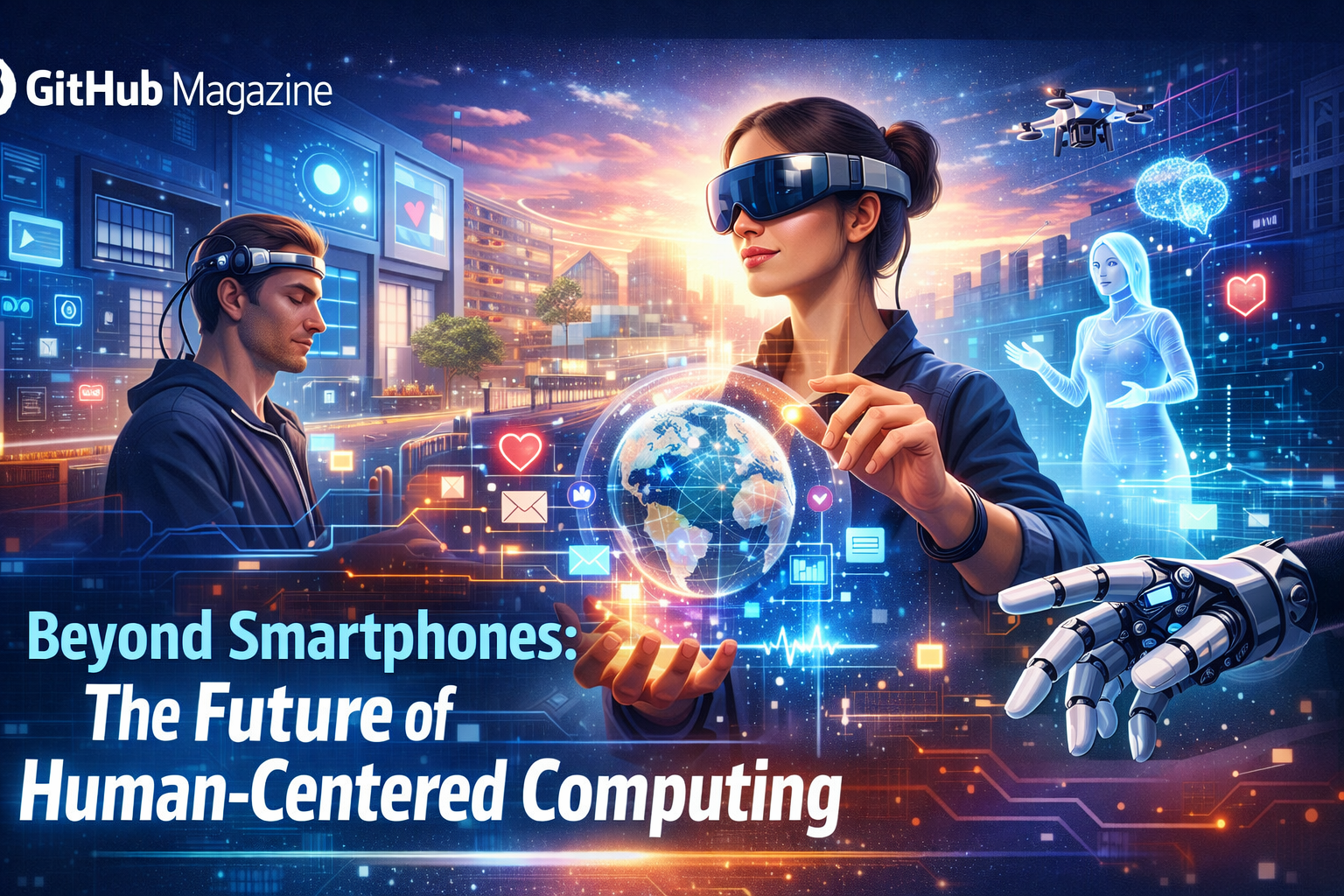
Beyond Smartphones: Life After the Pocket Screen
For almost twenty years, the smartphone has been the most intimate object most people own. It wakes us up, tracks our steps, connects us to work, and absorbs our idle moments. Yet even as new models arrive each year, the center of technological gravity is shifting. The most important changes no longer revolve around the phone itself, but around what happens when computing moves beyond a single screen.
In the first moments of this transition, the key question is simple: what comes after smartphones, and why does that future already feel close? The answer is not a dramatic replacement device. Instead, it is a gradual redistribution of computing into wearables, environments, and artificial intelligence systems that respond to context rather than commands. Technology is becoming less something we “use” and more something that accompanies us.
This change is driven by limits as much as ambition. Smartphones are mature products. Innovation has become incremental, while their demands on attention have grown heavier. At the same time, advances in sensors, low-power chips, and machine learning allow digital systems to operate quietly in the background. The result is a world where information appears when needed, often without a screen, and disappears just as quickly.
Moving beyond smartphones does not mean abandoning them. It means recognizing that the next phase of computing is defined by dispersion rather than convergence, by subtlety rather than spectacle, and by a new negotiation between convenience, privacy, and human presence.
From Pocket Computers to Ambient Companions
The smartphone succeeded by collapsing many tools into one object. Camera, map, calendar, wallet, and newspaper all converged into a single device. Over time, that success created friction. Endless notifications, constant updates, and the pressure to remain reachable at all times turned convenience into cognitive load.
The post-smartphone shift reverses that logic. Instead of forcing everything onto one screen, computing functions are spreading out again, but in smarter ways. Voice assistants handle simple requests. Environmental sensors adjust lighting, temperature, and security automatically. Wearables track health metrics without demanding constant attention.
This approach is often described as ambient computing. Its defining feature is not novelty but restraint. Systems are designed to fade into the background, surfacing only when relevant. The smartphone remains present, but increasingly as a coordinating hub rather than the primary interface. What matters is not what the device looks like, but how little it asks of the user.
Wearables and the Body as Interface
One of the clearest signs of life beyond smartphones is the rise of wearables that treat the human body itself as an interface. Smartwatches, rings, and biometric patches collect continuous data about movement, sleep, heart rhythm, and stress. Unlike phones, these devices are not meant to be stared at. Their value lies in persistence rather than interaction.
This has profound implications for health. Continuous monitoring can reveal patterns that short doctor visits cannot capture. Early warnings for heart irregularities or sleep disorders become possible not through dramatic alerts, but through quiet accumulation of data. The promise is medicine that reacts earlier and more personally.
Yet this intimacy raises new questions. Data gathered from the body is deeply personal. As wearables become more capable, the line between helpful monitoring and intrusive surveillance grows thinner. Beyond smartphones, the challenge is not simply technical capability, but trust in how invisible systems handle the most sensitive information humans produce.
Spatial Computing and the Expansion of Screens
While wearables shrink the interface, spatial computing expands it. Instead of concentrating information on a small rectangle, spatial systems project digital elements into physical space. Diagrams float in the air. Instructions appear directly on machinery. Remote collaborators feel present rather than distant.
This approach changes how people understand screens themselves. A display is no longer a boundary, but a layer. Digital content gains depth, scale, and spatial relationship. For designers, engineers, surgeons, and educators, this can transform complex tasks into more intuitive experiences.
Spatial computing also exposes the limits of smartphones. Holding a phone up to the world is a temporary solution. As systems learn to map environments and respond to movement and gaze, interaction becomes more natural and less performative. The phone becomes optional, even awkward, in spaces designed for three-dimensional interaction.
Artificial Intelligence as the Primary Interface
Beyond smartphones, artificial intelligence increasingly acts as the interface itself. Instead of navigating menus and apps, users express intentions in natural language. The system interprets, adapts, and executes. The screen becomes secondary, sometimes unnecessary.
This shift reduces friction. Tasks that once required multiple steps—searching, comparing, summarizing—are compressed into a single exchange. AI systems draw on context such as location, history, and timing to deliver relevant responses. In doing so, they replace visual complexity with conversational clarity.
However, this convenience depends on understanding. For AI to function well, it must know not just what users ask, but what they mean. That requires access to personal data and situational context. Beyond smartphones, the interface feels simpler, but the underlying systems become more complex and more powerful.
A Gradual Timeline Beyond Smartphones
The movement past smartphones is evolutionary rather than abrupt. Touchscreens did not disappear when voice assistants arrived. Apps did not vanish when wearables emerged. Instead, each layer reshaped expectations.
In the late 2000s, touchscreens redefined interaction. In the 2010s, app ecosystems dominated daily life. In the early 2020s, wearables and voice interfaces began to reduce dependence on screens. Looking ahead, spatial systems and contextual AI are likely to define the next decade.
This gradual pace explains why the transition feels both obvious and incomplete. People still rely on phones, but they increasingly expect technology to adapt automatically. The future beyond smartphones is arriving in pieces, not in a single announcement.
Power, Privacy, and Invisible Systems
As computing becomes ambient, questions of power and privacy intensify. Smartphones made data collection visible through apps and permissions. Ambient systems collect data continuously, often without explicit interaction. The danger is not malicious intent alone, but invisibility.
When devices disappear into clothing, furniture, or architecture, consent becomes harder to recognize and enforce. Data flows multiply, while user awareness diminishes. The challenge of the post-smartphone era is ensuring that convenience does not come at the cost of autonomy.
Regulation has struggled to keep pace. Laws designed for screens and browsers do not easily apply to sensors and spatial mapping. Beyond smartphones, societies must decide whether transparency and control can coexist with seamless design.
Work, Attention, and Cognitive Relief
In professional life, smartphones promised mobility but delivered constant interruption. Beyond smartphones, the hope is cognitive relief. Context-aware systems can filter information, surface priorities, and reduce the need for constant checking.
At the same time, ubiquity carries risk. When computing is everywhere, work can extend everywhere too. Boundaries between labor and rest become harder to defend. The post-smartphone workplace will require new norms around availability, focus, and disconnection.
Education and Learning Beyond the Screen
Education offers a glimpse of both promise and peril. Spatial simulations can turn abstract concepts into lived experiences. Wearables can adapt pacing to fatigue or stress. Learning becomes embodied rather than confined to text.
Yet access matters. If advanced post-smartphone tools remain expensive or restricted, existing inequalities may widen. The success of education beyond smartphones will depend on whether these tools amplify curiosity and understanding, or simply replicate old divides in new forms.
Cultural Life After the Phone
Perhaps the most subtle shift beyond smartphones is cultural. Phones changed posture, attention, and social norms. Moving past them invites a renegotiation of presence. Eye contact may return. Silence may feel less urgent to fill. Technology could recede from the center of daily interaction.
This outcome is not guaranteed. Tools reflect incentives. If ambient systems are designed to capture attention invisibly, they may reproduce the same problems in quieter ways. If designed with restraint, they may finally loosen the grip of constant connection.
Takeaways
- The future beyond smartphones is an ecosystem shift, not a single replacement device
- Wearables turn the body into a passive interface for data and care
- Spatial computing expands screens into physical environments
- Artificial intelligence replaces menus with intention-based interaction
- Privacy risks increase as technology becomes less visible
- Design and regulation will shape whether this future feels humane
Conclusion
Moving beyond smartphones does not mean rejecting their legacy. It means recognizing that the form factor that defined the last era is no longer sufficient for the next. As computing spreads into wearables, environments, and AI systems, interaction becomes quieter, more contextual, and more intimate.
This transformation carries both freedom and risk. Freedom from constant tapping and scrolling, and risk in the form of deeper surveillance and dependence. The balance between those forces will define the next decade of technological life.
The post-smartphone era is already here, scattered across devices and systems that work best when unnoticed. Its final shape remains undecided. Whether it becomes more humane than the last will depend not on what replaces the phone, but on what values guide the technology that comes after it.
FAQs
Will smartphones disappear completely?
No. Smartphones are likely to remain as hubs and backups, even as many tasks move to other interfaces.
What replaces apps beyond smartphones?
Context-aware services and AI responses reduce the need for discrete apps and manual navigation.
Are wearables safer for privacy than phones?
Not necessarily. They collect more continuous and intimate data, which requires stronger safeguards.
Is spatial computing practical for everyday life?
It is already practical in work, design, and education, though cost and comfort remain challenges.
When will the post-smartphone shift be complete?
It is gradual and ongoing, unfolding over years rather than arriving in a single moment.
Beyond Smartphones: Life After the Pocket Screen

Related Posts

ATFBooru Review: Inside a Tag-Driven Imageboard

Streameast.ms Explained: Legality, Risks, Future