
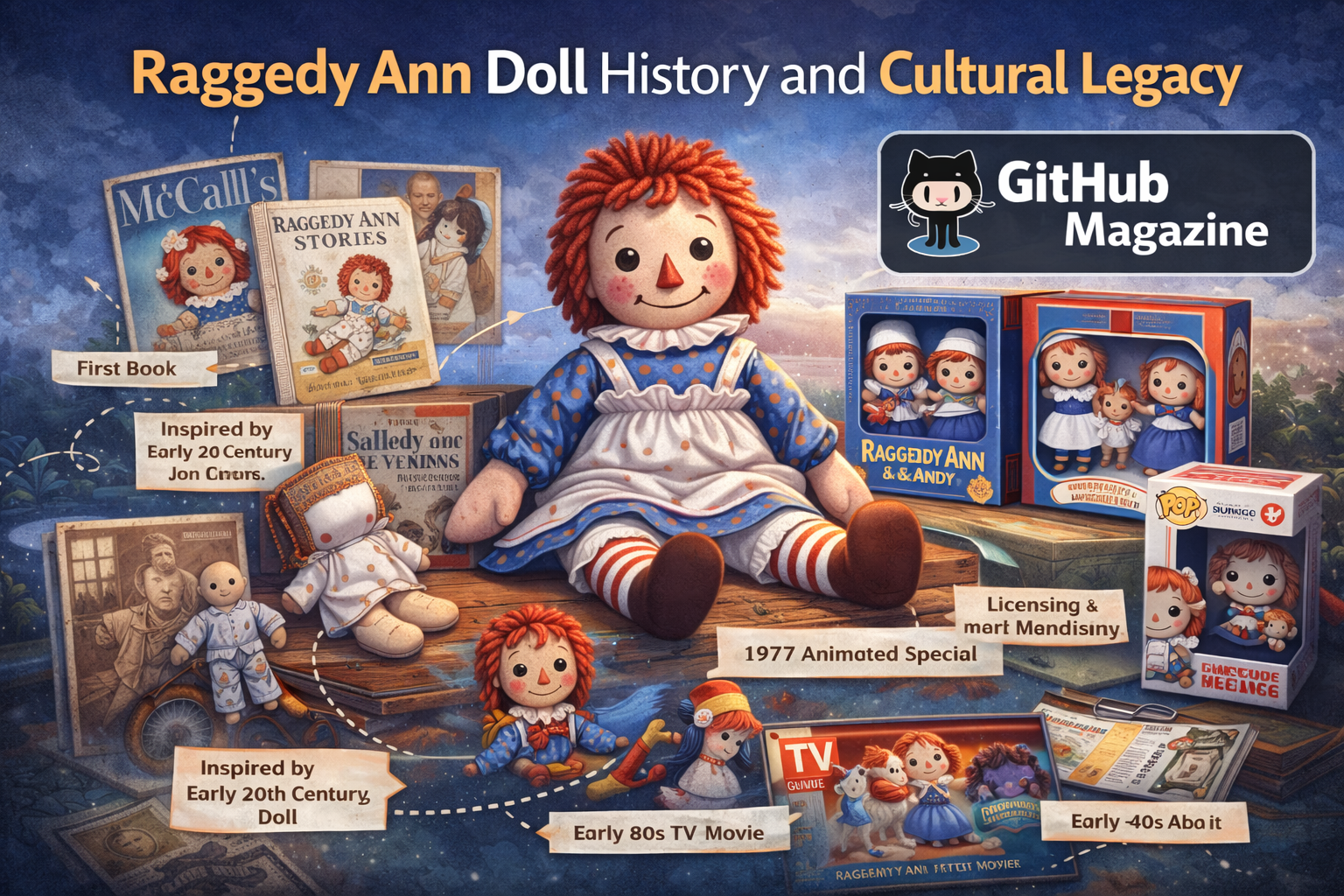
Raggedy Ann Doll History and Cultural Legacy
I have always been fascinated by how a simple cloth doll could become one of the most recognizable figures in American childhood. For anyone searching about a “doll raggedy,” the answer begins with Raggedy Ann, the red-haired, yarn-braided character created by cartoonist Johnny Gruelle in the early 20th century. First introduced as both a handmade doll and a storybook character in 1918, Raggedy Ann quickly evolved into a cultural icon. She was not only a toy but also a publishing phenomenon, a Depression-era comfort object, a merchandising empire, and eventually a subject of legal and cultural debates.
At a glance, Raggedy Ann appears disarmingly simple: button eyes, a triangular nose, a wide stitched smile, and a body made of soft cotton cloth. Yet her impact stretches far beyond nursery rooms. She has appeared in books, animation, film, advertising, and museum collections. She has been embraced as a symbol of wholesome Americana and criticized in unexpected cultural battles. More than a century after her debut, collectors still trade early editions for thousands of dollars, and parents still purchase updated versions for their children.
Her story is deeply American, born in a period of industrial expansion and shaped by war, grief, commerce, and nostalgia. To understand the rag doll is to understand the shifting emotional landscape of childhood itself.
The Birth of Raggedy Ann in 1918
Raggedy Ann officially entered the public record in 1918 when Johnny Gruelle received a U.S. patent for his doll design. The patent, granted on September 7, 1915, covered the distinctive cloth body and facial features, though commercialization accelerated with the publication of Raggedy Ann Stories in 1918. Gruelle, an illustrator and political cartoonist, claimed the character was inspired by a rag doll he had given his daughter, Marcella.
Marcella’s death in 1915 from complications following vaccination has often been woven into the mythology surrounding the doll, though historians debate the accuracy of some elements of that narrative. What remains clear is that Gruelle combined illustration, storytelling, and product design in a way that was unusually integrated for its time. The doll and the book reinforced one another.
The timing mattered. World War I had just ended. Families sought comfort and reassurance. Raggedy Ann’s stitched smile and gentle adventures offered exactly that. Within a few years, the doll and its companion books gained national popularity, marking the beginning of a merchandising model that foreshadowed modern character branding.
A Character Before a Commodity
Unlike many dolls that began as factory toys, Raggedy Ann was introduced simultaneously as a literary figure. In Raggedy Ann Stories, she lived in a world of animated toys and moral lessons. The tales emphasized kindness, resilience, and imaginative play. This narrative foundation gave emotional depth to what might otherwise have been a simple cloth toy.
Literary scholar Anne Lundin has observed that early 20th-century children’s books often reflected broader societal anxieties while presenting safe, contained worlds for young readers. Raggedy Ann’s adventures were whimsical but reassuring, set largely within domestic spaces that mirrored the home environment of her audience.
The connection between storytelling and product fueled demand. Children who read the books wanted the doll. Parents who bought the doll often purchased the books. This synergy prefigured later entertainment franchises, from Mickey Mouse to modern animated universes.
The doll’s design reinforced accessibility. She was soft, washable, and approachable, in contrast to porcelain dolls that required careful handling. Raggedy Ann was meant to be hugged.
The Great Depression and Emotional Comfort
The 1930s brought economic devastation to American households. During this period, Raggedy Ann’s image endured. Cloth dolls were less expensive than many other toys, and homemade versions proliferated. Patterns circulated widely, allowing families to sew their own.
Historian Miriam Formanek-Brunell has written extensively about the cultural meaning of dolls in America. She argues that dolls often serve as reflections of societal ideals and emotional needs. During the Depression, Raggedy Ann represented thrift, creativity, and comfort. Her stitched face did not crack. Her cloth body could be repaired.
Production figures from the early decades show steady growth despite economic turmoil. Raggedy Andy, introduced in 1920 as her male counterpart, expanded the brand and broadened its appeal. By mid-century, the dolls were fixtures in American toy chests.
The table below outlines major milestones in Raggedy Ann’s early history.
Key Milestones in Raggedy Ann History
| Year | Event | Significance |
|---|---|---|
| 1915 | Design patent granted | Legal protection for doll design |
| 1918 | Raggedy Ann Stories published | Launch of character in print |
| 1920 | Raggedy Andy introduced | Brand expansion |
| 1930s | Widespread homemade patterns | Depression-era accessibility |
| 1960s | Renewed merchandising push | Television and licensing growth |
Mid-Century Revival and Licensing Expansion
After Johnny Gruelle’s death in 1938, rights to Raggedy Ann changed hands multiple times. The character’s popularity waxed and waned, but a revival occurred in the 1960s and 1970s as nostalgia surged among Baby Boomers.
Knickerbocker Toy Company and later manufacturers expanded production, introducing new sizes and materials. The dolls appeared in television specials, including the 1977 animated film Raggedy Ann & Andy: A Musical Adventure, directed by Richard Williams.
Licensing grew beyond dolls. Bedding, lunchboxes, greeting cards, and clothing carried her likeness. This diversification mirrored broader trends in character merchandising during the postwar era.
Cultural historian Gary Cross notes that postwar consumer culture increasingly blurred the line between childhood innocence and commercial enterprise. Raggedy Ann’s brand longevity demonstrates how emotional attachment can sustain commercial viability across generations.
Collecting and Cultural Value
By the late 20th century, original early-edition Raggedy Ann dolls became prized collectibles. Auction houses began tracking provenance and condition carefully. Early dolls with original clothing and tags command significantly higher prices than later reproductions.
Collectors distinguish between pre-1930 hand-painted faces and later screen-printed versions. Fabric quality, stuffing material, and even yarn color variations influence value.
Collectible Market Overview
| Era | Characteristics | Collector Value Range |
|---|---|---|
| 1918–1925 | Hand-painted features | Highest |
| 1930s–1940s | Early factory production | High |
| 1960s Revival | Licensed mass production | Moderate |
| Modern Versions | Contemporary manufacture | Low to Moderate |
Dr. Susan Pearce, a museum studies scholar, has argued that collectibles gain value through storytelling as much as rarity. “Objects become artifacts when they carry narratives of memory and identity,” she writes. Raggedy Ann’s association with early childhood magnifies that emotional valuation.
Cultural Controversy and Legal Battles
Few would expect a cloth doll to become involved in legal disputes, yet Raggedy Ann’s image entered public debate in the late 20th century. In the 1990s, organizations that opposed abortion rights adopted the doll’s image in protests. In response, the family controlling the Raggedy Ann trademark filed lawsuits to prevent unauthorized political use.
These cases highlighted tensions between trademark protection and free speech. Courts weighed whether the doll’s image could be used symbolically in public demonstrations. The disputes underscored how deeply embedded Raggedy Ann had become in American consciousness.
Trademark law scholar Rebecca Tushnet has noted that iconic characters often face challenges balancing brand protection with expressive rights. Raggedy Ann’s journey into courtroom debates reflected the unexpected cultural power of childhood imagery.
Design Simplicity and Psychological Impact
Developmental psychologists often emphasize the importance of transitional objects in early childhood. Soft dolls can serve as comfort items during times of stress or separation. Raggedy Ann’s cloth construction made her particularly suited to this role.
Unlike rigid dolls, her flexible body invited physical closeness. The stitched smile remained constant, offering emotional reassurance. In child development theory, such features support imaginative play and attachment.
Dr. Donald Winnicott’s foundational work on transitional objects describes how children project emotional meaning onto soft toys. While not written specifically about Raggedy Ann, his theory explains why a simple rag doll can hold profound psychological significance.
Her aesthetic minimalism also allows children to imagine personality and backstory. The less defined the expression, the more interpretive freedom exists.
Raggedy Ann in Museums and Archives
Today, original Raggedy Ann dolls reside in museum collections dedicated to toys and childhood history. Institutions such as the National Museum of American History and specialized toy museums display early editions as examples of American design and mass culture.
Archival holdings include first-edition books, original patents, and early advertising materials. These materials contextualize the doll within broader narratives of industrialization and publishing.
Curators frame Raggedy Ann as both a design object and a cultural artifact. She occupies a place alongside Barbie, G.I. Joe, and other influential toys that shaped generational identity.
Her endurance across more than a century speaks to adaptive branding and emotional resonance. Few toys maintain relevance for that long without radical redesign.
Takeaways
- Raggedy Ann originated in 1918 as both a doll and literary character.
- Her popularity expanded through storytelling, licensing, and emotional resonance.
- Depression-era families embraced homemade versions for affordability.
- Mid-century merchandising revived her brand for new generations.
- Collectors prize early editions for historical and sentimental value.
- Legal disputes demonstrate her cultural symbolism beyond childhood.
- Psychological research explains the comfort associated with soft transitional toys.
Conclusion
As I reflect on Raggedy Ann’s long journey from patent drawing to museum display case, I am struck by how modest her design remains. She has no mechanical features, no batteries, no digital enhancements. She is fabric, thread, and yarn. Yet within that simplicity lies extraordinary staying power.
Her story intersects with publishing history, industrial manufacturing, childhood psychology, intellectual property law, and American consumer culture. She comforted children during economic hardship, adapted to television-era marketing, and survived political controversy. She continues to appear in nurseries, antique shops, and archival exhibits.
In an era dominated by fast-moving technology and rapidly shifting entertainment franchises, Raggedy Ann represents something enduring. She reminds us that imagination often thrives not in complexity but in openness. A stitched smile can hold a century of memory.
FAQs
When was Raggedy Ann first created?
Raggedy Ann was patented in 1915 and introduced through books and commercial production in 1918.
Who created the Raggedy Ann doll?
The doll was created by American cartoonist and illustrator Johnny Gruelle.
Why is Raggedy Ann considered valuable to collectors?
Early hand-painted versions and original-condition dolls from the 1918–1925 period command high auction prices.
What materials are traditional Raggedy Ann dolls made from?
They are typically made from cotton cloth, yarn hair, embroidered or painted facial features, and soft stuffing.
Is Raggedy Ann still produced today?
Yes, modern licensed versions continue to be manufactured and sold internationally.