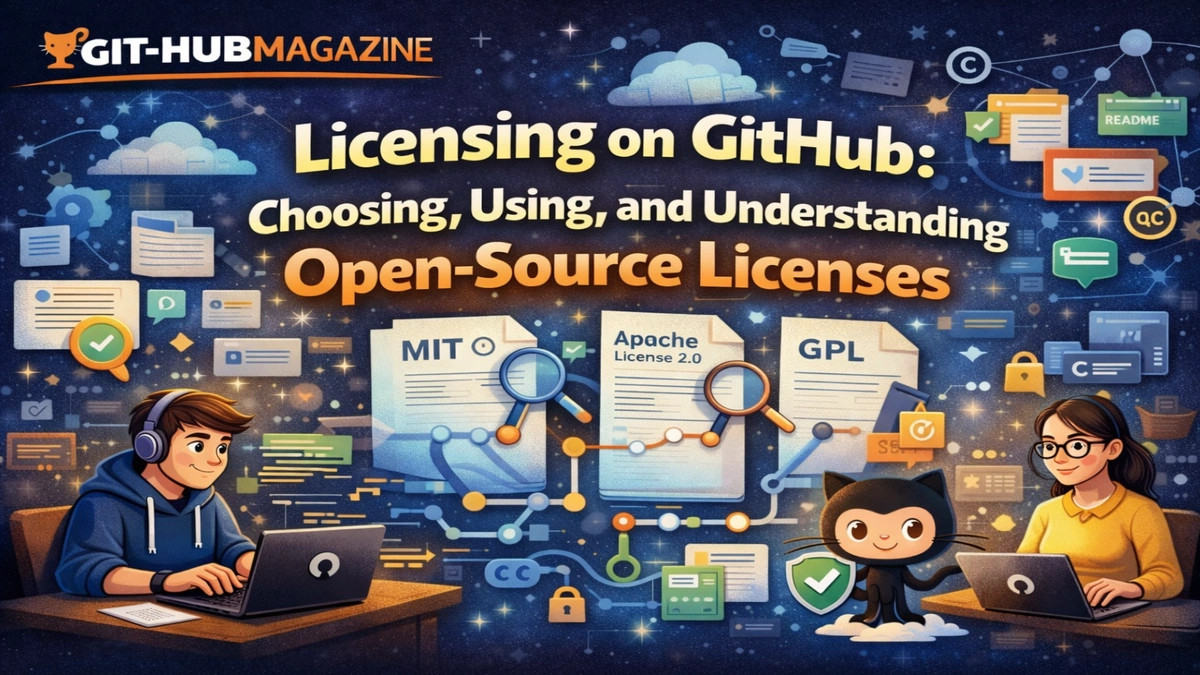
Licensing on git-hub: Choosing, Using, and Understanding Open-Source Licenses
Open-source software looks free, open, and frictionless on the surface, but underneath that openness sits a carefully constructed legal framework. Licenses are the rules that make open collaboration possible without turning every interaction into a legal risk. They define what others are allowed to do with your code, what they must do in return, and how responsibility and credit flow through the ecosystem.
In the first 100 words, the essential point is that licensing on GitHub is not optional if you want your code to be used, shared, or built upon. Without a license, your repository may be visible, but it is not legally reusable. A license converts code from a personal artifact into a shared resource. It tells the world whether your work can be copied, modified, redistributed, used commercially, or incorporated into other projects, and under what conditions.
For individual developers, licenses are a way to express intent. For companies, they are a way to manage risk. For communities, they are a social contract that defines fairness, openness, and obligation. Understanding how licenses work, what their differences mean, and how to apply them thoughtfully is as important as understanding version control or testing. This article explores open-source licensing not as a legal abstraction, but as a living system that shapes how software travels, evolves, and survives in the open.
Read: git-hub Workflow Patterns: Trunk-Based, GitFlow, and Feature Branching
What an open-source license actually does
An open-source license is a legal permission slip. It grants rights that copyright law would otherwise withhold, and it sets conditions for exercising those rights. Copyright law, by default, gives authors exclusive control over copying, modification, and distribution. Publishing code online does not waive those rights. Only a license does.
A license therefore performs two functions at once. It opens the door to collaboration by granting permission, and it defines the boundaries of that collaboration by attaching conditions. Those conditions might be light, such as requiring attribution, or strong, such as requiring that derivative works be released under the same terms.
This dual role explains why licenses are both empowering and restrictive. They empower reuse and innovation, but they also protect the original intent of the author or community.
Permissive licenses and their philosophy
Permissive licenses reflect a philosophy of maximal freedom. They allow others to use, modify, and redistribute code with minimal obligations. Typically, the only requirements are that the original copyright notice and license text remain intact.
This model encourages widespread adoption, including in commercial and proprietary products. It lowers barriers for companies and individuals who want to build on the code without exposing their own intellectual property.
The trade-off is that permissive licenses do not require improvements to be shared back with the community. Code can be taken, improved privately, and redistributed without those improvements ever returning upstream. For some communities, this is acceptable or even desirable. For others, it feels like a loss.
Copyleft licenses and their philosophy
Copyleft licenses take a different approach. They grant broad rights to use and modify code, but they require that any redistributed derivatives remain under the same license. This ensures that openness is preserved across generations of software.
This model is designed to prevent code from being absorbed into proprietary systems without contributing back. It protects the commons by making openness contagious.
The cost of this protection is reduced compatibility. Some organizations avoid copyleft code because it can impose obligations on their entire codebase. This can limit adoption, even when the software itself is valuable.
How GitHub fits into the licensing ecosystem
GitHub is not a legal authority, but it plays a critical role in normalizing and surfacing licenses. By encouraging developers to choose a license when creating a repository and by displaying license information prominently, GitHub makes licensing visible and actionable.
This visibility reduces uncertainty. Users can quickly see what they are allowed to do, and maintainers can communicate their intentions without personal negotiation.
GitHub also acts as a cultural amplifier. By making certain licenses easy to select and understand, it shapes which norms become dominant in the ecosystem.
Choosing a license as a values decision
Choosing a license is not only about legal mechanics. It is about values.
Do you want your work to spread as widely as possible, even if it becomes part of proprietary products. Do you want to ensure that improvements remain open and benefit everyone. Do you want to attract corporate contributors or protect a volunteer-driven community. Each of these goals points toward different licenses.
There is no neutral choice. Even choosing not to choose is a choice that defaults to restriction rather than openness.
Read: How Teams Use git-hub: A Practical Guide to Collaboration and Code Reviews
Obligations and responsibilities
Every license imposes responsibilities, even the permissive ones. Attribution must be preserved. License texts must travel with the code. In some cases, changes must be documented. In others, derivatives must be licensed in specific ways.
Failing to honor these obligations is not just impolite, it is legally risky and ethically corrosive. Open source depends on trust that people will respect the terms that make collaboration possible.
Compatibility and the hidden complexity
When code from different projects is combined, licenses interact. Sometimes they coexist peacefully. Sometimes they conflict.
A developer may inadvertently combine code under incompatible terms, creating a project that cannot legally be distributed. This risk grows as projects grow, and it is one reason why licensing is not a one-time decision but an ongoing responsibility.
How maintainers think about licensing
“Licensing is how you encode your social contract into law.”
“A good license choice reduces friction by making expectations clear.”
“Most licensing problems are not malicious, they are accidental.”
These reflections highlight that licensing is about communication as much as control.
License comparison
| License Type | Core Idea | Effect on Reuse |
|---|---|---|
| Permissive | Maximum freedom | Broad adoption |
| Weak Copyleft | Partial openness | Mixed models |
| Strong Copyleft | Mandatory openness | Protected commons |
| Consideration | Permissive | Copyleft |
|---|---|---|
| Corporate adoption | High | Lower |
| Community protection | Low | High |
| Legal complexity | Low | Higher |
| Contribution return | Optional | Required |
Best practices for using licenses
Clear documentation of licensing intent helps contributors understand expectations. Including license information in readme files, explaining why a license was chosen, and reminding contributors that their work falls under those terms all build trust.
Projects that involve both code and content benefit from applying different licenses to each, avoiding confusion and misapplication.
Regular review of dependencies and their licenses helps prevent future conflicts.
Takeaways
- Licenses transform code into a shared resource
- Permissive licenses maximize freedom and adoption
- Copyleft licenses protect openness across derivatives
- Choosing a license expresses values as well as rules
- Compatibility matters as projects grow
- Clear licensing builds trust and reduces friction
Conclusion
Open-source licensing is the quiet infrastructure beneath the visible world of collaborative software. It rarely attracts attention when it works, but everything depends on it working well.
Licenses allow strangers to build together without fear, enable companies to adopt and contribute responsibly, and give communities tools to protect their values. They are not obstacles to creativity, but frameworks that make creativity sustainable at scale.
By choosing, using, and understanding licenses thoughtfully, developers do more than protect themselves legally. They participate in shaping the norms of openness, fairness, and reciprocity that define the open-source world. In that sense, every license choice is a small act of governance, one that shapes not just a project, but the culture around it.
FAQs
Why do I need a license for my GitHub project
Without one, others have no legal permission to use, modify, or distribute your code.
What happens if I use code with an incompatible license
You may be unable to legally distribute your combined work.
Can I change my license later
Yes, but you may need contributor consent depending on prior contributions.
Is one license always better than others
No, the best license depends on your goals and values.
Does GitHub enforce licenses
No, GitHub displays them, but enforcement is a legal matter between parties.