
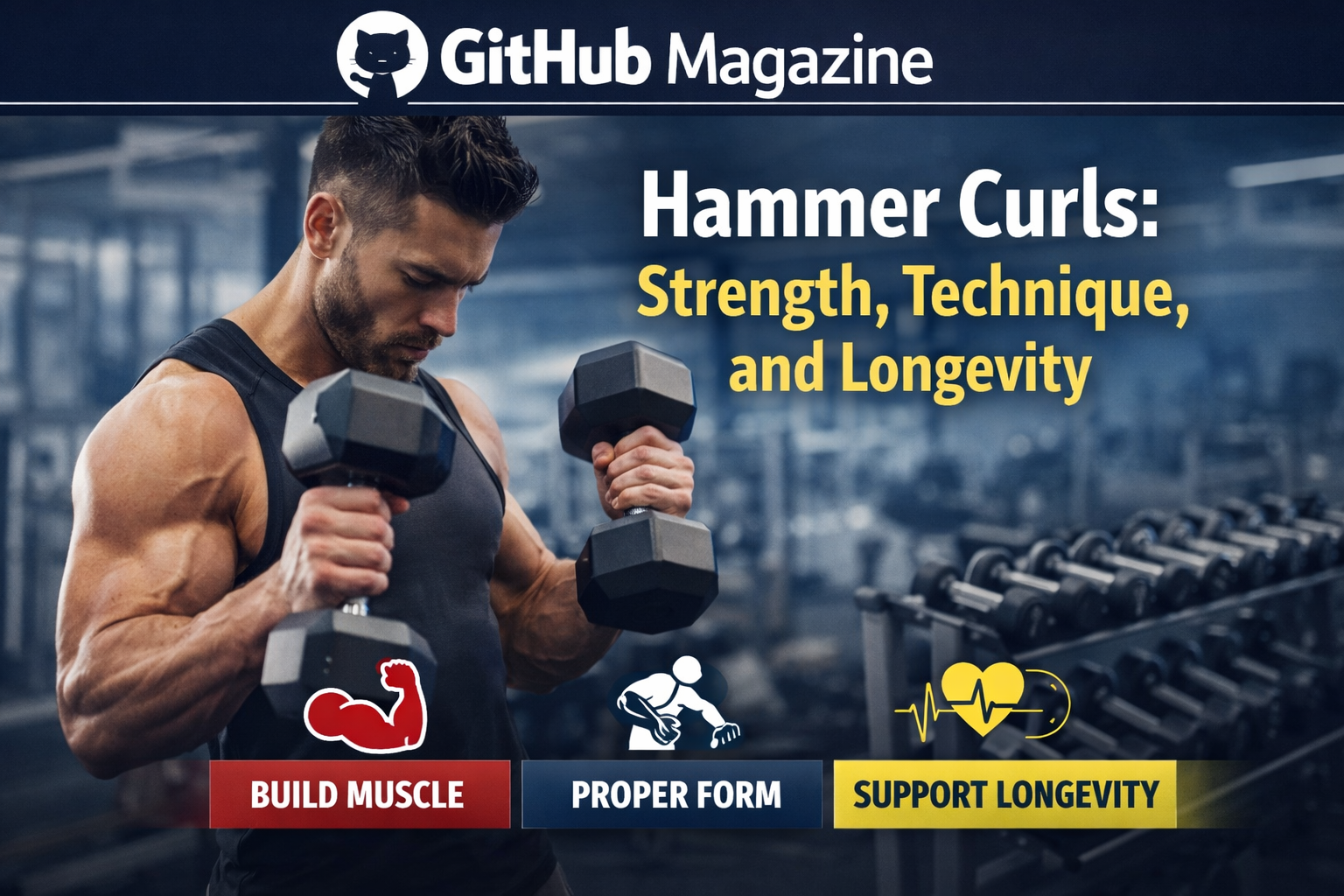
Hammer Curls: Strength, Technique, and Longevity
Hammer curls rarely command attention on a crowded gym floor. There is no dramatic setup, no theatrical bar bend, no visible strain that invites admiration. The movement is simple: dumbbells held at the sides, palms facing inward, arms rising and falling with deliberate control. Yet this simplicity masks a surprising depth. Hammer curls are not merely a variation of the biceps curl; they represent a different philosophy of strength—one focused on function, joint health, and long-term progress.
For many lifters, the appeal is immediate and practical. Hammer curls feel easier on the elbows, more stable at the wrists, and strangely more demanding despite lighter weights. For others, they are prescribed during rehabilitation, slipped into programs as “arm care,” or used to reinforce grip and forearm strength. Search trends reflect this dual identity: hammer curls are sought both by beginners building their first routines and by experienced athletes managing wear and tear.
Within the first few sets, the difference becomes clear. The familiar biceps burn gives way to a deeper fatigue along the arm, closer to the elbow and forearm. This sensation points to the exercise’s real value. Hammer curls emphasize muscles often overshadowed by aesthetics but essential for strength that carries over beyond the mirror.
Understanding hammer curls means looking past appearance and into mechanics, history, and intent. Their persistence across decades of changing fitness trends suggests something rare in exercise culture: a movement that adapts without losing relevance, quietly supporting the arms that lift, pull, and hold in everyday life.
The Mechanics of the Neutral Grip
The defining feature of the hammer curl is its neutral grip. With palms facing each other, the forearm neither supinates nor pronates, altering how force travels through the elbow joint. This small change redistributes muscular workload in a meaningful way.
In a traditional curl, the biceps brachii dominates. Its leverage improves as the forearm rotates upward, making it efficient for lifting heavier loads. The hammer curl removes some of that advantage. Instead, the brachialis—a muscle lying beneath the biceps—assumes a greater role. Because it functions solely to flex the elbow, it works consistently regardless of wrist position.
The brachioradialis, a large forearm muscle, also contributes significantly. It stabilizes the elbow and assists in flexion, particularly under heavier loads. This shared responsibility explains why hammer curls often feel harder even with reduced weight. More muscle is involved, but less leverage is available.
From a joint perspective, the neutral grip reduces rotational stress at the elbow and wrist. This makes hammer curls especially appealing for lifters managing tendon irritation or those accumulating high training volumes. The movement aligns strength with structure, prioritizing how joints age as much as how muscles grow.
Why Hammer Curls Feel Different From Traditional Curls
Lifters frequently notice that hammer curls produce a distinct type of fatigue. Instead of a sharp, localized pump in the biceps, the sensation spreads through the lower arm. This difference is not subjective; it reflects real changes in muscle recruitment and force distribution.
With reduced reliance on the biceps brachii, the arm must coordinate effort across multiple muscles. The nervous system works harder to stabilize the elbow and wrist while producing movement. This increases perceived effort even when the absolute load is lower.
The eccentric phase—the lowering portion of the lift—plays a particularly important role. When performed slowly, it places sustained tension on the brachialis and brachioradialis, encouraging strength gains that are less visible but highly transferable. Grip endurance, pulling strength, and elbow resilience all benefit from this controlled loading.
This is also why momentum undermines the exercise. Swinging the dumbbells forward shifts work away from the target muscles and increases shoulder involvement. Hammer curls reward patience and precision, not speed or excess weight.
Hammer Curls in the Context of Curl Variations
Curl variations differ not only in grip but in purpose. Each emphasizes different tissues and carries its own risk-reward profile.
| Exercise Variation | Grip Orientation | Primary Emphasis | Typical Stress Pattern |
|---|---|---|---|
| Standard Curl | Palms up | Biceps brachii | Moderate elbow and wrist stress |
| Hammer Curl | Palms neutral | Brachialis, brachioradialis | Lower joint stress |
| Reverse Curl | Palms down | Forearm extensors | Higher wrist demand |
| Preacher Curl | Fixed elbow | Biceps isolation | Elevated elbow stress |
Hammer curls occupy a stabilizing role within this landscape. They do not isolate the biceps as dramatically as preacher curls, nor do they overload the wrists like reverse curls. Instead, they provide balanced development and mechanical safety, making them suitable across a wide range of training goals.
For programs that emphasize longevity, this balance matters. Exercises that can be repeated week after week without aggravation tend to survive, regardless of trends. Hammer curls fall firmly into that category.
A Brief Cultural History of the Hammer Curl
Hammer curls emerged quietly alongside the rise of dumbbell training in the mid-20th century. Early strength manuals referenced neutral-grip curls as preparatory exercises for boxing and manual labor, where grip strength and elbow stability mattered more than arm shape.
As bodybuilding culture expanded in the 1970s and 1980s, the exercise was reframed as a forearm builder, often overshadowed by movements designed for visual impact. Its reputation remained secondary until sports performance training began emphasizing injury prevention and movement efficiency.
By the late 1990s and early 2000s, coaches increasingly favored exercises that distributed stress more evenly across joints. Hammer curls fit this shift naturally. They required no specialized equipment, scaled easily, and addressed common overuse issues associated with heavy supinated lifting.
Today, their cultural role is less about fashion and more about trust. They are included not because they impress, but because they endure.
Programming Hammer Curls for Sustainable Strength
Hammer curls are most effective when treated as supporting movements rather than centerpieces. They pair well with compound pulling exercises such as rows or pull-ups, reinforcing elbow flexion after larger muscle groups have been trained.
Typical programming emphasizes moderate loads and controlled repetitions. Higher rep ranges encourage blood flow and tendon health, while occasional heavier sets support grip strength and neural adaptation.
| Training Goal | Load Selection | Repetition Range | Weekly Frequency |
|---|---|---|---|
| Muscle Growth | Moderate | 8–12 | Two to three sessions |
| Joint Health | Light to moderate | 12–15 | Two sessions |
| Grip Support | Moderately heavy | 5–8 | One to two sessions |
Consistency matters more than intensity. Hammer curls accumulate benefit gradually, reinforcing structures that often determine whether a lifter can continue training uninterrupted.
Common Errors and Subtle Corrections
The most frequent mistake in hammer curls is excessive momentum. Swinging the weights converts the movement into a partial shoulder lift, reducing elbow flexor engagement. Slowing the tempo immediately restores effectiveness.
Another issue is wrist deviation. Allowing the dumbbells to tilt forward or backward increases strain on the forearm tendons. Maintaining a stacked wrist-over-elbow position preserves the neutral grip’s protective effect.
Finally, incomplete range of motion limits muscular development. Full extension at the bottom and controlled flexion at the top ensure even loading and reduce asymmetrical stress.
These corrections are quiet and often invisible to observers. Over time, however, they define the difference between exercises that build capacity and those that accumulate irritation.
Takeaways
- Hammer curls emphasize deeper arm muscles that support total arm strength
- The neutral grip reduces rotational stress at the elbow and wrist
- They often feel harder due to reduced leverage, not reduced effectiveness
- Controlled tempo enhances both strength and joint resilience
- Hammer curls complement, rather than replace, other curl variations
- Their value increases over long training timelines
Conclusion
Hammer curls persist because they answer questions that modern training increasingly asks. How can strength be built without sacrificing joint health? How can progress continue when recovery becomes as important as intensity? The neutral-grip curl offers one response.
It does not chase maximal loads or dramatic visuals. Instead, it reinforces the structures that allow lifting to continue year after year. For beginners, it provides a forgiving entry point into arm training. For experienced lifters, it offers continuity—a way to maintain strength when other movements must be reduced.
In a culture that often rewards excess, hammer curls stand for restraint. They remind us that effective training is not always loud or obvious. Sometimes it is measured, repetitive, and quietly reliable. That reliability is what keeps the movement relevant, long after flashier exercises fade.
FAQs
Are hammer curls suitable for beginners?
Yes. Their neutral grip feels natural and typically places less strain on the wrists and elbows.
Do hammer curls build arm size?
They contribute indirectly by developing the brachialis, which supports overall arm thickness.
Should hammer curls replace standard curls?
No. They work best alongside other curl variations, each serving a different purpose.
Why do hammer curls feel harder with lighter weight?
Reduced leverage shifts work to supporting muscles, increasing perceived effort.
How often should hammer curls be trained?
Most programs include them two to three times per week as accessory movements.

Related Posts

Directorate of Staff Development Explained

Toro Star: The Complete Guide to El Toro and the Constellation Taurus