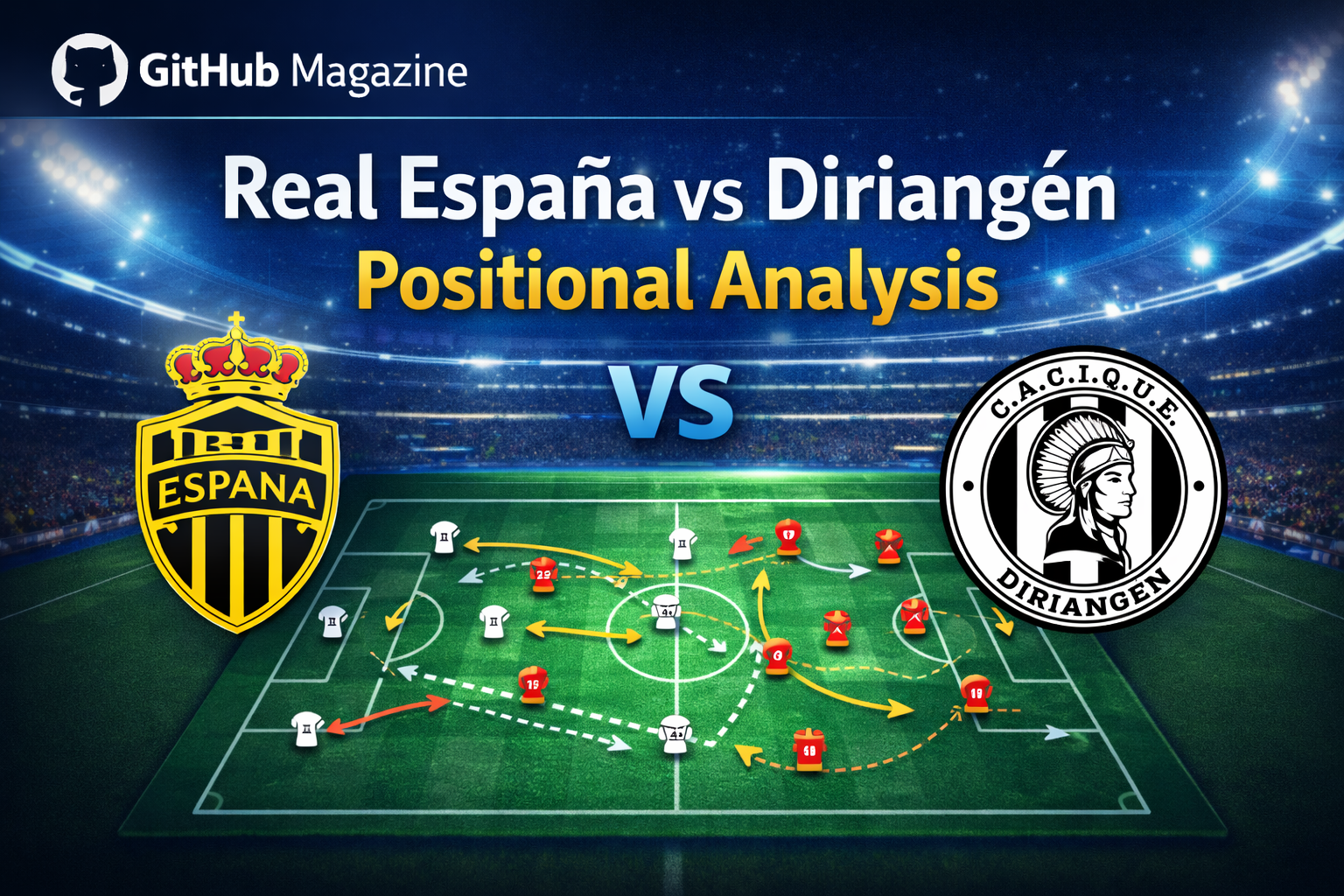
Real España Positional Review vs Diriangén
Real España’s encounters with Diriangén represent a fascinating window into the tactical chess of Central American football. In recent regional tournaments, the Honduran club has consistently leveraged structured positional play to gain the upper hand against the Nicaraguan side. Within the first stages of the match, Real España demonstrated disciplined control of the midfield, careful spacing in defensive lines, and strategic exploitation of wide areas, creating opportunities despite Diriangén’s compact defensive block. Their 1-0 victory in key fixtures highlights the direct impact of positional management, emphasizing the importance of structure and spatial awareness in high-level club competition. Understanding these dynamics is essential for appreciating how Real España navigates tactical challenges, balances defensive responsibilities, and transitions efficiently into attacking play.
Positional Strategy of Real España
Real España’s system against Diriangén typically revolves around a 4-3-3 formation with adaptive in-game adjustments. Defensively, the back four maintains compact lines, reducing gaps between center-backs and full-backs, while channeling opponents toward less threatening zones. The midfield trio orchestrates transitions: a defensive pivot provides stability, while two advanced interior midfielders oscillate between supporting attacks and pressing triggers. This configuration prioritizes central control while maintaining flexibility to exploit flanks during possession. Offensively, wingers sometimes invert toward the center, with full-backs stretching wide to create overlaps. Late midfield runs into the box complement this strategy, as demonstrated when Brayan Moya scored the decisive goal by exploiting the space created on the right flank.
| Phase of Play | Real España Positioning | Tactical Purpose |
|---|---|---|
| Defensive | Compact 4-3-3 | Deny central penetration, force lateral play |
| Transition | Quick full-back width | Open spaces and enable counter-attacks |
| Possession | Midfield rotations with pivot | Maintain ball control, organize forward play |
| Attack | Inside runs from wingers + midfield | Create overloads near the box for scoring |
Statistical Overview
In their key 2025 matchup, Real España dominated possession slightly at 52.7%, while Diriangén held 47.3%, reflecting the tight midfield battles and positional nuances. Real España attempted 19 shots compared to Diriangén’s 13, indicating controlled offensive phases facilitated by spatial management. Set pieces further emphasized positional advantage, with Real España earning seven corners to Diriangén’s five. Goalkeeper performance also underscored the effectiveness of defensive positioning, as Luis López’s four saves maintained a clean sheet. This statistical snapshot reinforces the connection between disciplined positioning and match outcomes, showing that Real España’s victory was as much about spatial strategy as finishing ability.
| Metric | Real España | Diriangén |
|---|---|---|
| Possession | 52.7% | 47.3% |
| Total Shots | 19 | 13 |
| Corners | 7 | 5 |
| Saves | 4 | 2 |
| Goals | 1 | 0 |
Expert Analysis
Juan Carlos García, former Honduran international, emphasizes, “Real España’s control of midfield and precise positional rotations dictate match tempo. Effective spatial awareness is essential against disciplined sides like Diriangén.” Tactical strategist Ricardo Gómez adds, “Diriangén’s low-block approach tests opponents’ ability to manipulate width and depth. Real España’s structured positional adjustments create the critical openings needed for decisive moments.” Their insights underline the strategic intelligence behind positional decisions, reinforcing the idea that football outcomes often stem from subtle spatial management rather than sheer skill alone.
Positional Adaptations
During matches, Real España often makes dynamic adjustments to maintain dominance. Midfielders may drop deeper under pressure while full-backs invert to support central buildup. These tactical shifts disrupt Diriangén’s compact defensive shape, creating overloads and opportunities for penetration. Even as Diriangén maintains a disciplined low block, Real España’s positional rotations and coordinated movements allow controlled exploitation of weaknesses, highlighting the interplay of structure, timing, and spatial awareness in high-level club football.
Takeaways
- Real España’s 4-3-3 formation emphasizes midfield control and width exploitation
- Disciplined positioning enabled Real España to secure possession advantage
- Diriangén’s compact defensive shape forced Real España to manipulate space creatively
- Set pieces and transitional plays were key to offensive effectiveness
- Positional discipline often dictated match outcomes over raw offensive power
Conclusion
The Real España vs Diriangén encounters illustrate the subtle art of positional football in Central America. Real España’s combination of structured defensive lines, intelligent midfield rotations, and strategic use of width demonstrates the impact of disciplined spatial management. Diriangén’s low-block strategy provided a stern challenge, but Real España’s calculated positional adjustments ensured control and ultimately facilitated decisive moments. By analyzing these positional dynamics, it becomes evident that match results are determined not only by talent but also by tactical awareness, timing, and precise spatial execution, offering insights for coaches, analysts, and fans alike.
FAQs
Q: What formation does Real España use against Diriangén?
A: Real España primarily uses a 4-3-3 formation emphasizing midfield control and width exploitation.
Q: Who scored the decisive goal in their latest encounter?
A: Brayan Moya scored the lone goal for Real España in the 1-0 match.
Q: How did possession reflect Real España’s tactical approach?
A: Real España maintained roughly 52.7% possession, demonstrating control through midfield rotations and structured buildup.
Q: How does Diriangén challenge Real España tactically?
A: Diriangén employs a compact low block, limiting space and forcing Real España to exploit width and transitional plays.
Q: Are positional adjustments important in these matches?
A: Yes, shifts in midfield and full-back positioning are crucial for breaking Diriangén’s defensive structure.

Related Posts
Directorate of Staff Development Explained

Toro Star: The Complete Guide to El Toro and the Constellation Taurus