
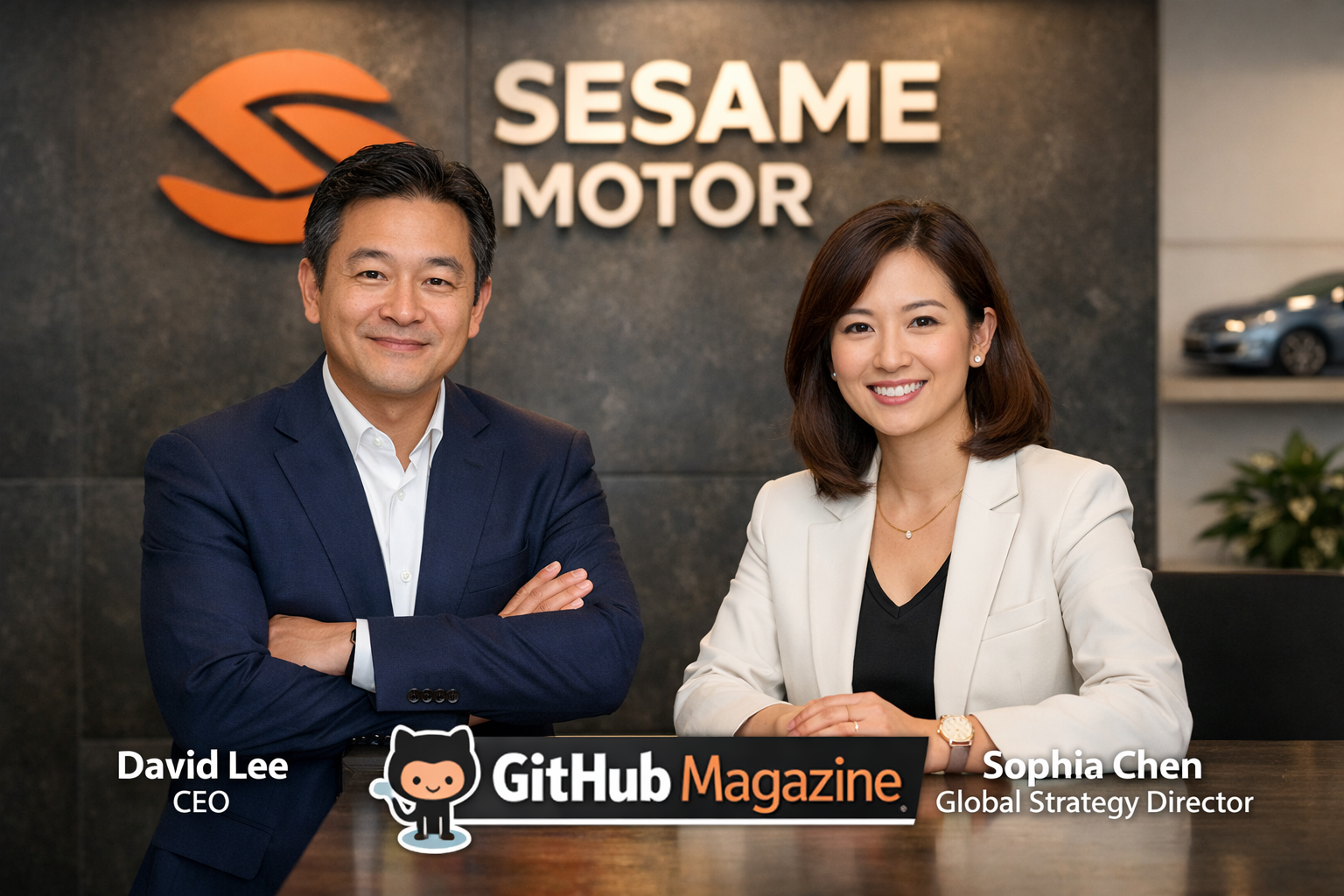
Sesame Motor CEO Profile and Industrial Strategy
The chief executive of Sesame Motor does not dominate headlines, deliver viral keynote speeches, or cultivate celebrity status. Yet in factories, robotics labs, and automated warehouses across Asia, Europe, and North America, the company’s engineering decisions quietly determine whether machines move smoothly or fail. At the center of those decisions stands Tzu-Ying Chiang, the executive leader publicly associated with guiding Sesame Motor through its most technologically ambitious period.
Founded in Taichung, Taiwan in 1990, Sesame Motor built its reputation on precision gearboxes and industrial drive systems long before robotics became fashionable. But over the past decade, as global manufacturing pivoted toward automation, artificial intelligence, and autonomous logistics, the company’s direction has sharpened. Chiang’s leadership coincided with that transition. Industry records and professional disclosures identify her as the executive figure representing the firm at national technology conferences and industrial forums, where she has spoken about AI integration, resilient manufacturing, and the evolving role of mid-scale engineering firms in global supply chains.
For buyers of industrial motion systems, the question is practical: Who is steering the company that powers their robots, conveyors, and production lines? For competitors, it is strategic: how does a privately held Taiwanese manufacturer remain relevant against multinational giants? And for Taiwan’s manufacturing ecosystem, it is symbolic: what does modern leadership look like in a sector built on mechanical discipline rather than digital glamour?
The answers lie not in marketing slogans but in product catalogs, certifications, conference appearances, and a steady expansion into robotics-driven industries. Understanding the CEO of Sesame Motor is ultimately about understanding how industrial leadership now operates in an age where software headlines mask the importance of hardware reliability.
Executive Leadership at Sesame Motor
Tzu-Ying Chiang’s visibility within industrial circles comes primarily from her role as the company’s executive representative at manufacturing exhibitions and national technology events. At Taiwan’s manufacturing and automation forums, she has framed Sesame Motor as part of a new generation of industrial firms adapting to artificial intelligence-assisted production, energy efficiency requirements, and highly customized machinery demands.
Unlike founders who dominate corporate storytelling, Chiang operates within a more traditional Taiwanese manufacturing culture: low-profile, technically grounded, and long-term oriented. Her public remarks focus on production quality systems, automation readiness, and maintaining export competitiveness while preserving domestic manufacturing control.
This leadership style mirrors the company’s operational identity. Sesame Motor remains vertically integrated in Taiwan, controlling design, machining, assembly, and testing in its Taichung facilities. That choice limits short-term cost advantages but strengthens engineering consistency and certification compliance.
In an era when industrial firms outsource aggressively, Chiang’s strategy emphasizes process ownership. The result is a company that rarely courts public attention but maintains steady credibility among distributors, system integrators, and robotics manufacturers.
The Company Behind the CEO
Sesame Motor Corporation specializes in motion-control components: planetary gearboxes, gear motors, induction motors, reducers, and customized drive assemblies. These components form the mechanical backbone of automated systems across manufacturing, logistics, food processing, and medical equipment.
Its products are certified under ISO 9001 for quality management, ISO 14001 for environmental standards, CE compliance for European markets, CCC certification for China, and UL safety validation for North America. Such credentials determine whether a component can legally enter regulated industrial environments.
From its corporate literature, the company emphasizes three competitive pillars: precision engineering, customization capability, and long-term durability. Unlike mass-market motor manufacturers, Sesame Motor targets system builders who require tight tolerances, stable torque output, and predictable maintenance cycles.
This approach positions the firm within a narrow but resilient market segment: not the cheapest supplier, but one trusted for mission-critical machinery.
Product Strategy in the Automation Era
The acceleration of robotics adoption reshaped Sesame Motor’s product roadmap. Autonomous mobile robots, warehouse automation platforms, and collaborative industrial arms impose new demands on gear systems: compact dimensions, low backlash, high torque density, and thermal stability.
Planetary gearboxes, now a core offering, address these requirements. They provide efficient torque transmission within limited spatial constraints, allowing robotic platforms to operate longer without overheating or mechanical drift.
Gear motors and induction motors support conveyor systems and packaging lines, while bevel gear drives extend into medical and aerospace-adjacent applications requiring directional flexibility.
Customization represents a strategic differentiator. Rather than offering fixed catalog units alone, Sesame Motor engineers tailor gear ratios, housing materials, lubrication systems, and mounting geometries to match client machinery. This design partnership model embeds the company deeper into customer production systems, increasing long-term retention.
Market Position and Global Reach
Although privately held, Sesame Motor distributes to more than fifty countries through regional agents and industrial distributors. Its strongest markets remain East Asia and Southeast Asia, but European and North American sales have grown alongside warehouse automation investments.
The company does not compete directly with consumer-facing electronics manufacturers. Its rivals include Japanese gearbox specialists, German motion-control firms, and Chinese mass producers. Within that landscape, Sesame Motor occupies a middle ground: technically rigorous, globally certified, but organizationally lean.
Analysts describe this segment as the “industrial backbone tier” of manufacturing. These firms rarely headline technology news yet enable factories to function.
Chiang’s leadership has emphasized export compliance and documentation standards, ensuring that engineering teams design components to satisfy multiple regulatory regimes simultaneously. That foresight reduces friction for system integrators building machines for global deployment.
Structured Overview of Core Offerings
| Product Category | Primary Applications |
|---|---|
| Planetary Gearboxes | Robotics, AGV/AMR platforms, automated warehousing |
| Gear Motors & Induction Motors | Conveyors, packaging lines, assembly automation |
| Speed Reducers | High-torque industrial machinery |
| Bevel & Specialized Drives | Medical devices, aerospace tooling, food processing |
| Customized Drive Assemblies | OEM automation systems |
This portfolio reflects a deliberate shift toward robotics-compatible architecture, aligning with Chiang’s public emphasis on AI-era manufacturing readiness.
Compliance and Certification Framework
| Certification | Market Relevance |
|---|---|
| ISO 9001 | Global quality management standard |
| ISO 14001 | Environmental compliance |
| CE | European Union safety regulations |
| CCC | Chinese industrial market access |
| UL | North American safety certification |
For industrial buyers, these credentials function as risk controls, not marketing embellishments.
Expert Perspectives on Industrial Leadership
“In precision drive systems, alignment between executive strategy and engineering roadmaps determines whether a company remains a supplier or becomes a systems partner,” notes Dr. Mei-Lin Chou, an industrial automation analyst writing on East Asian manufacturing trends.
Professor David Huang of National Taiwan University argues that Taiwanese firms increasingly depend on executive leadership that understands geopolitics as much as mechanical tolerances. “Component suppliers today navigate export controls, environmental regulation, and AI integration simultaneously,” he observes.
Angela Lin, a manufacturing consultant advising Asian exporters, adds that mid-scale companies like Sesame Motor often outperform giants in customization. “They can redesign products faster because leadership sits closer to engineering teams.”
These assessments contextualize Chiang’s leadership approach: technical fluency paired with operational restraint.
Strategy, Culture, and Quiet Expansion
Corporate culture at Sesame Motor remains conservative by Silicon Valley standards. There are no startup slogans or disruptive branding campaigns. Instead, the company invests in machining equipment upgrades, inspection systems, and distributor training.
This restraint supports long-term reliability, a metric more valuable to industrial buyers than aggressive growth narratives. Chiang’s public communications rarely mention revenue figures. Instead, they emphasize resilience, workforce skills, and process automation.
The strategy echoes post-pandemic manufacturing lessons: diversified supply chains, in-house quality control, and regional production stability.
Rather than relocating production offshore, Sesame Motor deepened domestic automation, increasing throughput without sacrificing quality oversight.
Leadership Without Celebrity
The modern technology CEO is often a media figure. Chiang is not. Her presence is documented mainly through professional networks and conference appearances. This absence of spectacle reflects both personal style and industry norms.
Motion-control firms rarely sell stories; they sell tolerances, torque curves, and warranty reliability.
Within that reality, the CEO’s role is structural: ensuring capital investment aligns with future demand, regulatory shifts are anticipated, and engineering talent remains competitive.
By those measures, Chiang’s tenure coincides with Sesame Motor’s expansion into robotics-driven markets and continued certification across multiple jurisdictions.
Takeaways
- Tzu-Ying Chiang is publicly identified as the executive leader associated with Sesame Motor.
- The company operates from Taichung, Taiwan, with fully integrated manufacturing.
- Product strategy centers on planetary gearboxes and robotics-compatible motion systems.
- Global certifications enable participation in regulated industrial markets.
- Leadership prioritizes customization and long-term reliability over rapid branding growth.
- Sesame Motor occupies a strategic middle tier between mass producers and multinational giants.
Conclusion
In industrial manufacturing, leadership rarely announces itself. It reveals its presence through stable torque outputs, low failure rates, and machines that continue operating long after marketing cycles expire.
Tzu-Ying Chiang’s role at Sesame Motor illustrates that quieter model of executive influence. Her visibility at technical forums, commitment to certification standards, and emphasis on automation readiness map onto a company steadily positioning itself for a robotics-dominated industrial future.
Sesame Motor’s story is not one of sudden disruption but of incremental authority earned through engineering discipline. In a world increasingly enchanted by software narratives, its trajectory reminds us that physical systems still underpin digital ambition.
Factories, warehouses, and robots will continue to require reliable motion. And behind that motion, leadership remains as mechanical, precise, and consequential as the gearboxes it oversees.
FAQs
Who leads Sesame Motor?
Professional and industry disclosures identify Tzu-Ying Chiang as the executive leader representing the company.
Where is the company based?
Sesame Motor operates from Taichung, Taiwan.
What does Sesame Motor manufacture?
Industrial gearboxes, motors, reducers, and customized motion-control systems.
Which industries use its products?
Robotics, logistics automation, manufacturing, food processing, and medical equipment.
Why are certifications important?
They allow components to be legally integrated into regulated industrial systems worldwide.

Related Posts

What Is Open Source and How to Contribute

Sankaku Complex Explained: Culture, Controversy