
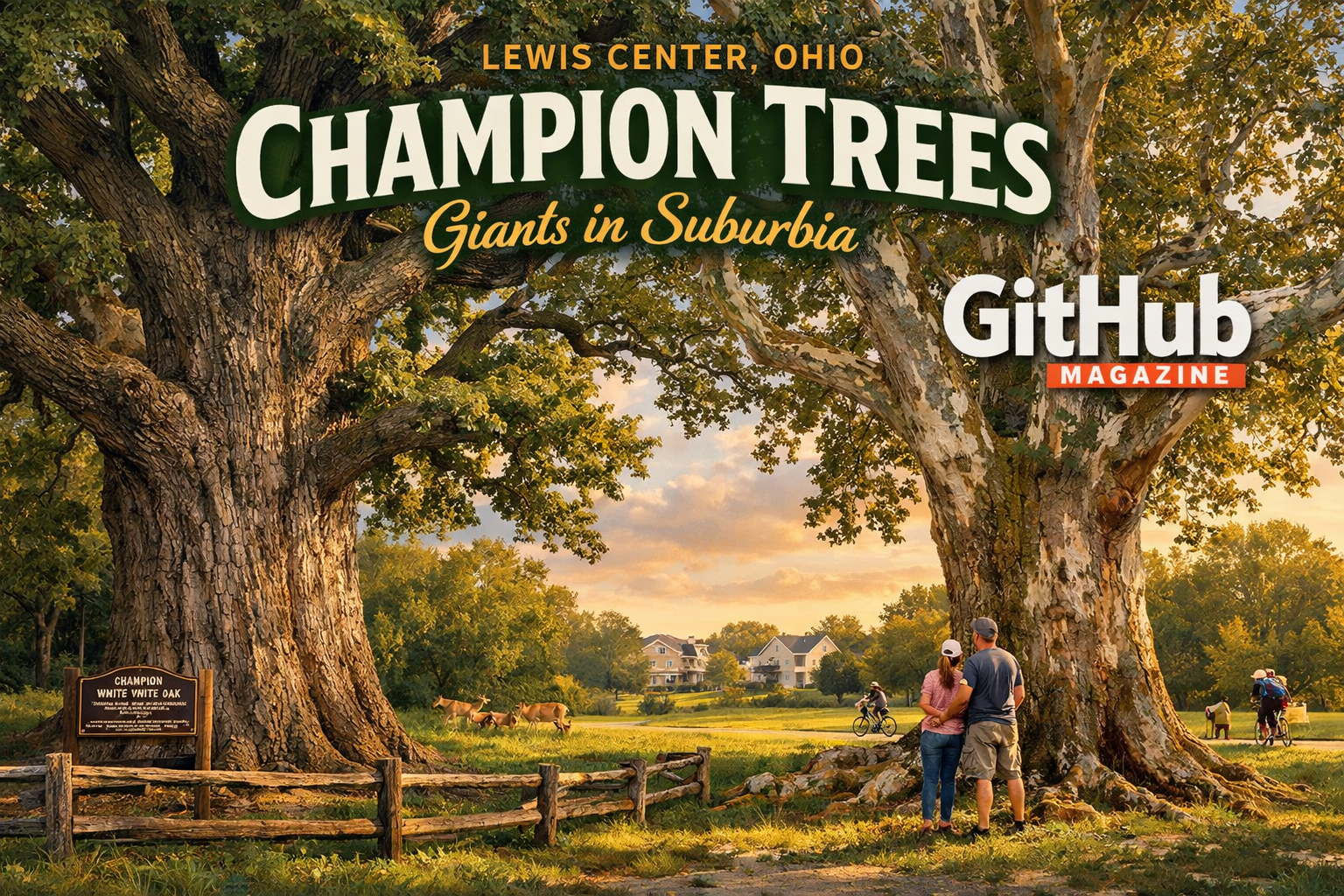
Lewis Center Ohio Champion Trees Guide
Lewis Center, Ohio, is often described in terms of schools, highways, and new housing developments, but another identity rises quietly above the rooftops. It is written in bark and branches, in shadows cast across lawns and creeks, in living organisms measured not by decades but by centuries. These are champion trees: the largest documented examples of their species within the state, identified through formal measurement systems that calculate trunk circumference, height, and crown spread. In the first moments of understanding, what matters most is this: champion trees are not legends or folklore, but scientifically verified giants that still grow among ordinary neighborhoods.
Within the first hundred words, the story becomes clear. Lewis Center is not merely a suburb expanding north from Columbus. It is also a place where biological history remains rooted in soil shaped by glaciers and watered by tributaries of the Olentangy River. Champion trees thrive here because the land remembers what came before pavement: floodplains, hardwood forests, and open meadows where oak, sycamore, cottonwood, and maple grew without fences or zoning laws.
These trees are not museum pieces. They shade driveways, lean over schoolyards, and anchor public parks. Some stand on private property, protected by homeowners who recognize their rarity. Others rise in preserved green spaces, where hikers pass beneath canopies wider than small houses. Together, they form an unplanned archive of natural history, marking time in rings instead of calendars.
This article examines how champion trees are defined, why Lewis Center has become a quiet refuge for several notable specimens, and how science, community involvement, and development pressures intersect around these living monuments. It is not only a story about trees, but about how a modern town negotiates its relationship with the deep past growing in its own backyards.
Roots of a Champion: How Ohio Defines Its Largest Trees
Champion trees earn their status through measurement, not mythology. The system used in Ohio mirrors national forestry standards and assigns points based on three variables: the circumference of the trunk measured at 4.5 feet above the ground, the total height of the tree, and the average width of the crown. Add these numbers together, and the resulting score determines whether a tree becomes the largest documented specimen of its species in the state.
This process is overseen by Ohio’s forestry authorities but depends heavily on citizens. A neighbor notices a tree that seems unusually large. A park naturalist compares it to known records. A landowner submits a nomination. Trained measurers arrive with tapes and rangefinders, moving carefully around roots older than the town itself. When a tree qualifies, it enters the state registry and becomes part of a living catalogue of botanical extremes.
Age alone does not guarantee champion status. Some trees reach remarkable size in two centuries; others require four. Soil chemistry, water access, sunlight, and competition all influence growth. In central Ohio, deep glacial soils and moderate rainfall create ideal conditions for fast-growing hardwoods. The result is a landscape capable of producing giants that rival those in more famous forest regions.
Champion trees serve as benchmarks for scientists studying climate resilience and urban forestry. They reveal how species respond to environmental pressures across long timelines. A cottonwood that thrives beside a modern subdivision offers data on pollution tolerance. An oak that survived centuries of storms becomes evidence of genetic durability. These trees are not only impressive to look at; they are biological records written in living tissue.
Lewis Center’s Quiet Forest History
Before Lewis Center was mapped in property lines, it existed as part of a mosaic of wetlands, woodlands, and prairie edges. Delaware County lay within the path of ancient glaciers, whose retreat left nutrient-rich sediment ideal for deep-rooting trees. White oaks, silver maples, American sycamores, and eastern cottonwoods established themselves long before the first barns were built.
As agriculture spread in the nineteenth century, many forests were cleared, but not all trees were cut. Some remained to shade livestock. Others marked property boundaries or grew too massive to justify removal. When suburban development accelerated in the late twentieth century, builders again faced choices: remove everything, or design around what already stood. In many cases, they chose the latter, preserving trees that had already lived longer than the concept of zoning laws.
Today, Lewis Center contains several trees that local residents consider landmarks even if they do not always appear on official maps. A cottonwood near a drainage corridor stretches skyward with a trunk so wide it takes several adults to encircle. An oak on a former farmstead stands behind newer houses, its canopy extending over fences that did not exist when its first branches formed.
These trees are ecological anchors. Their cavities shelter owls and woodpeckers. Their roots stabilize soil during heavy rain. Their shade cools pavement and lawns alike. In a region increasingly shaped by construction schedules, these champions impose a slower rhythm, reminding residents that growth can be measured in inches per year rather than square feet per month.
Notable Champion Tree Species in Ohio
| Species | Typical Champion Location | Measurement Highlights |
|---|---|---|
| American Sycamore | Central and northern Ohio floodplains | Trunks exceeding 430 inches in circumference, heights near 100 feet |
| Eastern Cottonwood | Delaware County and river corridors | Heights exceeding 120 feet, massive crown spreads |
| White Oak | Southeastern Ohio | Circumference often above 300 inches |
| Silver Maple | Central Ohio lowlands | Wide crowns, rapid vertical growth |
These species dominate Ohio’s champion registry because they combine rapid growth with long life spans. In Lewis Center, cottonwoods and maples are especially visible near waterways, while oaks tend to persist in residential pockets where development slowed or adapted around them.
Parks, Private Land, and the Geography of Preservation
Not all champion trees are hidden behind backyard fences. Some rise in public landscapes where their size becomes part of shared experience. Nearby Highbanks Metro Park, established in the early 1970s along dramatic river bluffs, contains mature forests where sycamores and oaks approach sizes rarely seen in urban settings. Visitors walk beneath canopies shaped by centuries of wind and ice, gaining perspective on how small modern timelines truly are.
Urban parks closer to Columbus also host recognized champions: catalpas near playgrounds, elms beside walking paths, and maples framing historic gardens. These trees become visual anchors, used as meeting points and reference markers as much as sources of shade.
Yet in Lewis Center itself, many of the most remarkable specimens remain on private property. Their survival depends on individual stewardship. Homeowners consult arborists before trenching. They redirect driveways to avoid root systems. They accept fallen leaves as the price of living beside a living monument.
This private-public balance defines the modern geography of champion trees. Unlike protected wilderness giants, suburban champions survive through negotiation: between development and preservation, convenience and heritage, short-term planning and long-term thinking.
Champion Trees Near Lewis Center by Habitat
| Species | Habitat Context | Notes |
|---|---|---|
| White Oak | Residential edges | Often predates modern housing |
| Eastern Cottonwood | Drainage corridors | Visible landmarks near creeks |
| American Sycamore | Parklands | Common in preserved floodplains |
| Silver Maple | Urban green spaces | Thrives in moist, compact soils |
Each habitat tells a different survival story. Cottonwoods endure fluctuating water tables. Maples adapt to compacted soils near sidewalks. Oaks withstand decades of construction vibration and altered drainage patterns. Together, they demonstrate that champion status is not only about size, but about endurance.
Scientific and Community Perspectives
Forestry researchers often describe champion trees as “biological infrastructure.” One environmental scientist from Ohio’s academic community has noted that such trees store exponentially more carbon than younger ones, acting as long-term reservoirs that mitigate climate impacts at a scale difficult to replicate artificially.
Urban ecologists emphasize their disproportionate value. A single large tree can provide the ecological services of dozens of smaller plantings: cooling neighborhoods by several degrees in summer, absorbing thousands of gallons of stormwater annually, and offering nesting habitat unavailable in young landscaping.
Community forestry advocates point to the nomination process itself as an educational tool. When residents measure trees and submit records, they learn to see their surroundings differently. A front yard becomes part of statewide natural history. A familiar trunk becomes evidence of centuries of environmental continuity.
In Lewis Center, this awareness has quietly grown. Local discussions about development increasingly include references to tree preservation. Builders market properties “around heritage trees.” Schools organize walks to nearby giants. The presence of champion trees subtly reshapes how progress is defined.
Takeaways
- Champion trees are identified through scientific measurement, not folklore.
- Lewis Center’s soil and water conditions support unusually large hardwood species.
- Cottonwoods, oaks, maples, and sycamores dominate local champion candidates.
- Many giants survive on private land due to homeowner stewardship.
- Large trees provide outsized ecological benefits in suburban environments.
- Public awareness programs strengthen preservation efforts.
- Development and conservation increasingly coexist rather than compete.
Conclusion
Champion trees in Lewis Center are not relics isolated from modern life. They are participants in it. They stand beside roads, behind shopping centers, and within subdivisions, quietly insisting that time can be measured differently. Where buildings rise and fall within decades, these trees remain, adding rings to their trunks long after architectural styles fade.
Their presence complicates the narrative of suburban expansion. Growth is no longer only horizontal, mapped in housing plots and traffic lanes. It is vertical, reaching into skies first claimed by branches centuries ago. Champion trees remind residents that continuity is possible even amid constant change, that a town can expand without erasing every trace of what preceded it.
In Lewis Center, the largest trees are not tourist attractions advertised on billboards. They are quieter than that. They exist as neighbors, shade-givers, and silent historians. And in their persistence, they offer a rare form of stability in a landscape otherwise defined by motion.
FAQs
What qualifies a tree as a champion in Ohio?
A point system combining trunk circumference, height, and crown spread determines champion status.
Are champion trees protected by law?
Designation alone does not guarantee legal protection; preservation depends on ownership and local regulations.
Can anyone nominate a tree?
Yes. Residents can submit measurements for verification through the state forestry program.
Are there champion trees on private property in Lewis Center?
Yes. Several notable specimens exist in residential areas and former farm sites.
Why are cottonwoods common among champions?
They grow rapidly, tolerate floodplains, and develop massive trunks and crowns over time.

Related Posts

Directorate of Staff Development Explained

Toro Star: The Complete Guide to El Toro and the Constellation Taurus