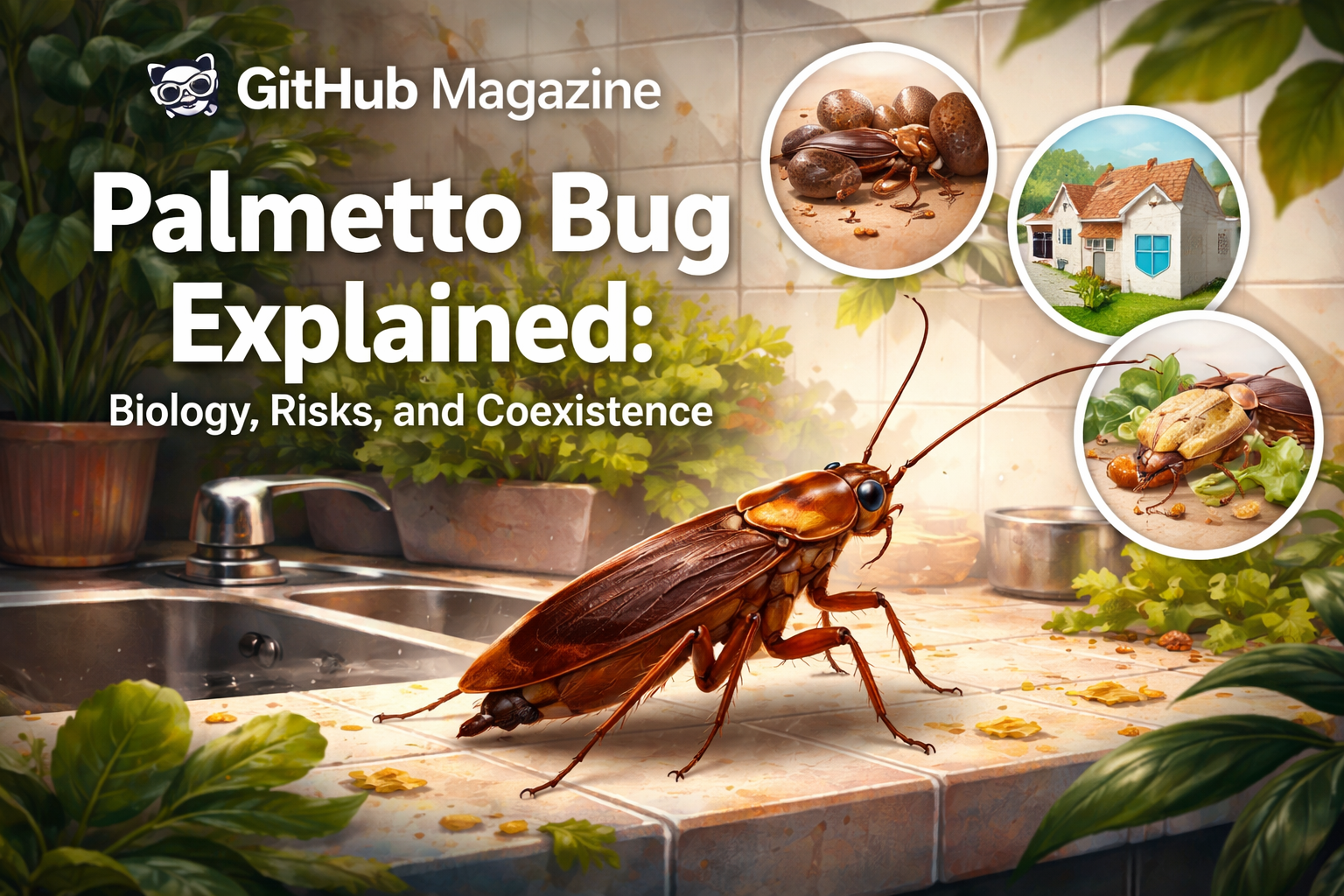
Palmetto Bug Explained: Science, Risks, and Reality
The phrase “palmetto bug” is usually spoken with a shudder. In kitchens, hotel rooms, garages, and screened porches across the southern United States, it functions as shorthand for a large, fast-moving insect that seems to appear without warning and vanish just as quickly. For millions of residents, tourists, and new arrivals, the name carries emotional weight before it carries biological meaning. Yet in scientific terms, the palmetto bug is not a distinct species at all. It is a regional label, most often applied to large cockroaches such as the American cockroach and the smokybrown cockroach, insects that have lived on Earth for more than 300 million years.
For readers searching for clarity, the answer is simple and direct: a palmetto bug is a cockroach, typically one adapted to warm, humid climates and outdoor environments, which sometimes wanders indoors. That truth, however, opens the door to deeper questions. Why does this insect thrive so successfully alongside human civilization? What role does it play in ecosystems? How dangerous is it, really, to human health? And why has it become such a potent symbol of discomfort in Southern culture?
Understanding the palmetto bug requires stepping beyond fear and folklore into biology, urban ecology, and the psychology of disgust. It is a story about survival strategies perfected long before humans built houses, about misunderstandings reinforced by language, and about the uneasy coexistence between people and one of the planet’s most durable life forms. What follows is not an extermination manual, nor a defense of an unpopular creature, but a careful examination of how science, environment, and culture converge in a single insect.
What Is a Palmetto Bug? Science and Regional Language
In formal taxonomy, there is no insect officially named the palmetto bug. The term developed in the southeastern United States, where palmetto palms are common and large cockroaches are frequently seen resting in fronds, leaf litter, and landscaping debris. Over time, residents began referring to these insects by association with their surroundings rather than their scientific classification.
Most insects called palmetto bugs belong to the genus Periplaneta, particularly Periplaneta americana and Periplaneta fuliginosa. Both species are large, reddish-brown to dark brown cockroaches with long antennae and functional wings. They are strong runners and capable of short, clumsy flights, a trait that contributes significantly to their reputation for causing panic.
The name itself softens the image. “Palmetto bug” sounds local, even quaint, while “cockroach” carries centuries of stigma tied to filth and disease. Linguistically, the difference matters. In everyday conversation, people often insist that palmetto bugs are different, cleaner, or less invasive than “real roaches.” Biologically, this distinction does not hold. The insects share anatomy, behavior, and evolutionary lineage with other cockroach species.
Entomologist Louis Sorkin of the American Museum of Natural History has summarized the issue plainly: “Common names tell you more about human culture than insect biology. From a scientific perspective, a palmetto bug is a cockroach, full stop.” His observation reflects a broader reality in science communication: names can obscure more than they reveal.
Taxonomy and Common Names Compared
| Common Name | Typical Species | Scientific Group | Notes |
|---|---|---|---|
| Palmetto bug | American cockroach | Periplaneta americana | Most common in homes |
| Palmetto bug | Smokybrown cockroach | Periplaneta fuliginosa | Prefers outdoor habitats |
| Water bug | Various cockroaches | Blattodea | Often misapplied |
| Cockroach | Hundreds of species | Blattodea | Global distribution |
The table reveals the central confusion: multiple species, one nickname. The palmetto bug is not unique in this respect, but it is unusual in how emotionally charged the nickname has become.
An Ancient Insect in a Modern World
Cockroaches are among the oldest insect groups still living today. Fossil evidence places their ancestors in the Carboniferous period, more than 300 million years ago, when giant ferns dominated landscapes and vertebrates were only beginning to colonize land. Their basic body plan has changed remarkably little since then: flattened shape for squeezing into narrow spaces, long antennae for detecting chemical cues, and tough exoskeletons for protection.
This evolutionary stability is not accidental. It reflects an extraordinarily flexible survival strategy. Cockroaches are omnivores. They eat decaying plants, fungi, paper, glue, food scraps, animal waste, and even one another. They tolerate a wide range of temperatures, reproduce efficiently, and hide in places inaccessible to many predators.
Dr. Coby Schal, an urban entomologist at North Carolina State University, has noted that cockroaches are “masters of ecological opportunism,” organisms that exploit whatever environment humans accidentally create. The palmetto bug, as a warm-climate specialist, thrives especially well in the subtropical conditions of the American South, the Caribbean, and coastal regions.
Urbanization has not displaced these insects; it has provided new niches. Storm drains, sewer systems, landscaped yards, crawl spaces, and garbage collection points form an interconnected habitat network. From the insect’s perspective, cities are not hostile territory but complex ecosystems rich in shelter, moisture, and food.
Ecological Role Outside the Home
Away from kitchens and bathrooms, palmetto bugs perform tasks that ecologists consider valuable. In forests and gardens, they act as decomposers, feeding on dead leaves, rotting wood, and other organic material. This activity accelerates the breakdown of plant matter, returning nutrients to the soil and supporting microbial communities that form the base of terrestrial food webs.
In this role, cockroaches are similar to earthworms or beetles, organisms rarely celebrated but essential to ecological balance. They are also prey for birds, reptiles, amphibians, and small mammals. Their abundance helps sustain these populations, particularly in urban-edge environments where traditional prey species may be scarce.
The ecological importance of cockroaches complicates the popular narrative that they are purely pests. They become problematic primarily when their natural behaviors intersect with human living spaces. In outdoor ecosystems, their presence is unremarkable, even beneficial.
How and Why Palmetto Bugs Enter Homes
Palmetto bugs do not typically evolve as indoor specialists. Unlike the German cockroach, which depends heavily on human structures, American and smokybrown cockroaches prefer outdoor habitats with vegetation and moisture. They enter buildings opportunistically rather than by design.
Common triggers include drought, flooding, sudden drops in temperature, or construction that disrupts their shelters. Cracks in foundations, gaps around plumbing, open doors, and poorly sealed windows provide easy entry points. Once inside, the insects seek dark, humid spaces that resemble their natural hiding places: under sinks, behind appliances, inside wall voids.
Their presence does not necessarily indicate poor sanitation. A clean home near wooded areas or dense landscaping can still experience occasional intrusions. However, clutter, exposed food, standing water, and cardboard storage significantly increase the likelihood of longer infestations.
Health Implications and Scientific Evidence
The reputation of cockroaches as disease carriers is not unfounded, but it is often exaggerated. Palmetto bugs can mechanically transport bacteria on their legs and bodies after moving through decaying matter or sewage. Studies have identified pathogens such as Salmonella and E. coli on cockroach surfaces. Transmission occurs indirectly, when contaminated insects walk across food or preparation surfaces.
The more consistent health concern involves allergens. Proteins found in cockroach saliva, feces, and shed exoskeletons are known triggers for asthma and allergic reactions, particularly in children. In dense urban housing, cockroach allergens rank among the most significant indoor environmental risk factors for respiratory illness.
Dr. Herman Mitchell, a pediatric allergist involved in national asthma research, has stated, “Cockroach allergen exposure is one of the strongest predictors of asthma severity in inner-city children.” His research underscores that the danger lies less in bites or stings, which are rare, and more in chronic exposure to insect debris.
Still, occasional sightings of palmetto bugs do not automatically translate into health emergencies. Risk increases with population density, poor ventilation, and long-term infestation.
Health Risks at a Glance
| Risk Category | Mechanism | Typical Severity |
|---|---|---|
| Bacterial contamination | Mechanical transfer to surfaces | Low to moderate |
| Allergens | Feces and shed skins in air | Moderate to high for sensitive individuals |
| Bites | Defensive, extremely rare | Low |
| Psychological stress | Fear and phobia | Variable |
Myths That Refuse to Die
Several persistent myths surround palmetto bugs. The most famous is that they can survive nuclear radiation. While cockroaches are more resistant to radiation than humans, they are not indestructible. High doses are lethal, and their survival advantage stems from slower cell division, not supernatural durability.
Another belief is that palmetto bugs deliberately attack humans. In reality, they avoid confrontation. When they fly toward people, it is usually accidental, the result of poor navigation and attraction to light sources.
A third myth claims that palmetto bugs are “cleaner” than other cockroaches because they live outdoors. While outdoor species may encounter different bacteria than sewer-dwelling ones, they are not hygienic in any meaningful sense. Cleanliness is a human concept, not an insect behavior.
Managing Palmetto Bugs Without Panic
Effective management emphasizes environmental modification rather than constant chemical warfare. Sealing structural gaps, repairing leaky pipes, reducing outdoor leaf litter near foundations, and storing food in airtight containers address the root causes of intrusion.
When chemical treatments are necessary, modern pest management favors targeted baits over widespread spraying. Baits exploit social behaviors, allowing poisoned individuals to return to harborage sites and affect others. This approach reduces environmental contamination and long-term resistance.
Integrated pest management, or IPM, combines sanitation, structural maintenance, monitoring, and limited chemical use. It recognizes that complete eradication is unrealistic in warm climates but population control is achievable.
Cultural Fear and the Psychology of Disgust
Few insects provoke the same visceral reaction as cockroaches. Psychologists attribute this to several factors: erratic movement, glossy exoskeletons, association with decay, and their tendency to appear unexpectedly at night. These traits activate deep evolutionary responses related to disease avoidance.
In the South, the palmetto bug occupies a special niche in storytelling. It appears in jokes, childhood memories, horror anecdotes, and moving-day warnings given to newcomers. The insect becomes a cultural symbol of climate itself, a living reminder of heat and humidity.
Sociologist Mark Griffiths has argued that such creatures become “narrative shorthand,” allowing communities to express shared discomfort and identity. The palmetto bug, in this sense, is both an insect and a character in regional folklore.
Palmetto Bugs in Numbers and Time
| Year | Notable Context |
|---|---|
| 300+ million years ago | First cockroach ancestors appear |
| 1600s | Periplaneta americana spreads globally via trade |
| 20th century | Urban pest management develops |
| Present | Climate change expands warm-habitat species |
Expert Perspectives Beyond the Lab
Urban ecologist Dr. Menachem Ben-Shahar has described cockroaches as “ecological diplomats between the wild and the built world,” organisms that move freely between forests and kitchens, reminding humans that cities are not sealed systems.
Entomologist Dr. Nancy Hinkle of the University of Georgia notes that the palmetto bug’s reputation often obscures its biology: “When people panic, learning stops. Fear blocks curiosity, and curiosity is how we manage problems intelligently.”
Public health researcher Dr. Wanda Phipatanakul emphasizes that prevention matters more than extermination: “You don’t need to kill every insect to protect your family. You need to change the environment so insects cannot thrive indoors.”
These voices converge on a central message: understanding reduces risk more effectively than fear.
Takeaways
- The palmetto bug is a regional name for large cockroach species, not a unique insect.
- These insects evolved long before humans and are highly adaptable.
- Outdoors, they contribute to decomposition and nutrient cycling.
- Indoors, they can spread bacteria and trigger allergies when populations grow.
- Most infestations are preventable through moisture control and structural maintenance.
- Cultural fear often exaggerates biological reality.
Conclusion
The palmetto bug survives not because it is malicious, but because it is exquisitely suited to the environments humans create. Its flattened body fits the cracks in our architecture, its diet mirrors our waste, and its life cycle unfolds in the shadows of our comfort. To encounter one is unsettling, but to understand one is to glimpse a deeper truth about coexistence.
Insects do not respect property lines or cultural boundaries. They respond to temperature, moisture, and food, indifferent to human preferences. The palmetto bug, renamed and reimagined across generations, stands as a small ambassador of that indifference. It challenges the fantasy that civilization has separated us from nature, reminding us instead that we live inside it.
Seeing the insect clearly does not require affection, only accuracy. Knowledge transforms the palmetto bug from an object of irrational dread into a subject of biological reality, an organism shaped by ancient forces, navigating a world remade by human hands.
FAQs
Is a palmetto bug different from a cockroach?
No. It is a regional name commonly applied to large cockroach species, especially in the southeastern United States.
Can palmetto bugs fly?
Yes. Most have wings and can glide or fly short distances, particularly in warm weather.
Do they mean my house is dirty?
Not necessarily. They often enter clean homes seeking moisture or shelter, especially after heavy rain or drought.
Are they dangerous to touch?
They do not sting and rarely bite, but touching them can transfer bacteria, so handwashing is advised.
What attracts them most?
Moisture, food residue, clutter, and outdoor vegetation close to buildings.

Related Posts
Koalas Habitat History and Conservation Review

Scrub Cap Guide: Purpose, Types, and Evolution