
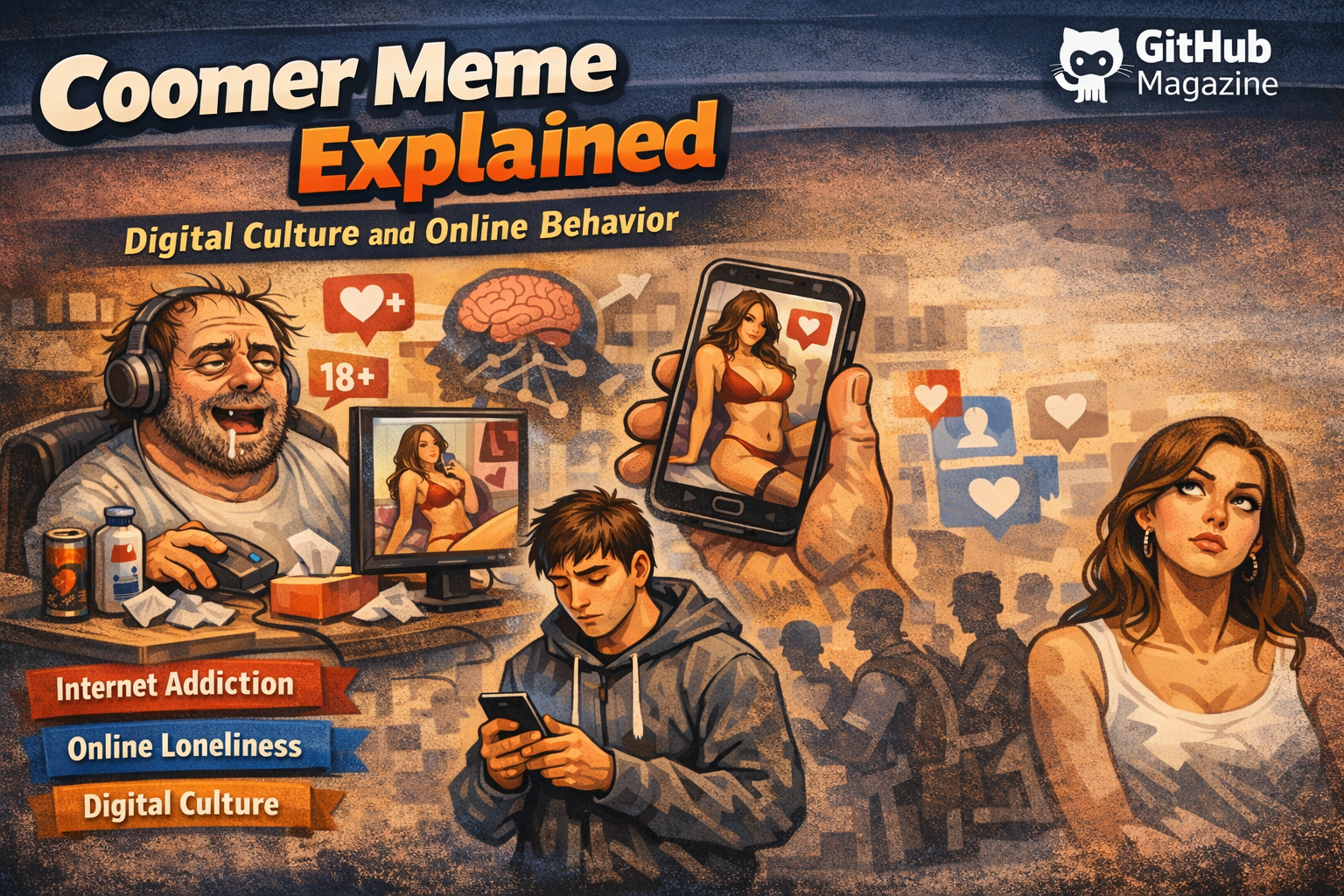
Coomer Meme Explained: Digital Culture and Online Behavior
The word coomer did not enter the world through a dictionary or a university lecture hall. It appeared instead in the messy, fast-moving underground of internet forums, drawn in crude lines, paired with exaggerated features, and shared as a joke that was meant to disappear within hours. Yet like many digital artifacts, it refused to stay small. Within a few years, coomer became a recognizable symbol across platforms, a shorthand for compulsive online behavior, and a meme that quietly documented how modern life is shaped by screens, stimulation, and repetition.
At its most literal level, coomer refers to a cartoonish character associated with excessive consumption of explicit online content. But in practice, the term quickly expanded. It came to describe broader cycles of digital overindulgence: endless scrolling, compulsive gaming, late-night streaming, and the restless search for instant gratification that defines much of contemporary internet use. In online conversations, it became both an insult and a confession, a label applied to others and sometimes to oneself.
This dual identity explains why the meme endured. Coomer functions simultaneously as comedy and criticism. It allows internet communities to laugh at unhealthy habits while also acknowledging how common those habits have become. In a culture where attention is constantly monetized and distraction is engineered into everyday tools, the figure of the coomer captures something uncomfortably familiar.
Understanding this meme is therefore not only about tracing an online joke. It is about understanding how language, humor, and digital identity adapt to technological environments that reward excess. In that sense, coomer is less a character than a cultural diagnosis, drawn in pixels instead of paragraphs.
Origins: From Wojak to a Digital Archetype
The visual foundation of coomer comes from the larger “Wojak” family of memes, a series of simple, human-like drawings used for years to represent emotional states and social stereotypes on internet forums. These figures were never polished. Their power lay in how little detail they used to express complex feelings: loneliness, anxiety, pride, resentment, or nostalgia.
In late 2018, users on anonymous message boards began circulating a new variation. The character had messy hair, red-rimmed eyes, and an exaggerated grin. Early versions appeared without explanation, but captions soon followed, describing a person trapped in repetitive cycles of online indulgence. The nickname “coomer” emerged as a slang adaptation rooted in internet vocabulary and the familiar “-oomer” suffix used for generational meme characters.
By 2019, the image had spread widely. It became particularly visible during online challenges such as “No Nut November,” where participants humorously used the coomer image to represent failure or temptation. What began as a niche visual joke developed into a recognizable archetype.
The meme’s simplicity allowed it to travel easily. It required no translation, no backstory, and no platform loyalty. Anyone familiar with internet humor could understand its meaning within seconds. That accessibility ensured its survival and transformation.
How the Meme Spread Across Platforms
The growth of coomer followed the familiar path of many internet symbols: anonymous boards to mainstream platforms, then into general digital vocabulary. Reddit threads dissected its meaning. Twitter users turned it into reaction images. Discord communities used it as shorthand in daily conversation.
What distinguished coomer from many short-lived memes was its adaptability. It did not rely on a single joke structure. Instead, it represented a behavior pattern. As digital habits changed, the meme changed with them.
| Phase | Platform Influence | Cultural Meaning |
|---|---|---|
| Early circulation | 4chan and imageboards | Satire of compulsive explicit content |
| Expansion | Reddit, Twitter, Discord | Symbol of overconsumption |
| Normalization | General internet slang | Commentary on digital habits |
| Reinterpretation | Meme communities | Self-irony and social critique |
Over time, the character was edited into new situations: gaming addiction, online shopping, cryptocurrency obsession, or endless social media scrolling. The original sexual context faded into the background for many users, replaced by a broader association with loss of control in digital environments.
This flexibility turned coomer into a living meme rather than a static joke.
From Crude Joke to Cultural Commentary
Although the meme originated in crude humor, its long-term relevance came from something more serious. It captured a widespread feeling: that technology makes it easier than ever to fall into habits that are difficult to stop.
Digital culture researchers often describe memes as informal sociology. They compress shared experiences into simple images. In that sense, coomer functions as an exaggerated portrait of modern overstimulation.
One digital culture researcher summarized the phenomenon clearly: “Memes like coomer are not created in isolation. They emerge when large groups recognize the same pattern in themselves and others, even if they express it through mockery.”
Psychologists studying online behavior have pointed out that compulsive digital habits are rarely about weakness alone. They involve reward systems, habit loops, and platforms designed to maximize engagement. The meme does not explain these mechanisms, but it gestures toward them.
Another behavioral health specialist noted that humor often becomes a coping strategy. By turning discomfort into a joke, communities can discuss sensitive issues without direct confrontation.
Still, the meme walks a narrow line between commentary and cruelty.
The Ethical Debate Around Labeling
Not everyone views coomer as harmless satire. Critics argue that it simplifies complex behavioral issues into a single insulting caricature. The term is frequently used against men, reinforcing gendered assumptions about self-control and sexuality.
Mental health professionals caution that repeated labeling can discourage people from seeking help. When behavior is reduced to a punchline, the human reality behind it becomes invisible.
At the same time, internet anthropologists counter that memes do not invent social problems. They reflect them. In this view, coomer is a symptom of digital life, not its cause.
The debate mirrors a larger tension in online culture: whether humor that exposes harmful patterns should be celebrated as honesty or criticized as stigma.
Both interpretations coexist, which is part of why the meme continues to provoke discussion years after its creation.
Coomer as a Symbol of Digital Overconsumption
As the meme matured, its meaning expanded far beyond its original context. Many online communities began applying the label to anyone trapped in cycles of constant stimulation, regardless of content type.
This shift reflected changing realities. Smartphones blurred the boundaries between work, leisure, and rest. Algorithms learned to deliver endless novelty. The result was a population increasingly aware of its own dependency on digital environments.
| Behavior Pattern | Platform Examples | Meme Interpretation |
|---|---|---|
| Endless scrolling | Social media feeds | Loss of time awareness |
| Compulsive gaming | Online multiplayer platforms | Escapism |
| Streaming binges | Video platforms | Emotional numbing |
| Online shopping loops | E-commerce apps | Dopamine-driven consumption |
Media theorists argue that language evolves to describe new experiences. Before smartphones, there was no need for a word that captured constant digital temptation. Memes filled that gap.
In this sense, coomer is part of a broader vocabulary that includes terms like “doomscrolling” and “digital burnout.” All point to the same phenomenon: technology reshaping attention.
Why the Meme Refuses to Disappear
Most internet jokes fade quickly. Coomer did not.
Its persistence lies in three factors: visual simplicity, emotional recognition, and adaptability. The drawing is easy to reproduce. The emotion it represents is familiar. The meaning evolves with technology.
Each new platform creates new forms of compulsive behavior, and the meme quietly absorbs them.
This durability suggests that the conditions which created the meme have not changed. If anything, they have intensified.
Takeaways
- Coomer originated as a variation of the Wojak meme on anonymous forums in 2018–2019.
- It evolved from a sexualized caricature into a symbol of broader digital overconsumption.
- The meme functions as both humor and social criticism.
- Critics argue it can stigmatize mental health struggles.
- Supporters see it as a mirror reflecting modern attention economics.
- Its survival shows how deeply technology shapes everyday habits.
Conclusion
The story of coomer is not really about a cartoon character. It is about how digital culture learns to describe itself.
What started as a crude sketch became a symbol for a generation navigating endless content, constant stimulation, and shrinking moments of silence. The meme endures because the behavior it represents endures. People recognize themselves in it, sometimes uncomfortably.
Whether viewed as satire or stigma, coomer reveals something essential about life online: that modern technology does not merely provide entertainment, it reshapes habits, expectations, and even language. In the rough lines of a low-effort drawing, internet communities recorded their unease with a world that never stops offering the next distraction.
That may be the quiet power of memes. They tell the story of an era, not in polished essays, but in symbols simple enough to travel anywhere.
FAQs
What does “coomer” mean?
It is internet slang describing a caricature of someone trapped in compulsive digital or sexual behavior.
Where did the term originate?
It appeared on anonymous imageboards around 2018 as a variation of the Wojak meme.
Is “coomer” a medical term?
No. It is a cultural and internet expression, not a clinical diagnosis.
Why do people still use the meme?
Because it adapts easily to new forms of digital overuse and remains relatable.
Is the term offensive?
It can be, depending on context, because it reduces complex behavior to a stereotype.