
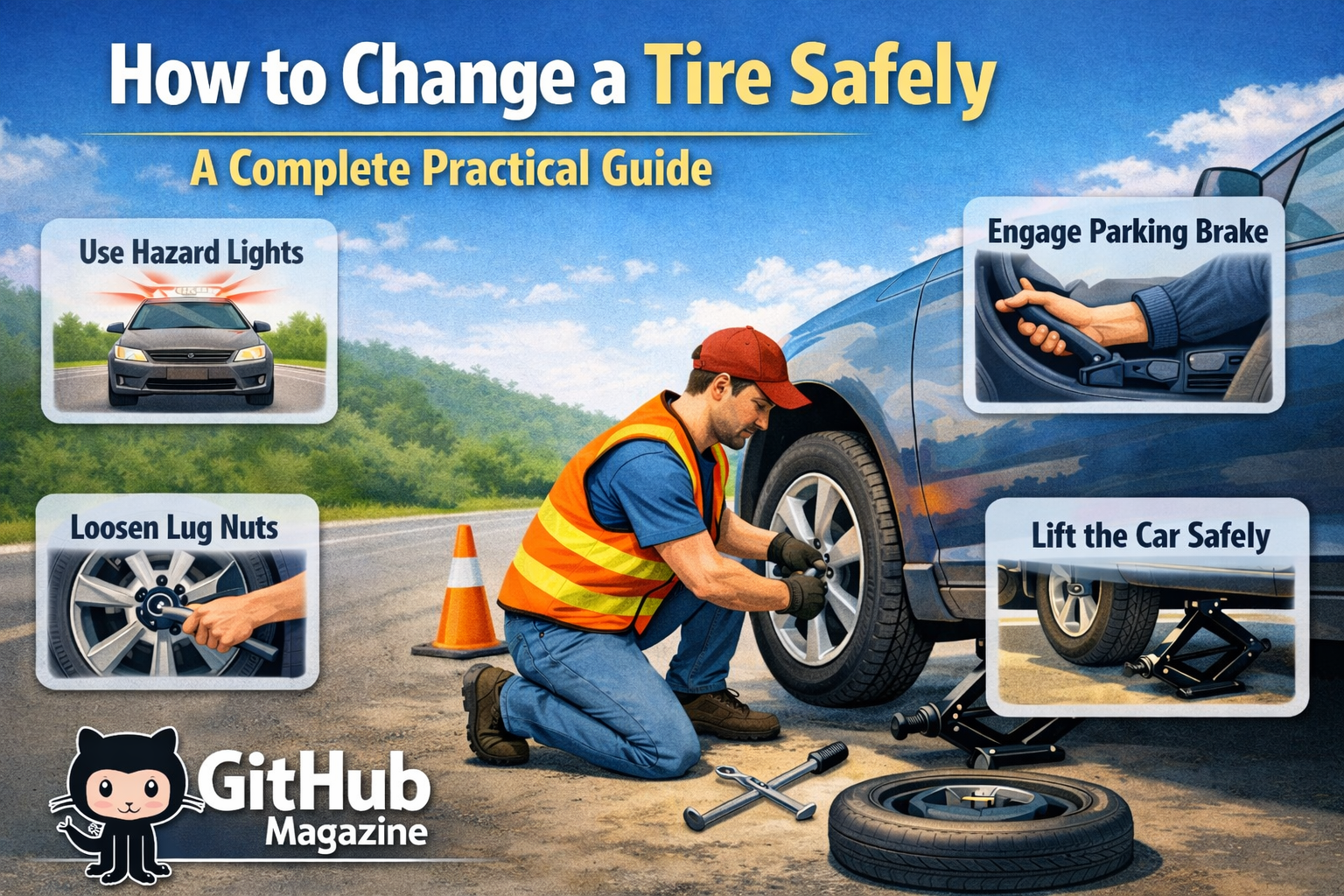
How to Change a Tire Safely: A Complete Practical Guide
A flat tire rarely arrives with drama. More often it announces itself quietly, a faint pull on the steering wheel, a rhythmic thump, the subtle sense that the road has shifted its texture beneath you. Within minutes, a routine drive becomes a logistical problem. How to change a tire is not an abstract question in that moment. It is immediate, physical, urgent.
The essential process is straightforward: pull over safely, secure the vehicle, loosen the lug nuts, lift the car with a jack, remove the damaged tire, mount the spare, tighten the nuts, lower the car, and drive carefully to a repair shop. That sequence, practiced calmly, restores mobility and prevents further damage.
But the search intent behind “how to change a tire” goes deeper than steps alone. Drivers want to know how to do it safely, how long it takes, what tools are required, where mistakes occur, and whether modern cars still make it possible at all. Many newer vehicles ship without full-size spares. Roadside traffic has grown faster and more distracted. Tires themselves have changed, with low-profile sidewalls, sensors, and run-flat technology reshaping what failure looks like.
This article treats tire changing not as a checklist but as a modern life skill: part mechanical literacy, part risk management, part quiet confidence. It draws from real automotive practice, safety research, and roadside experience to explain not only what to do, but why each step matters. The goal is not bravado, but competence. When the road interrupts your plans, the knowledge to continue becomes a form of freedom.
Understanding Why Tires Fail
Tires are engineered compromises: rubber compounds balancing grip and durability, steel belts layered for strength, air pressure providing both structure and cushioning. Over time, that balance degrades.
Most flats result from punctures, nails, screws, shards of metal, broken glass. Others come from sidewall damage after hitting potholes or curbs, slow leaks from corroded valve stems, or internal belt separation caused by age and heat cycles. According to automotive safety research, tire rubber begins to harden measurably after five to six years, even if tread remains adequate.
Modern vehicles also rely on tire pressure monitoring systems, mandated in the United States since 2007. These sensors alert drivers earlier than human perception alone, but they do not prevent failure. They only announce it.
Understanding this context matters because it reframes a flat tire as normal wear, not personal failure. Tires are consumable components. Changing one is maintenance, not crisis management.
Where to Stop and Why It Matters
The most dangerous part of changing a tire is not the wrench or the jack. It is traffic.
High-speed roads transform minor mechanical tasks into high-risk behavior. Safety agencies consistently report that roadside fatalities often involve disabled vehicles struck by passing cars whose drivers never saw the hazard in time.
The correct response is deliberate: pull over as far from traffic as possible, choose flat solid ground, avoid curves and narrow shoulders, turn on hazard lights immediately, engage the parking brake, and place wheel chocks or heavy stones behind the opposite wheels.
On highways, many experts recommend exiting completely if the tire still holds minimal pressure. Destroying a rim is cheaper than risking your life.
Changing a tire should never begin until the environment is controlled.
Tools Every Driver Should Know
Most vehicles equipped with a spare include three essentials: a jack designed for the vehicle’s weight and frame geometry, a lug wrench, and a spare tire.
Additional items improve safety and speed: reflective vest, flashlight or headlamp, gloves, wheel wedges, rain poncho, kneeling mat, and tire pressure gauge.
Many drivers discover too late that their spare is underinflated or missing entirely. Experts recommend checking spare tire pressure every three months.
A tool you do not verify is a tool you do not truly have.
The Mechanical Sequence Explained
Changing a tire is simple but unforgiving of skipped steps.
Remove the hubcap if present. Loosen the lug nuts slightly while the tire is still touching the ground. Do not remove them completely. The car’s weight prevents the wheel from spinning.
Position the jack at the manufacturer-specified jacking point. Improper placement can bend body panels or collapse the jack.
Raise the car until the tire clears the ground. Remove the lug nuts fully and pull the tire straight toward you.
Mount the spare tire by aligning it with the wheel studs. Hand-tighten the lug nuts.
Lower the car until the tire touches the ground and tighten the nuts firmly in a star pattern.
Fully lower the car, perform a final tightening, stow tools, and drive slowly. Recheck tightness after 50–100 kilometers.
Precision matters more than strength. Over-tightening can warp brake rotors. Under-tightening can cause wheel separation.
Temporary Spares and Their Limits
Many modern vehicles provide narrow temporary spare tires designed only for short distances.
Typical limits are 80 km/h maximum speed and 80 to 120 kilometers of driving range.
They handle poorly in rain, offer reduced braking, and stress differentials in all-wheel-drive vehicles.
A spare is a bridge, not a solution.
Roadside Risk in the Age of Distraction
Traffic safety data over the past decade shows a sharp rise in collisions involving stationary vehicles. Smartphones and in-car screens reduce reaction times.
Legal scholars studying roadway liability note that disabled vehicles create unpredictable hazards, sudden braking, lane changes, and visibility conflicts.
If traffic is heavy, weather is severe, or visibility is low, calling roadside assistance is often the safer choice. Pride is not a safety strategy.
Expert Perspectives
“Before you ever need to change a tire, pressure and tread inspections should already be routine,” says Ronit Tehrani, a senior instructor at a North American driving safety institute. “Most failures give warning signs weeks in advance.”
AAA safety analysts emphasize location over speed. “The decision of where to stop determines most outcomes. Mechanical skill cannot compensate for unsafe positioning.”
Automotive engineer Marcus Feldman notes, “Improper jack placement is the most common cause of secondary vehicle damage during tire changes. People rush. The frame does not forgive mistakes.”
These are not dramatic insights. They are boring ones. And boring, in roadside safety, is excellence.
Comparison Table: Spare Tire Types
| Feature | Full-Size Spare | Temporary Spare |
|---|---|---|
| Speed limit | Normal driving | 80 km/h |
| Distance | Unlimited | 80–120 km |
| Handling | Normal | Reduced |
| Storage space | Large | Compact |
| Cost | Higher | Lower |
| AWD compatibility | Yes | Sometimes limited |
Timeline of a Safe Tire Change
| Phase | Typical Duration | Key Risk |
|---|---|---|
| Pulling over | 1–3 minutes | Traffic proximity |
| Securing vehicle | 1 minute | Vehicle roll |
| Tool preparation | 2 minutes | Visibility |
| Loosening nuts | 2 minutes | Slipping wrench |
| Jacking vehicle | 1–2 minutes | Jack instability |
| Swapping tire | 3–5 minutes | Hand injuries |
| Final tightening | 2 minutes | Under-torque |
| Cleanup | 2 minutes | Leaving tools |
Average total time: 15–20 minutes under calm conditions.
Psychology of the Breakdown
Stranding triggers a mild stress response: elevated heart rate, narrowed attention, impaired fine motor skills.
That is why mistakes happen. Drivers forget to set the parking brake, place the jack on gravel, drop lug nuts into roadside grass, or rush.
Training reduces this effect. Even reading a detailed explanation builds mental rehearsal.
Confidence is not bravado. It is familiarity.
Modern Vehicles and Changing Design
Electric vehicles introduce heavier frames, battery-mounted underbodies, and often no spare tire at all. Some rely entirely on sealant kits or service subscriptions.
Run-flat tires allow limited driving after puncture but cost more and reduce ride comfort.
As design evolves, tire changing becomes less universal but more valuable.
Legal and Insurance Context
In many regions, drivers are legally required to remove disabled vehicles from traffic lanes if physically possible.
Insurance providers may reduce claims if negligence worsens damage.
Photographing the scene protects against later disputes.
Practical knowledge intersects quietly with law.
Takeaways
- Choose safety over speed when pulling over
- Secure the vehicle before touching tools
- Loosen lug nuts before lifting the car
- Use manufacturer-approved jack points only
- Temporary spares are short-term solutions
- Visibility saves lives
- Practice mentally before emergencies
Conclusion
Changing a tire sits at the intersection of technology and human judgment. It is mechanical, but also situational. It demands awareness, patience, and restraint more than strength.
The skill endures not because vehicles are unreliable, but because the road remains unpredictable. Construction debris falls. Nails scatter. Heat weakens rubber. Pressure drops quietly overnight.
What distinguishes inconvenience from disaster is not the flat itself, but the response.
To know how to change a tire is to carry a small measure of independence. It is to refuse helplessness without courting danger. It is to understand that modern mobility still depends on calm thinking beside moving traffic.
In an era of automation, this remains a stubbornly human skill.
FAQs
How long does it take to change a tire?
Typically 15–20 minutes under safe conditions.
Is it safe to change a tire on the highway shoulder?
Only if traffic is light and visibility is good. Otherwise, roadside assistance is safer.
Can I drive normally on a temporary spare?
No. Speed and distance are limited.
Do electric cars have spare tires?
Many do not. Check your vehicle documentation.
Should lug nuts be rechecked later?
Yes. After 50–100 kilometers.

Related Posts

Koalas Habitat History and Conservation Review

Scrub Cap Guide: Purpose, Types, and Evolution