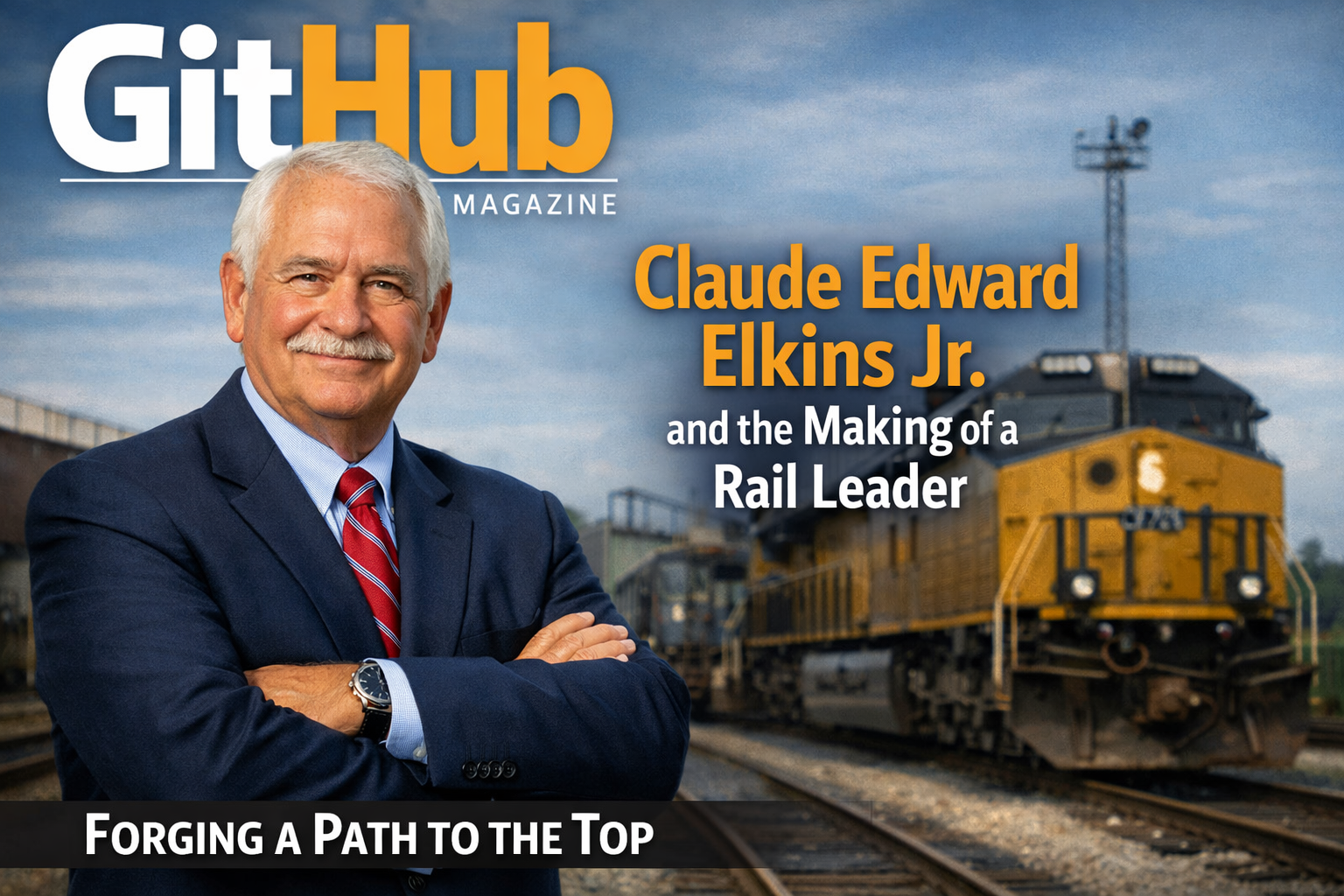
Claude Edward Elkins Jr and the Making of a Rail Leader
Within the first hundred words of any account of Claude Edward Elkins Jr, one fact tends to matter most: he began at the bottom. In 1988, Elkins joined Norfolk Southern as a road brakeman, learning the railroad from ballast level upward. That beginning, physical and exacting, would come to define a career that eventually carried him to Executive Vice President and Chief Commercial Officer, responsible for the company’s commercial engine across intermodal, industrial, and automotive markets. The arc from rail yard to boardroom is not unusual in American lore, but it is rare in contemporary corporate leadership, and rarer still in industries as operationally complex as freight rail.
Elkins’ ascent unfolded over more than three decades, spanning operational roles, customer-facing commercial work, and senior executive leadership. Along the way, he absorbed the rhythms of railroading: the choreography of crews, the economics of carloads, the patience required by infrastructure measured in decades rather than quarters. His career reflects a leadership philosophy grounded in experience rather than abstraction, shaped by early military service, long exposure to frontline labor, and sustained engagement with customers whose businesses depend on predictable, efficient transportation.
As railroads confront the pressures of globalization, sustainability, and supply-chain volatility, Elkins’ story offers a lens into how legacy industries adapt without abandoning their core strengths. It is a narrative about continuity and change, about learning an industry from the inside out, and about the enduring value of leaders who understand the work before they seek to direct it.
Early Life and Foundations of Discipline
Claude Edward Elkins Jr. grew up with an ethic of responsibility that would later surface in his professional life. Raised in Southwest Virginia, he encountered early the cultural importance of steady work and community accountability. These formative influences were reinforced through his service in the United States Marine Corps, an experience that introduced him to structured leadership, logistical coordination, and decision-making under pressure.
Military service did not simply precede Elkins’ civilian career; it informed it. The Marines’ emphasis on preparation, teamwork, and respect for systems larger than oneself translated naturally to railroading, where safety, coordination, and reliability are paramount. Logistics, after all, sits at the heart of both enterprises. Moving people and equipment efficiently, anticipating failure points, and maintaining discipline across large, distributed operations are shared challenges.
When Elkins entered the railroad industry, he did so without shortcuts. Beginning as a brakeman meant long hours, physical labor, and strict adherence to safety protocols. It also meant proximity to the work that keeps freight moving: coupling cars, communicating with engineers, understanding yards and mainlines not as diagrams but as lived environments. This early immersion laid a foundation of credibility that would follow him into management and executive roles, shaping how he listened to employees and evaluated operational realities.
Learning the Railroad from the Ground Up
Elkins’ early years at Norfolk Southern were defined by progression through core operating roles. After working as a brakeman, he advanced to conductor and locomotive engineer, positions that demanded technical proficiency, situational awareness, and accountability for crew safety. Each role added layers of understanding about how decisions made in offices translated into consequences on the ground.
These operational years were not merely a prelude to management; they were an education in systems thinking. Railroads are among the most complex industrial networks in the United States, integrating infrastructure, labor, regulation, and customer demand. Elkins’ firsthand experience with these systems fostered an appreciation for constraints that cannot be solved by policy alone. Weather, terrain, mechanical wear, and human factors all play roles that resist simplification.
This grounding would later inform his approach to leadership. Colleagues have noted that Elkins tends to ask how strategies will work in practice, not just how they appear on paper. His credibility with frontline employees stemmed from shared experience, enabling dialogue across organizational levels. In an industry where trust and safety culture are inseparable, such credibility is not cosmetic; it is operationally essential.
Transition to Commercial and Marketing Roles
After years in operations, Elkins moved into intermodal marketing, marking a significant shift from train crews to customers. Intermodal freight sits at the intersection of rail, trucking, and maritime transport, requiring coordination across modes and sensitivity to customer supply chains. The role demanded not only technical understanding but also communication skills and market insight.
Over roughly two decades in intermodal and commercial positions, Elkins developed a deep familiarity with how shippers evaluate transportation options. Reliability, cost, transit time, and flexibility all factor into decisions that can reshape freight flows across regions. His operational background allowed him to speak credibly about service capabilities, while his marketing responsibilities required translating those capabilities into customer value.
This period coincided with major changes in global logistics, including the rise of containerization, e-commerce growth, and increasing emphasis on supply-chain resilience. Elkins’ work placed him at the center of these shifts, negotiating between the railroad’s physical constraints and customers’ evolving expectations. The experience honed his ability to balance long-term infrastructure planning with near-term commercial demands, a balance that would define his later executive roles.
Advancing Through Senior Leadership
By the mid-2010s, Elkins’ career entered a phase of accelerated leadership responsibility. In 2016, he became Vice President of Chemicals Marketing, overseeing a sector with stringent safety requirements and complex regulatory oversight. Two years later, he advanced to Vice President of Industrial Products, taking charge of metals, construction materials, forest products, and other core freight categories.
These roles expanded his purview beyond intermodal into the industrial backbone of the U.S. economy. They required strategic coordination with manufacturing customers, attention to cyclical demand, and collaboration with operations to ensure service consistency. The positions also exposed him to broader economic indicators, from housing starts to energy markets, reinforcing the railroad’s role as both a transportation provider and an economic barometer.
In December 2021, Elkins was appointed Executive Vice President and Chief Commercial Officer. In this role, he assumed responsibility for the company’s commercial strategy across multiple business lines. The appointment represented not a departure from his earlier career, but its culmination: operational insight, customer engagement, and strategic leadership converging in a single portfolio.
Leadership Philosophy and Management Style
Elkins’ leadership philosophy emphasizes listening, continuity, and respect for institutional knowledge. Having spent decades within the same organization, he understands both its strengths and its vulnerabilities. Rather than imposing abrupt change, his approach tends toward incremental improvement informed by data and experience.
Colleagues describe him as approachable and measured, a leader who values dialogue across hierarchies. This style reflects his belief that effective strategy emerges from understanding how policies affect daily work. In safety-critical industries, such attentiveness can have tangible consequences, influencing not only morale but also operational performance.
Education also plays a role in Elkins’ leadership. Holding a degree in English from the University of Virginia’s College at Wise, he brings a communication-centered sensibility to strategy. Clarity, narrative coherence, and persuasion matter in aligning large organizations, particularly during periods of change. His ability to articulate goals in accessible language has been cited as a strength in engaging both employees and customers.
Career Progression Overview
| Year | Role | Focus |
|---|---|---|
| 1988 | Road Brakeman | Frontline rail operations and safety |
| 1990s | Conductor / Engineer | Train handling and crew leadership |
| 2000s | Intermodal Marketing | Customer engagement and supply-chain strategy |
| 2016 | VP, Chemicals Marketing | Industrial freight and regulatory coordination |
| 2018 | VP, Industrial Products | Core manufacturing and materials markets |
| 2021 | EVP & Chief Commercial Officer | Company-wide commercial strategy |
The Broader Industry Context
Elkins’ career unfolded alongside significant transformation in the freight rail industry. Consolidation reduced the number of major railroads, while technological advances improved efficiency and visibility. At the same time, public scrutiny intensified around safety, labor relations, and environmental impact.
As Chief Commercial Officer, Elkins has been positioned at the intersection of these debates. Commercial strategy increasingly involves sustainability considerations, as rail competes with trucking on emissions efficiency. Railroads move a ton of freight with significantly lower greenhouse gas emissions per mile than trucks, a fact that has become central to customer discussions.
The industry also faces labor challenges, balancing efficiency initiatives with workforce expectations. Leaders with operational backgrounds, like Elkins, are often better equipped to navigate these tensions, understanding how policy decisions resonate with crews. His career thus illustrates how leadership profiles matter as much as strategies in shaping organizational outcomes.
Rail Industry Metrics and Impact
| Dimension | Illustration |
|---|---|
| Freight Volume | Millions of carloads annually across eastern U.S. |
| Intermodal Reach | Extensive network linking ports, hubs, and markets |
| Environmental Efficiency | Lower emissions per ton-mile than highway transport |
| Economic Role | Backbone for manufacturing and agriculture |
Engagement Beyond the Corporation
Beyond Norfolk Southern, Elkins has participated in broader industry and community initiatives. Serving on business councils and civic organizations, he has contributed to discussions on economic development, workforce readiness, and infrastructure investment. Such involvement reflects a view of corporate leadership that extends into public life.
This external engagement also reinforces the railroad’s role as a public-facing institution. Railroads shape communities through infrastructure placement, employment, and environmental footprint. Leaders who engage with stakeholders outside the company help mediate these relationships, aligning corporate objectives with regional development goals.
Elkins’ participation in industry forums further underscores a commitment to shared learning. Freight transportation operates within a complex ecosystem of shippers, regulators, and competitors. Knowledge exchange across this ecosystem can improve safety standards, operational efficiency, and public trust.
Expert Perspectives on His Leadership
Industry analysts often highlight Elkins’ blend of operational depth and commercial acumen. One logistics analyst has noted that leaders who understand both the mechanics of railroading and the economics of shipping are better positioned to craft realistic strategies. Another observer emphasizes his role in positioning rail as a sustainable alternative within modern supply chains.
A business culture expert points to Elkins’ communication style as a differentiator, arguing that clear articulation of strategy reduces friction during change. These perspectives converge on a central theme: credibility matters. In industries built on physical systems and long time horizons, trust is earned through experience and consistency.
Takeaways
- A career beginning in frontline operations can shape durable executive leadership.
- Operational credibility strengthens communication across organizational levels.
- Commercial strategy in rail increasingly intersects with sustainability goals.
- Incremental, experience-based change can be more effective than abrupt shifts.
- Engagement beyond the corporation enhances industry and community alignment.
Conclusion
Claude Edward Elkins Jr.’s professional journey offers a case study in continuity within change. His rise from brakeman to chief commercial officer underscores the enduring value of learning an industry from the inside out. At a time when many organizations seek leaders from outside their ranks, his career suggests that deep institutional knowledge can coexist with adaptability and innovation.
As freight rail continues to evolve under economic, technological, and environmental pressures, leaders like Elkins illustrate how experience can inform strategy without constraining it. His story is not simply about personal advancement, but about stewardship of a system that underpins much of the American economy. In that sense, his career reflects a broader truth: industries endure when their leaders understand both where they have been and where they are going.
FAQs
Who is Claude Edward Elkins Jr.?
He is an American railroad executive who rose from operational roles to become Executive Vice President and Chief Commercial Officer at Norfolk Southern.
Why is his career notable?
His progression from frontline rail work to senior leadership exemplifies experience-based advancement in a complex industry.
What shaped his leadership style?
Military service, decades of rail operations, and extensive customer-facing roles shaped his disciplined, communicative approach.
What areas does he oversee?
His responsibilities have included intermodal, industrial products, chemicals, and broader commercial strategy.
What broader impact does his work have?
His leadership influences how freight rail addresses efficiency, sustainability, and long-term economic support.