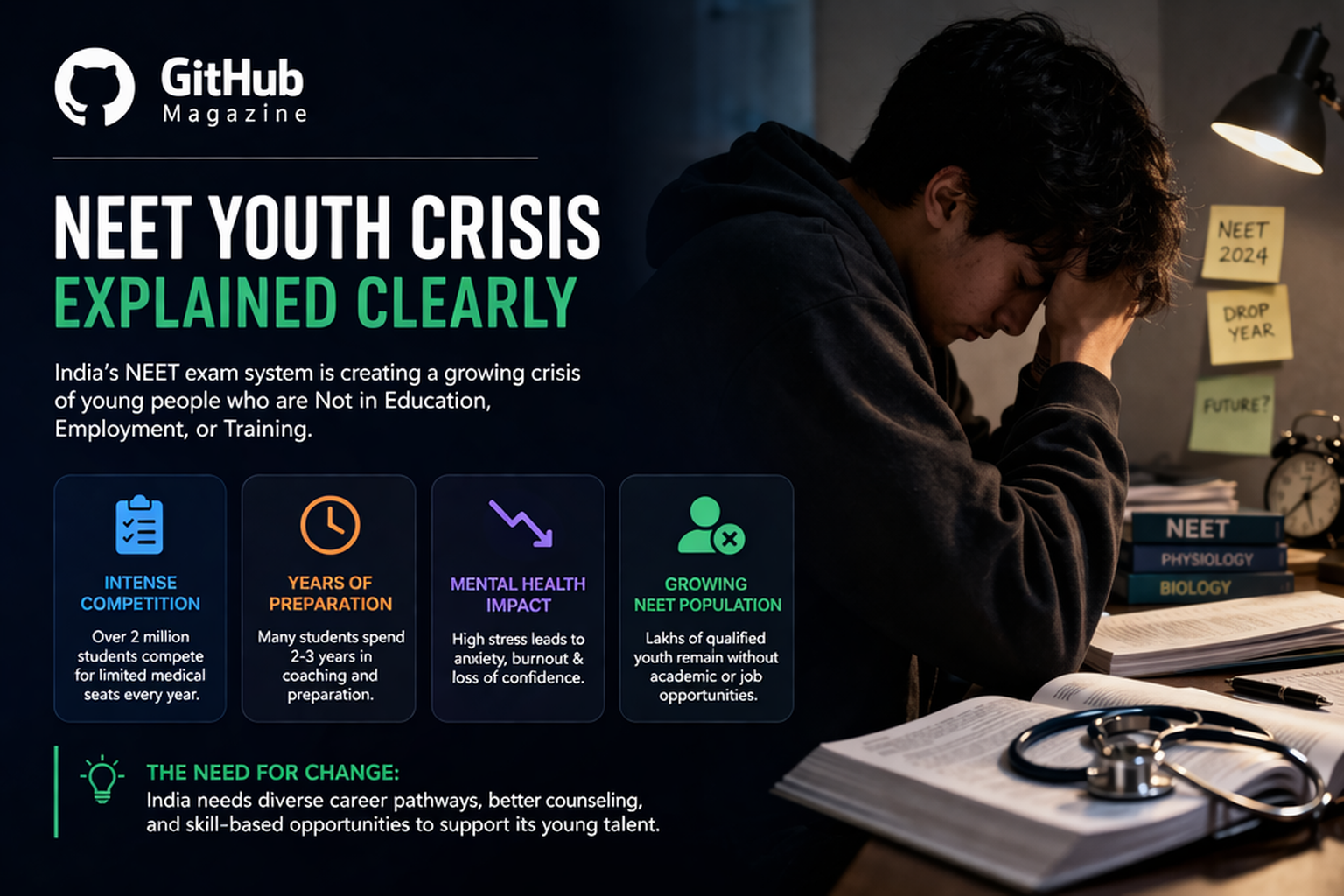
NEET Youth Crisis Explained Clearly
I open with a reality that is difficult to ignore: millions of young people today are neither studying, working, nor training, a condition that has come to be known as NEET. The term may sound clinical, but it represents a deeply human crisis. It signals stalled ambitions, fractured pathways, and a growing disconnect between young people and the systems meant to support them.
Within the first few moments of understanding, the meaning becomes clear. NEET refers to individuals, usually between the ages of 15 and 29, who are not engaged in education, employment, or training. This category matters because it highlights a group that traditional labor statistics often overlook. These are not just unemployed youth; many are entirely disengaged, invisible within official systems.
I have observed that the rise of NEET youth reflects deeper systemic problems. It is not simply about job scarcity or educational access. It is about misalignment between institutions and lived realities. From economic shocks to cultural expectations, multiple forces converge to push young people toward disengagement.
Across regions, the patterns vary but the consequences converge. A generation that struggles to find its footing risks carrying that instability into adulthood. The NEET phenomenon is not just a statistic. It is a warning sign, quietly reshaping the future of societies.
Understanding the Meaning and Origins of NEET
I trace the origins of the term NEET to the United Kingdom in the late 1990s, where policymakers sought a clearer way to identify young people disconnected from both education and employment. Over time, the concept expanded globally and became a central metric used by international organizations to assess youth vulnerability.
What distinguishes NEET from unemployment is its broader scope. It includes those who are not actively seeking work, whether due to discouragement, caregiving responsibilities, or structural barriers. This makes the category both comprehensive and complex.
The significance of NEET lies in its ability to reveal hidden exclusion. A young person who has stopped applying for jobs may not appear in unemployment statistics, yet remains economically and socially marginalized. Similarly, individuals constrained by cultural or familial expectations may be excluded without recognition.
I see NEET as more than a classification. It represents a shift in how societies evaluate participation and opportunity. It forces a deeper look at inclusion, beyond traditional measures of economic activity, and challenges institutions to account for those who fall through the cracks.
The Global Scale of the Crisis
I find the scale of the NEET issue both striking and sobering. Across the world, a significant portion of young people are disengaged, with some regions experiencing particularly high rates due to structural and cultural challenges.
Global NEET Rates Snapshot
| Region | Estimated NEET Rate (%) | Key Challenge |
|---|---|---|
| Europe | 12–15% | Economic stagnation after crises |
| South Asia | 25–30% | Gender barriers and limited access |
| Middle East | 20–25% | Political instability and youth surge |
| Sub-Saharan Africa | 20–28% | Informal economies and weak systems |
| OECD Average | ~14% | Skill mismatch and structural gaps |
In South Asia, I notice a pronounced gender disparity, where young women are disproportionately represented among NEET populations. Social norms and safety concerns often restrict their access to education and employment. In contrast, developed economies struggle more with transitions from education to stable employment.
An expert once noted that high NEET rates often reflect deeper inefficiencies within economies, pointing to issues that extend beyond youth alone. I find this perspective compelling because it shifts the focus from individuals to systems, highlighting the need for structural reform.
The global dimension of NEET underscores its urgency. It is not confined to any one region or economy. It is a shared challenge, shaped by local contexts but united by common patterns of exclusion.
Economic Roots and Structural Barriers
When I examine the causes of NEET, I see a complex network of economic and institutional factors. Economic downturns often act as catalysts, as seen during the global financial crisis and the COVID-19 pandemic, both of which disrupted youth employment significantly.
However, the deeper issue lies in structural mismatches. Education systems frequently fail to equip students with skills aligned to labor market demands. As a result, graduates may struggle to find relevant employment, leading to frustration and eventual disengagement.
Another factor is the rise of precarious work. Temporary contracts and gig-based roles offer limited stability, making it difficult for young people to build sustainable careers. Over time, repeated instability can lead to withdrawal from the labor market altogether.
Mental health also emerges as a critical dimension. Increasing levels of anxiety and depression among young people can hinder participation in both education and employment. This creates a cycle where disengagement exacerbates psychological distress, further reducing the likelihood of re-entry.
I see these barriers not as isolated issues but as interconnected forces. Addressing them requires coordinated efforts across education, employment, and health systems.
Social Dimensions and Hidden Inequalities
I have come to understand that NEET is deeply intertwined with social inequality. Factors such as gender, geography, and socioeconomic background significantly influence who becomes disengaged.
In many societies, young women face restrictions that limit their participation in education and work. Even when opportunities exist, cultural expectations and safety concerns can act as barriers. This results in a disproportionate representation of women within NEET populations.
Rural communities face their own challenges. Limited access to quality education and employment opportunities often forces young people into inactivity or migration. Those who remain may lack the resources to transition into productive roles.
An expert once emphasized that NEET status is both a cause and consequence of social exclusion. I find this insight particularly powerful because it highlights the cyclical nature of the issue. Disengagement leads to exclusion, which in turn reinforces disengagement.
The social implications extend beyond individuals. Communities with high NEET rates often experience reduced cohesion, increased inequality, and limited economic mobility.
Long-Term Consequences for Individuals and Economies
I see the long-term consequences of NEET status as one of its most concerning aspects. Disengagement during youth can have lasting effects on income, health, and social mobility.
Long-Term Impacts of NEET Status
| Impact Area | Consequence | Duration |
|---|---|---|
| Income | Reduced lifetime earnings | Long-term |
| Employment | Repeated job instability | Persistent |
| Health | Increased mental health challenges | Ongoing |
| Social Mobility | Limited upward movement | Intergenerational |
| Civic Engagement | Lower participation in society | Continuing |
The concept of “scarring” captures these effects. Once a young person becomes disconnected, the gap in experience can make re-entry into the workforce increasingly difficult. Employers may interpret periods of inactivity negatively, further limiting opportunities.
From an economic perspective, the cost is substantial. Lost productivity, increased social support needs, and reduced economic participation all contribute to long-term economic strain.
I find it clear that the impact of NEET extends far beyond the individual. It shapes the trajectory of entire economies.
Policy Responses and Global Initiatives
I observe that governments and organizations are increasingly recognizing the urgency of addressing NEET. Various policy responses have emerged, focusing on education, employment, and social support.
Programs such as youth employment guarantees aim to provide timely opportunities for young people who are disengaged. These initiatives seek to ensure that individuals receive offers of work, education, or training within a defined period.
In developing regions, skill development and entrepreneurship programs play a crucial role. Digital training and microfinance initiatives offer pathways for young people to engage with emerging economic opportunities.
An expert perspective suggests that successful programs combine multiple elements, including training, job placement, and support services. I find this integrated approach particularly effective because it addresses the multifaceted nature of disengagement.
Despite these efforts, challenges remain. Implementation gaps, funding limitations, and systemic barriers continue to hinder progress. Sustained commitment and innovation are essential.
Technology, Automation, and the Future of Work
I reflect on how technology is reshaping the landscape of youth engagement. Automation and artificial intelligence are transforming labor markets, creating both opportunities and risks.
Digital platforms offer new avenues for participation. Online education, remote work, and freelance opportunities can provide alternatives for those who struggle within traditional systems. These pathways have the potential to reduce barriers and expand access.
At the same time, automation threatens to eliminate entry-level jobs that serve as stepping stones for young people. This raises concerns about future exclusion, particularly for those with limited skills.
An expert insight highlights that the future of work will demand higher levels of skill, placing low-skilled youth at greater risk. I see this as a critical challenge that requires proactive investment in education and training.
Balancing technological advancement with inclusion will be key to shaping a more equitable future.
Cultural Narratives and the Psychology of Disengagement
I recognize that NEET is not solely an economic condition but also a psychological experience. Disengagement often comes with feelings of isolation, failure, and uncertainty.
Cultural expectations can intensify these experiences. In societies that emphasize success through education and employment, those who fall outside these pathways may internalize stigma.
Social media further complicates this dynamic. Constant exposure to curated success stories can amplify feelings of inadequacy, leading some young people to withdraw rather than engage.
Psychological research emphasizes the importance of identity and purpose. Without clear pathways, young people may struggle to envision a future for themselves. Rebuilding engagement requires not only opportunities but also a sense of belonging.
I see this dimension as crucial. Addressing NEET is not just about creating jobs or educational programs. It is about restoring confidence and connection.
Takeaways
- NEET represents youth disengagement from education, employment, and training systems
- The issue affects millions globally with significant regional and gender disparities
- Structural mismatches between education and labor markets are central causes
- Long-term consequences include reduced earnings and limited social mobility
- Effective solutions require integrated policy approaches and sustained commitment
- Technology presents both risks and opportunities for youth engagement
Conclusion
I conclude with a reflection on the broader significance of the NEET phenomenon. It is not merely a statistical category but a reflection of systemic gaps within societies. It reveals where institutions fail to meet the needs of young people and where opportunities remain unevenly distributed.
What stands out to me is the human dimension. Behind every number is a story of potential interrupted, of pathways not taken, of futures uncertain. These stories deserve attention, not just as data points but as lived experiences.
Addressing NEET requires a shift in perspective. It calls for policies that are inclusive, adaptive, and responsive to changing realities. It demands collaboration across sectors and a commitment to long-term solutions.
The challenge is significant, but so is the opportunity. By investing in young people and creating pathways for engagement, societies can transform a crisis into a catalyst for growth and inclusion.
FAQs
What does NEET mean?
NEET stands for Not in Education, Employment, or Training. It refers to young people who are disengaged from both education systems and the labor market.
Why is NEET a concern?
It signals systemic issues such as skill mismatches, inequality, and economic inefficiencies, with long-term impacts on individuals and societies.
Who is most affected by NEET?
Young people from disadvantaged backgrounds, particularly women in certain regions and those in rural areas, are more likely to be affected.
Can NEET rates be reduced?
Yes, through integrated policies including education reform, vocational training, and employment support programs.
Does technology help or worsen NEET?
It can do both. Technology creates new opportunities but also risks excluding those without necessary skills.

Related Posts

Rowdy Oxford Lawsuit Explained

Stevens Disposal and Waste Management Systems