
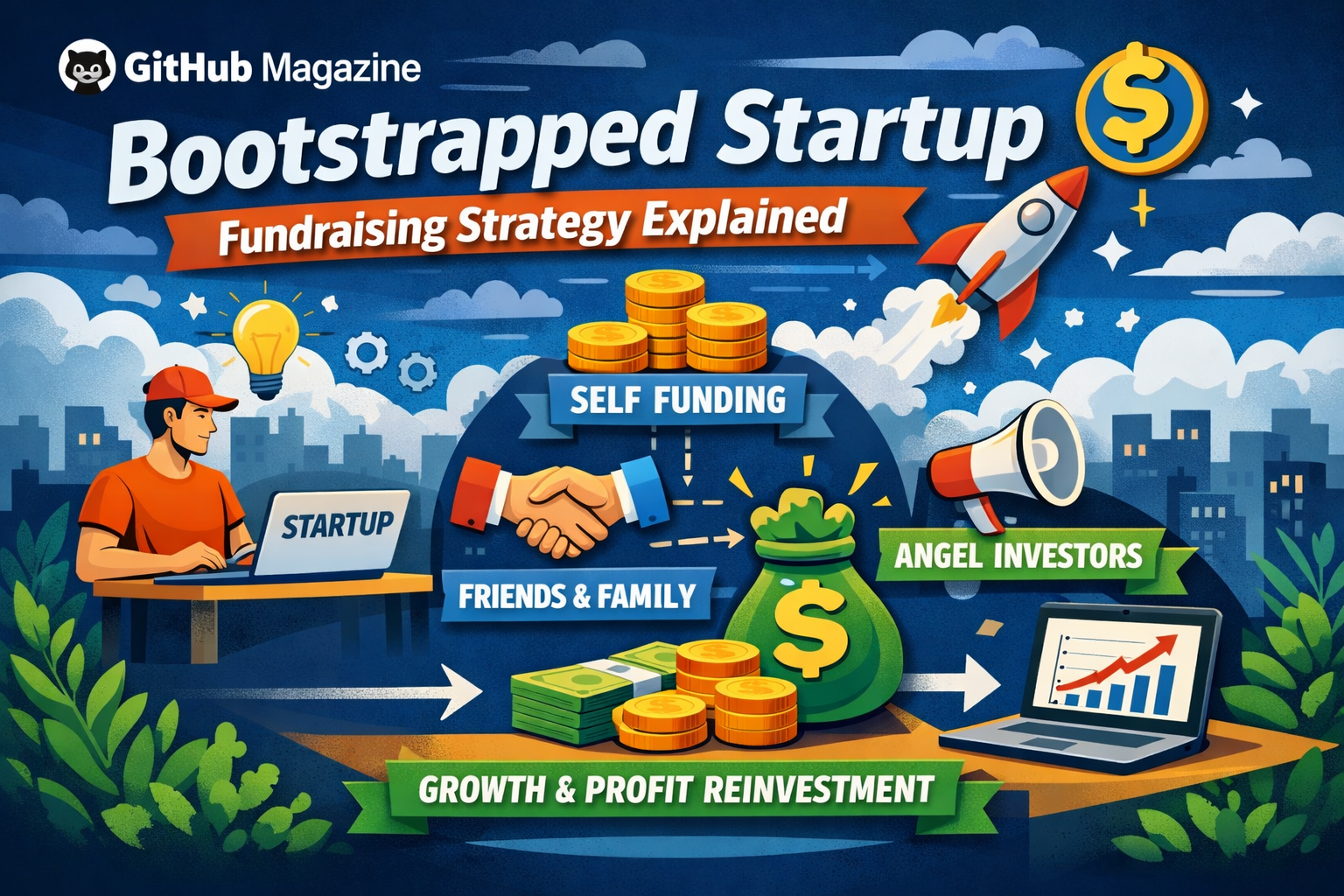
Bootstrapped Startup Fundraising Strategy Explained
I have seen the startup world evolve from an era obsessed with rapid fundraising to one that increasingly values disciplined building. The booted fundraising strategy answers a central question founders are asking today: can you build a successful company without relying on early external capital? The answer, increasingly, is yes. Many startups now prioritize revenue generation, product validation, and customer traction before ever approaching investors.
This approach flips the conventional model. Instead of raising money to build a product, founders build the product first and use real performance data to justify funding later. In doing so, they gain stronger negotiating power, retain more ownership, and develop businesses grounded in real demand rather than projections.
This shift is not happening in isolation. Market conditions, investor expectations, and founder mindsets have all changed. Capital is no longer as abundant as it once was, and investors now demand efficiency alongside ambition. As a result, founders are choosing to delay fundraising, focusing instead on proving their business works.
The implications extend beyond finance. This model reshapes how startups grow, how risk is managed, and how success is defined. It signals a broader transformation in entrepreneurship, one that values sustainability as much as speed.
The Origins of the Booted Fundraising Mindset
The philosophy behind building before raising capital has long existed, though it was often overshadowed by venture-backed success stories. Companies like Mailchimp and Basecamp demonstrated early on that it was possible to scale profitable businesses without external funding. They built slowly, focused on customers, and maintained control over their operations.
What distinguishes the current moment is how widely this mindset has spread. During the previous decade, venture capital was abundant, encouraging founders to prioritize rapid scaling over profitability. The correction that followed forced a reevaluation. Founders began to recognize the risks of over-reliance on funding and the advantages of building sustainable models.
The shift also reflects a deeper understanding of leverage. When founders bootstrap, they enter fundraising discussions from a position of strength. They are no longer selling potential alone but demonstrating actual results. This changes the nature of investor relationships and the structure of deals.
At its core, the booted fundraising mindset is about timing and control. It acknowledges that capital is a tool, not a starting point, and that its value depends on when and how it is used.
Why Founders Are Delaying Fundraising
I believe one of the most compelling reasons founders delay fundraising is simple: leverage improves with progress. When a startup generates revenue, even at a modest level, it signals product-market fit in a tangible way. Investors respond differently to evidence than to ideas.
Delaying funding allows founders to avoid early dilution, maintain control over decision-making, and negotiate from a stronger position. It also provides clarity. Founders who bootstrap must understand their customers deeply, refine pricing strategies, and validate demand before scaling.
| Factor | Traditional VC-First Model | Booted Fundraising Strategy |
|---|---|---|
| Capital Timing | Early-stage | Post-revenue |
| Equity Dilution | High early dilution | Lower dilution |
| Growth Pressure | Aggressive scaling | Controlled scaling |
| Investor Leverage | High | Balanced |
| Risk Profile | Shared with investors | Founder-heavy early risk |
The psychological dimension is equally important. Founders who delay fundraising often feel less pressure to conform to external expectations. They can build according to their vision rather than investor timelines.
This does not eliminate risk. It shifts it. Founders assume more responsibility in the early stages but gain greater autonomy in return.
The Discipline of Building Without Capital
Operating without external funding imposes constraints that shape behavior in meaningful ways. Every decision becomes more intentional. Spending is measured. Hiring is deliberate. Product development is closely tied to customer needs.
This discipline often results in stronger operational foundations. Startups that bootstrap must prioritize revenue-generating activities, ensuring that each step contributes directly to sustainability. They cannot rely on funding to compensate for inefficiencies.
Entrepreneurs frequently describe constraints as beneficial. Limited resources force creativity, encourage focus, and prevent unnecessary expansion. Instead of pursuing multiple directions, founders concentrate on what works.
However, the discipline comes with trade-offs. Growth may be slower, and opportunities may be missed due to limited capacity. The absence of financial cushioning also increases pressure on founders, both professionally and personally.
The balance between constraint and opportunity defines this stage. While bootstrapping fosters resilience, it demands endurance and strategic patience.
Revenue as the New Pitch Deck
In this model, revenue becomes the most persuasive argument a founder can present. Instead of relying on projections, startups demonstrate performance through measurable metrics such as recurring revenue, retention rates, and customer acquisition efficiency.
| Metric | Pre-Revenue Startup | Bootstrapped Startup |
|---|---|---|
| Valuation Basis | Market potential | Actual performance |
| Risk Perception | High | Reduced |
| Investor Confidence | Moderate | High |
| Negotiation Power | Limited | Strong |
This shift reflects a broader evolution in investor expectations. Data has become central to decision-making. Startups that can show consistent growth and customer engagement are more likely to attract favorable investment terms.
Revenue does more than validate a business. It shapes its narrative. Instead of telling a hypothetical story, founders present a proven one. This changes how investors evaluate risk and opportunity.
The emphasis on metrics does not eliminate storytelling. It enhances it. Numbers provide credibility, while narrative provides context. Together, they form a compelling case for investment.
Case Studies in Booted Fundraising
Several companies illustrate how this strategy works in practice. Notion built its product and user base over time before attracting major funding. Its early focus on design and usability created strong organic growth.
Calendly offers another example. The company operated profitably for years before raising significant capital, demonstrating that sustainable growth can precede large-scale investment. By the time it sought funding, it had already established a strong market position.
Zapier followed a similar path, prioritizing customer needs and steady expansion. It grew without heavy reliance on venture capital, proving that automation tools could scale through consistent value delivery.
These examples share common characteristics. They emphasize customer-centric development, disciplined spending, and long-term thinking. They also highlight the flexibility of the booted fundraising strategy. Founders can choose if and when to raise capital based on their needs rather than external pressure.
The Investor Perspective: A Changing Appetite
I have noticed that investors are adapting to this shift as well. In a more cautious funding environment, they increasingly value startups that demonstrate efficiency and resilience. Companies that can grow without constant capital infusion are seen as lower risk and more sustainable.
Investors are paying closer attention to fundamentals. Revenue growth, profitability, and operational efficiency are becoming key indicators of potential success. Startups that bootstrap first often excel in these areas.
At the same time, investor preferences are not uniform. Some still prioritize rapid scaling and market dominance, favoring startups that raise early and aggressively. Others prefer disciplined growth and long-term viability.
This diversity creates opportunities for founders. By aligning with investors who share their vision, they can build partnerships that support their strategy rather than constrain it.
Strategic Timing: When to Raise
Timing is central to the booted fundraising strategy. Founders must decide when external capital will add the most value. Raising too early can lead to unnecessary dilution, while raising too late can limit growth opportunities.
Typically, founders wait until they achieve key milestones. These include consistent revenue growth, clear product-market fit, and scalable acquisition channels. At this stage, funding becomes a tool for acceleration rather than survival.
This distinction is important. Capital used to scale a proven model carries less risk than capital used to validate an uncertain one. It allows startups to expand efficiently while maintaining control over their direction.
The decision requires careful consideration of market conditions, competition, and internal readiness. There is no universal timeline, only strategic judgment.
Risks and Limitations of Bootstrapping First
Despite its advantages, this approach is not without challenges. Limited resources can restrict growth, making it difficult to compete with well-funded rivals. Marketing efforts, hiring, and product development may all be constrained.
Founder burnout is another concern. Bootstrapping often involves financial sacrifice and prolonged uncertainty. The pressure to sustain operations without external support can be intense.
Certain industries also pose structural challenges. Sectors that require significant upfront investment, such as biotechnology or hardware, may not be suitable for this strategy.
These limitations highlight the importance of context. The booted fundraising model works best in environments where capital requirements are manageable and revenue can be generated early.
The Cultural Shift Among Founders
I sense a broader cultural transformation shaping this trend. Founders are redefining what success means. Instead of pursuing rapid valuation growth, many prioritize sustainability, profitability, and autonomy.
This shift reflects both experience and necessity. Economic volatility has made founders more cautious, while technological advancements have lowered the barriers to building and scaling businesses.
Tools such as cloud computing and no-code platforms enable startups to achieve meaningful progress with fewer resources. This makes bootstrapping more accessible and practical.
The result is a new entrepreneurial mindset. Founders are choosing paths that align with their values and long-term goals rather than following established norms.
Takeaways
- Booted fundraising prioritizes building revenue before seeking investment
- Founders gain stronger leverage and retain more equity
- Market shifts have accelerated adoption of this strategy
- Bootstrapping encourages discipline and efficiency
- Revenue-based validation strengthens investor confidence
- Strategic timing determines the success of fundraising efforts
Conclusion
I see the rise of the booted fundraising strategy as a reflection of a more mature startup ecosystem. Founders are no longer dependent on early capital to validate their ideas. Instead, they are proving value through execution, using funding as a tool rather than a foundation.
This approach demands discipline and patience, but it offers significant rewards. Greater control, stronger negotiating power, and a clearer understanding of the business all emerge from building before raising.
The choice between bootstrapping and early fundraising is not absolute. It depends on the nature of the business, the market environment, and the founder’s goals. What matters is alignment. When strategy matches intention, startups are more likely to succeed.
The booted fundraising model represents a shift toward intentional growth. It challenges assumptions and expands possibilities. For many founders, it is not just an alternative path. It is becoming the preferred one.
FAQs
What is a booted fundraising strategy?
It is a method where startups build revenue and validate their business before seeking external investment.
Why do founders delay fundraising?
They aim to gain leverage, reduce dilution, and present stronger evidence of product-market fit.
Is this strategy suitable for all startups?
No, it works best for businesses with low initial capital requirements.
How does revenue impact fundraising?
Revenue provides proof of demand, increasing investor confidence and improving negotiation terms.
What are the main risks?
Limited resources, slower growth, and potential founder burnout are key challenges.

Related Posts

Paymand and the Future of Digital Payments

Crystal Spontak and Community Mortgage Lending