
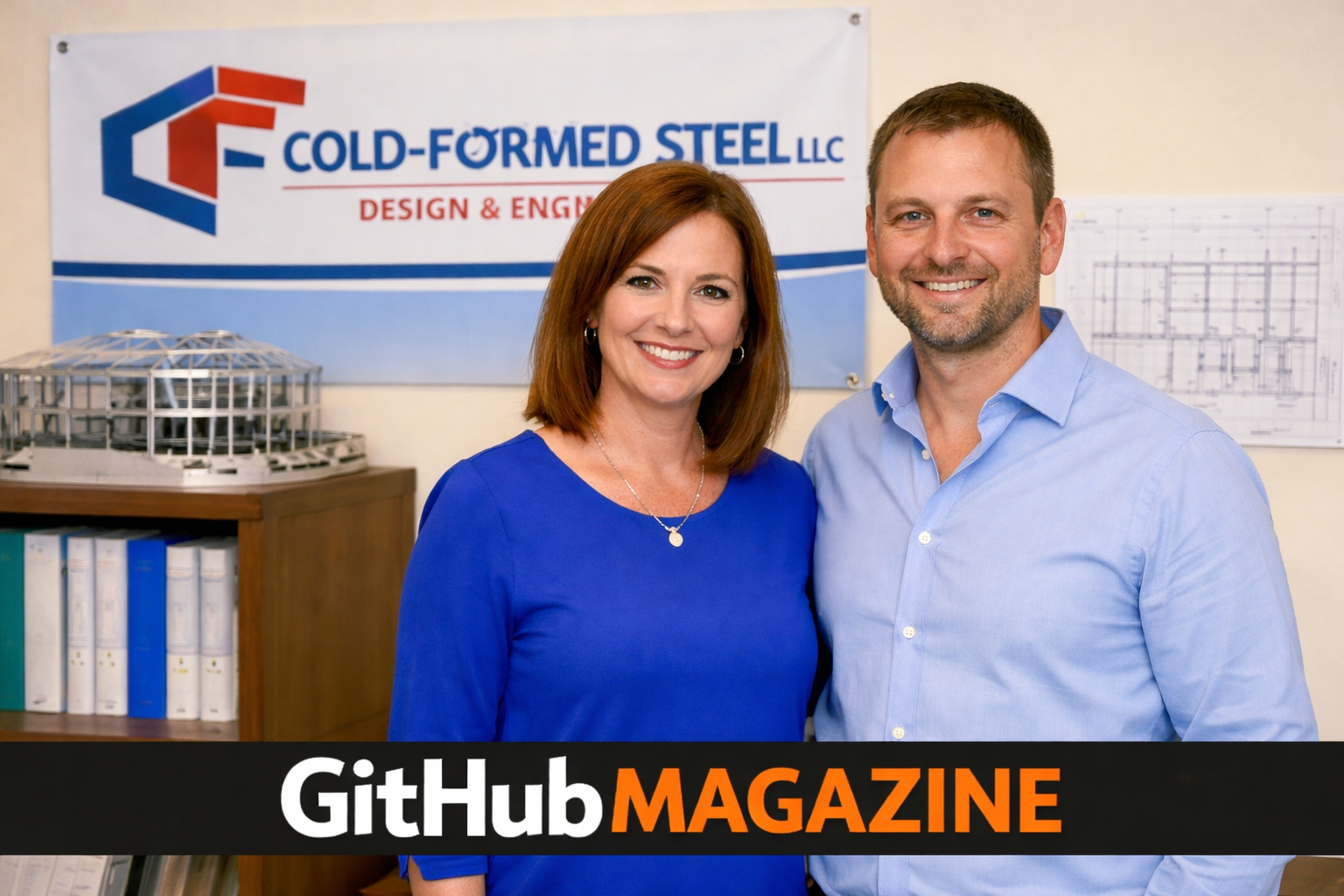
Cold-Formed Steel Engineering and Zsolt Nemedi
I have always found that the most important innovations in construction rarely receive public attention. They emerge quietly in engineering offices where calculations, drawings, and structural models determine how buildings will stand for decades. Cold-formed steel is one of those understated innovations. Although many people never notice it, this lightweight structural material has become essential to modern construction.
Cold-formed steel refers to steel sheets or strips shaped at room temperature using processes such as roll forming, pressing, and bending. Unlike traditional hot-rolled steel beams, which are thick and heavy, cold-formed steel components are thin, precisely shaped, and remarkably efficient. These characteristics allow engineers to create structural systems that use less material while maintaining strength and stability.
In contemporary construction, cold-formed steel appears in wall framing, roof structures, floor systems, and prefabricated building modules. The material’s ability to be manufactured with precision has also made it ideal for modern construction techniques that rely on factory-produced components and rapid on-site assembly.
Within this specialized field, engineers play a crucial role in ensuring these lightweight systems function safely and efficiently. Among them is structural engineer Zsolt V. Nemedi, whose professional work has focused on the analysis and design of cold-formed steel systems. Through consulting and engineering practice, Nemedi has contributed to projects that demonstrate how advanced structural analysis can support architectural creativity.
Understanding cold-formed steel engineering requires looking not only at the material itself but also at the professionals who design with it. Their work reveals how engineering knowledge quietly shapes the buildings people occupy every day.
The Emergence of Cold-Formed Steel in Construction
Cold-formed steel has gradually evolved from a niche material into a widely used structural system. Its development reflects broader shifts in construction technology, engineering research, and architectural design.
The fundamental concept behind cold-formed steel is straightforward. Thin sheets of steel are mechanically shaped into structural profiles without heating the material. This process allows manufacturers to produce components with precise geometries that maximize structural efficiency.
In the early decades of the twentieth century, engineers began experimenting with thin steel members for building structures. However, widespread adoption remained limited because structural design standards for these materials had not yet been established. Without clear engineering guidelines, building regulators and designers were cautious about using thin-walled steel sections in load-bearing applications.
The situation began to change when engineering organizations developed formal design specifications for cold-formed steel members. These standards provided engineers with formulas and analytical methods for evaluating structural performance. Once those guidelines were widely adopted, the material quickly gained acceptance across the construction industry.
Today, cold-formed steel is used in residential buildings, commercial structures, industrial facilities, and modular construction systems. Its adaptability allows engineers to design structural frameworks that are both lightweight and durable, making it one of the most versatile materials in modern building design.
Engineering Principles of Cold-Formed Steel Structures
The performance of cold-formed steel depends heavily on structural mechanics and careful engineering analysis. Because these members are thin compared with traditional steel beams, their behavior under load differs significantly.
One key phenomenon engineers must consider is buckling. Thin steel elements can deform under compressive forces long before the material itself reaches its maximum strength. This behavior requires engineers to analyze different types of instability that may occur within the structural system.
Local buckling occurs when individual plates within a steel member bend or distort. Distortional buckling involves deformation of the member’s cross-sectional shape. Global buckling, on the other hand, affects the entire structural member.
To address these challenges, engineers rely on sophisticated analytical models and computational tools. Structural software can simulate loads such as gravity forces, wind pressure, and seismic activity. By modeling these forces, engineers can determine whether a proposed design will remain stable under real-world conditions.
Cold-formed steel design therefore requires both theoretical knowledge and practical engineering experience. The material rewards careful analysis because even small changes in geometry can dramatically influence structural performance.
Key Characteristics of Cold-Formed Steel Systems
Cold-formed steel offers several properties that make it attractive for modern construction. These characteristics explain why architects and engineers increasingly rely on this material when designing contemporary buildings.
| Property | Description | Engineering Benefit |
|---|---|---|
| Lightweight members | Thin steel sections form structural elements | Easier transportation and installation |
| High strength-to-weight ratio | Cold working strengthens steel | Efficient structural performance |
| Precision manufacturing | Roll-forming produces consistent shapes | Reliable structural quality |
| Recyclable material | Steel can be reused or recycled | Environmental sustainability |
These characteristics allow cold-formed steel to support modern building methods, particularly those involving prefabrication. Components can be manufactured in controlled factory environments and then assembled quickly on construction sites.
The result is a construction system that reduces waste, shortens project timelines, and allows engineers to achieve highly efficient structural designs.
Specialized Engineering Firms and Structural Expertise
As cold-formed steel systems have become more complex, specialized engineering firms have emerged to provide technical expertise in this field. These consultancies often collaborate with architects, contractors, and structural engineering firms to solve challenging design problems.
Cold-Formed Steel Expert, LLC represents one example of this type of specialized practice. Firms in this niche focus on analyzing structural systems that rely on thin-walled steel members. Their work often involves evaluating unique architectural features, unconventional structural arrangements, or complex load-transfer conditions.
Such projects may require advanced structural modeling, detailed connection design, and careful coordination with other building systems. Engineers must ensure that each component functions as part of a larger structural framework.
These consulting firms play a critical role in translating architectural concepts into buildable structures. When architects propose innovative designs involving lightweight steel framing, specialized engineers help ensure that those ideas remain safe, stable, and code-compliant.
Their work illustrates how modern construction increasingly depends on collaboration between multiple engineering disciplines.
The Professional Path of Structural Engineer Zsolt V. Nemedi
Structural engineers often spend their careers working behind the scenes, ensuring that buildings remain safe and stable. Zsolt V. Nemedi represents one example of the professionals who specialize in advanced structural analysis.
Nemedi’s academic background includes engineering studies at the Technical University of Budapest followed by graduate-level civil engineering education in the United States. This combination of international academic experience and professional practice helped shape his approach to structural engineering.
Over the years, his work has focused on analyzing and designing structural systems involving cold-formed steel. These projects require a deep understanding of structural mechanics, building codes, and engineering software used to model structural behavior.
Engineers like Nemedi often contribute to projects that involve unusual structural configurations. Their role may include designing support systems for architectural features, evaluating structural stability, or developing solutions for complex load paths.
Although the work may appear technical, it ultimately influences how buildings are constructed and how architectural ideas become reality. Each design calculation and structural analysis contributes to the safety and durability of the finished structure.
Case Study: Structural Engineering in the Prado Project
One example illustrating the application of cold-formed steel engineering can be seen in a project involving The Prado development in Sandy Springs, Georgia. The project involved designing a distinctive architectural feature incorporating cantilevered structural elements.
A cantilever occurs when a structural member extends outward without direct support beneath its free end. While visually striking, such designs can create significant engineering challenges. The unsupported portion of the structure must still resist gravity forces, wind loads, and other stresses.
In this project, the design required a wing-shaped wall element extending beyond the corner of an existing building. The available structural space for supporting elements was extremely limited, requiring engineers to develop a compact yet stable framing system.
The solution involved arranging multiple cold-formed steel frames so that they functioned together as a structural system. By distributing loads across several members, the design allowed the cantilevered structure to remain stable while maintaining the architectural vision.
| Structural Feature | Design Challenge | Engineering Approach |
|---|---|---|
| Cantilevered wing wall | Unsupported structural extension | Load redistribution through steel frames |
| Limited structural depth | Only narrow framing space available | Multi-span framing system |
| Exposure to wind forces | Corner location increased wind loads | Reinforced framing configuration |
Projects like this illustrate how engineering creativity often supports architectural ambition.
Expert Perspectives on Lightweight Steel Construction
Many structural engineers and researchers have emphasized the advantages of cold-formed steel systems in contemporary construction.
Engineering researchers frequently point out that the material’s high strength-to-weight ratio enables efficient structural design. By shaping steel into optimized profiles, engineers can reduce material usage without compromising safety.
Another perspective focuses on manufacturing precision. Because cold-formed steel members are produced using automated roll-forming equipment, their dimensions remain consistent from one component to the next. This precision improves the reliability of structural assemblies.
Experts in construction technology also note the compatibility between cold-formed steel and modern prefabrication methods. Buildings increasingly rely on modular components produced in factories, and lightweight steel framing fits naturally within that approach.
These insights highlight why cold-formed steel has become an integral part of modern engineering practice. The material’s efficiency, adaptability, and precision align well with the demands of contemporary construction.
The Future of Cold-Formed Steel Engineering
Cold-formed steel continues to evolve as engineering technology advances. Several developments are shaping how the material will be used in future construction projects.
Digital engineering tools have dramatically improved the ability to analyze thin-walled steel structures. Advanced simulation software allows engineers to model structural behavior under complex loading conditions, making designs safer and more efficient.
Another major trend involves modular construction. Buildings assembled from prefabricated components can be constructed more quickly and with less material waste. Cold-formed steel provides the structural framework for many modular building systems.
Sustainability considerations are also influencing material choices in construction. Steel’s recyclability makes it attractive for environmentally conscious building projects. Many cold-formed steel components can be recycled at the end of a building’s life cycle.
Together, these trends suggest that cold-formed steel will remain an important structural material for decades to come. Engineers and designers will continue exploring new ways to integrate lightweight steel systems into innovative architectural concepts.
Takeaways
• Cold-formed steel is created by shaping steel sheets at room temperature using mechanical forming processes.
• The material offers a high strength-to-weight ratio and supports efficient structural design.
• Engineering standards developed during the twentieth century enabled its widespread use in construction.
• Specialized engineering firms provide expertise in designing cold-formed steel systems.
• Structural engineer Zsolt Nemedi has contributed to projects involving advanced lightweight steel framing.
• Cold-formed steel is increasingly used in modular construction and prefabricated building systems.
• Sustainability and recyclability make the material attractive for future construction technologies.
Conclusion
Engineering innovation often advances quietly through materials and techniques that improve how structures are designed and built. Cold-formed steel represents one of these important developments in modern construction.
The material’s ability to combine lightweight efficiency with structural strength has made it an essential component of contemporary building systems. Architects and engineers increasingly rely on cold-formed steel to create structures that are both visually compelling and structurally reliable.
Behind these projects are engineers who specialize in understanding how thin-walled steel behaves under complex loads. Professionals such as Zsolt Nemedi demonstrate the value of expertise within specialized engineering disciplines. Their work ensures that architectural ideas can be realized without compromising safety or stability.
As construction technology continues evolving, cold-formed steel will likely remain central to innovations in building design. The collaboration between engineers, architects, and specialized consultants will continue shaping the structures that define modern cities.
FAQs
What is cold-formed steel?
Cold-formed steel is structural steel created by shaping thin sheets or strips at room temperature using mechanical forming processes such as roll forming or bending.
Where is cold-formed steel commonly used?
It is widely used in wall framing, roof systems, floor structures, prefabricated buildings, and modular construction projects.
Why is cold-formed steel considered efficient?
The material provides high structural strength while using relatively little steel, resulting in a strong yet lightweight structural system.
Who is Zsolt Nemedi?
Zsolt V. Nemedi is a structural engineer associated with cold-formed steel engineering projects and consulting related to lightweight steel framing systems.
Is cold-formed steel environmentally sustainable?
Yes. Steel is highly recyclable, and many cold-formed steel components can be reused or recycled after a building’s lifecycle ends.

Related Posts

Primal Queen: Inside the Viral Women’s Wellness Supplement

Navy Aviation Electrician Career Overview