
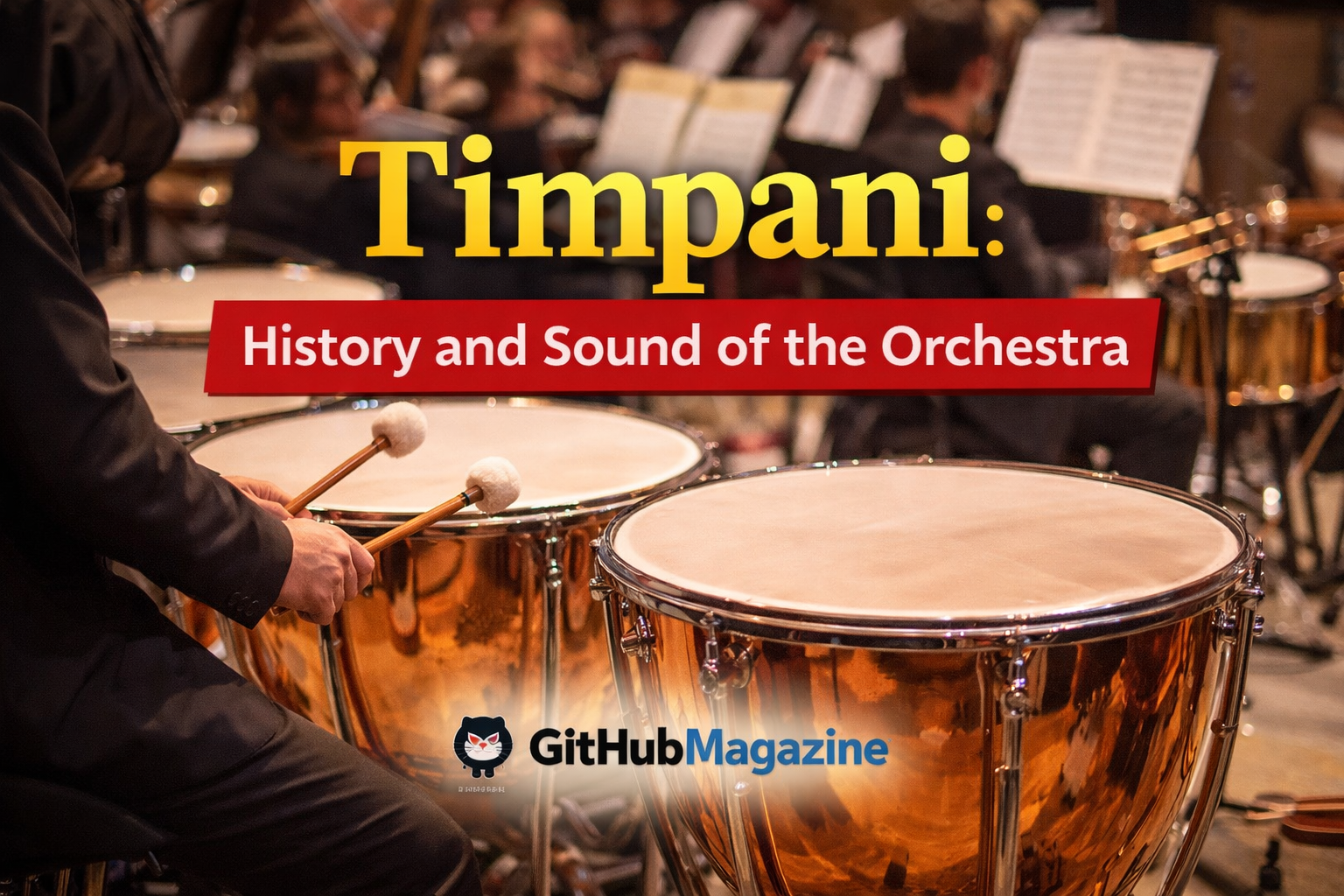
History and Sound of the Orchestra
Timpani, often called kettle drums, are large tuned percussion instruments that play a central role in orchestras, concert bands, and film scores. Unlike most drums, timpani produce definite musical pitches, allowing performers to tune them precisely to notes within a composition. The instrument consists of a large bowl-shaped shell, traditionally made from copper, covered by a stretched drumhead that can be tightened or loosened to adjust pitch. Pedals or tuning mechanisms allow players to change notes quickly during performance.
When I first encountered the timpani in a concert hall, the sound was unmistakable. A single stroke could ripple across the entire orchestra, providing both rhythmic foundation and dramatic emphasis. Yet the instrument’s history is far older than the symphony orchestra itself. Timpani trace their lineage to Middle Eastern and Central Asian drums used in military and ceremonial music centuries ago.
Over time, the instrument evolved from a symbol of royal power into one of the most expressive voices in Western classical music. Composers such as Beethoven, Berlioz, and Stravinsky expanded its musical role, transforming it from simple rhythmic punctuation into a powerful melodic and harmonic element.
Today, the timpani remains one of the most distinctive instruments in orchestral performance. Its thunderous resonance, precise tuning, and dramatic presence continue to define the sound of symphonic music across the world.
The Ancient Origins of the Timpani
The story of the timpani begins long before the modern orchestra existed. Early versions of kettle drums appeared in Central Asia and the Middle East more than a thousand years ago. These instruments, known historically as naqqara, were paired drums played during military ceremonies, royal processions, and religious events.
The drums were often mounted on camels or horses, allowing musicians to accompany armies as they traveled. Their booming sound carried across large distances, making them effective tools for signaling and ceremonial display.
By the thirteenth century, kettle drums had become associated with military prestige in the Ottoman Empire and other Islamic states. The instruments symbolized authority and power, often reserved for royal courts.
European travelers and diplomats encountered these drums during cultural exchanges with the Ottoman world. Over time, the instruments made their way into European courts through trade, diplomacy, and military contact.
Music historian James Blades noted that kettle drums were initially viewed in Europe not as musical instruments but as symbols of aristocratic status and ceremonial grandeur.
Arrival in Europe and Royal Courts
When kettle drums reached Europe in the fifteenth century, they were primarily used in cavalry units and royal ceremonies. The instruments were paired with trumpets and used to announce the arrival of nobility or accompany royal processions.
In many European courts, the right to use kettle drums was strictly regulated. Only certain aristocratic families or military units were permitted to perform with them.
Gradually, musicians began experimenting with the drums in musical contexts beyond ceremonial events. By the seventeenth century, composers had started incorporating timpani into early orchestral works.
The tuning of these drums allowed them to reinforce harmonic structures within compositions. Instead of serving solely as rhythmic accents, they could match specific notes in the musical key.
This innovation opened the door for the timpani to become an essential orchestral instrument.
Construction and Design of the Instrument
Modern timpani consist of several key components that determine their sound and tuning capabilities. The bowl-shaped shell acts as a resonating chamber, amplifying the vibrations produced by the drumhead.
Copper is the most common material used for professional timpani bowls because it produces a warm and resonant tone. Some instruments also use fiberglass or aluminum for durability and cost efficiency.
The drumhead, traditionally made from calfskin, is now often produced using synthetic materials designed to provide stable tuning and durability.
Components of a Timpani
| Component | Description | Function |
|---|---|---|
| Bowl | Large metal shell, usually copper | Resonates and amplifies sound |
| Drumhead | Stretched membrane over the bowl | Produces vibration when struck |
| Pedal mechanism | Adjustable tuning system | Changes pitch quickly |
| Tuning gauge | Visual pitch indicator | Helps performers tune accurately |
These elements work together to create the instrument’s distinctive pitch and resonance.
The Role of Timpani in the Orchestra
Within the modern orchestra, timpani occupy a unique position among percussion instruments. Unlike snare drums or cymbals, they produce definite pitches that interact directly with the harmonic structure of the music.
Typically, orchestras use sets of two to four timpani, each tuned to different notes. Skilled timpanists adjust tuning throughout a performance to match changing harmonic progressions.
The instrument often reinforces the tonal center of a composition by playing the tonic and dominant notes of a key.
Composer Hector Berlioz famously described the timpani as an instrument capable of both “terrible fury and majestic solemnity.”
Its ability to shift from subtle background resonance to explosive dramatic accents makes it indispensable in orchestral music.
Famous Composers and Timpani Innovation
Several composers revolutionized the role of timpani in orchestral writing. Ludwig van Beethoven expanded its musical importance in his symphonies, particularly in the Ninth Symphony, where timpani rhythms drive moments of intense drama.
Hector Berlioz later pushed the instrument further in works like Symphonie Fantastique, where he used multiple timpani players to create powerful sonic landscapes.
Igor Stravinsky continued this evolution in the twentieth century. In The Rite of Spring, the timpani contribute to the primal rhythmic intensity that shocked audiences at its 1913 premiere.
Musicologist Richard Taruskin once observed that Stravinsky’s percussion writing redefined the expressive potential of orchestral rhythm.
These innovations transformed timpani from supporting instruments into dynamic musical voices.
Interview: The Art of Playing the Timpani
The Thunder Behind the Orchestra
Date: April 2022
Location: Chicago Symphony Orchestra rehearsal hall
On a quiet afternoon inside the Chicago Symphony Orchestra rehearsal space, the timpani sat gleaming under stage lights. Principal timpanist David Herbert, widely respected for his expressive playing, adjusted tuning pedals while discussing the art of the instrument.
Q: What makes the timpani different from other percussion instruments?
Herbert paused before answering. “Unlike many percussion instruments, we deal with pitch. Every note must be tuned precisely. The timpani is as much a melodic instrument as it is rhythmic.”
Q: How important is listening within the orchestra?
He leaned forward slightly. “Listening is everything. The timpanist has to know what the strings, brass, and woodwinds are doing at every moment. The drum has to blend with harmony.”
Q: What challenges do performers face during live performances?
“Pitch changes,” he said with a smile. “In some pieces you’re adjusting pedals constantly while playing. The audience rarely sees it, but it’s like solving a puzzle in real time.”
Q: What advice would you give young musicians interested in timpani?
“Develop your ears,” he said quietly. “Technique matters, but hearing the orchestra around you matters more.”
After the interview ended, Herbert struck a soft roll across two drums. The sound filled the room with a deep resonance that seemed to echo long after the vibration stopped.
Production credits: Interview conducted by staff writer.
The Evolution of Timpani Technology
Technological innovation has significantly improved timpani design over the past century. Early instruments required manual tuning using hand screws around the drumhead.
In the nineteenth century, inventors developed mechanical systems that allowed performers to adjust pitch more quickly.
The introduction of pedal tuning mechanisms in the late nineteenth century transformed the instrument. Pedals connected to tension rods allowed performers to change pitch instantly while playing.
Timeline of Timpani Development
| Year | Innovation | Impact |
|---|---|---|
| 1600s | Introduction into orchestral music | Expanded musical use |
| 1800s | Mechanical tuning systems | Faster pitch adjustments |
| Late 1800s | Pedal tuning mechanism | Real-time pitch changes |
| 1900s | Synthetic drumheads | Improved tuning stability |
These advancements allowed composers to write increasingly complex timpani parts.
Playing Techniques and Sound Production
Producing the distinctive sound of the timpani requires precise technique. Players use specialized mallets with wooden shafts and felt-covered heads.
Different mallet types produce varying tonal qualities. Soft mallets create warm sustained sounds, while harder mallets generate sharper attacks.
The most common technique is the timpani roll, in which the performer alternates strokes rapidly between hands to create a continuous sound.
Percussion educator Anthony Cirone has emphasized that timpanists must combine rhythmic precision with sensitive musical listening.
Each stroke must be controlled carefully to produce consistent pitch and tone.
The Cultural Influence of the Timpani
Beyond classical music, timpani have influenced film scores, theatrical productions, and even modern popular music.
Film composers frequently use timpani to create dramatic tension or emphasize climactic moments. The instrument’s deep resonance adds weight and grandeur to cinematic soundtracks.
In marching bands and contemporary percussion ensembles, timpani continue to evolve with new performance styles.
Music scholar Nicholas Cook once wrote that orchestral instruments like the timpani shape not only musical sound but also cultural expectations of grandeur and drama.
The instrument’s powerful presence remains deeply embedded in the soundscape of modern music.
Key Takeaways
- Timpani are pitched percussion instruments central to orchestral music.
- The instrument originated from Middle Eastern kettle drums used in military ceremonies.
- European composers expanded its role beginning in the seventeenth century.
- Modern timpani feature pedal mechanisms for rapid pitch adjustments.
- Famous composers such as Beethoven and Stravinsky elevated its musical importance.
- Skilled timpanists combine rhythmic precision with harmonic awareness.
Conclusion
The timpani occupy a remarkable place in the history of music. Few instruments have traveled such a long journey from military ceremony to symphonic artistry.
I often think about how a single timpani strike can transform the emotional character of an entire orchestral passage. The instrument’s resonance seems to connect past and present, echoing centuries of musical tradition.
From royal courts to modern concert halls, the timpani have evolved alongside the orchestra itself. Innovations in design and technique have expanded their expressive potential, allowing composers and performers to explore new sonic landscapes.
Yet the essence of the instrument remains unchanged: a deep, resonant voice capable of commanding attention across an entire ensemble.
As orchestral music continues to evolve, the timpani will likely remain one of its most powerful and dramatic instruments.
FAQs
What are timpani?
Timpani are large pitched percussion instruments used primarily in orchestras. They consist of a bowl-shaped shell covered with a stretched drumhead that produces a specific musical pitch.
Why are timpani called kettle drums?
The instruments resemble large kettles because of their rounded bowl shape, which led to the nickname “kettle drums.”
How are timpani tuned?
Modern timpani use pedal mechanisms that adjust the tension of the drumhead, allowing players to change pitch quickly during performance.
How many timpani are used in an orchestra?
Most orchestras use a set of two to four timpani, though larger works may require additional drums.
Who plays the timpani in an orchestra?
A specialized percussionist known as a timpanist performs the instrument and often serves as the principal percussionist.