
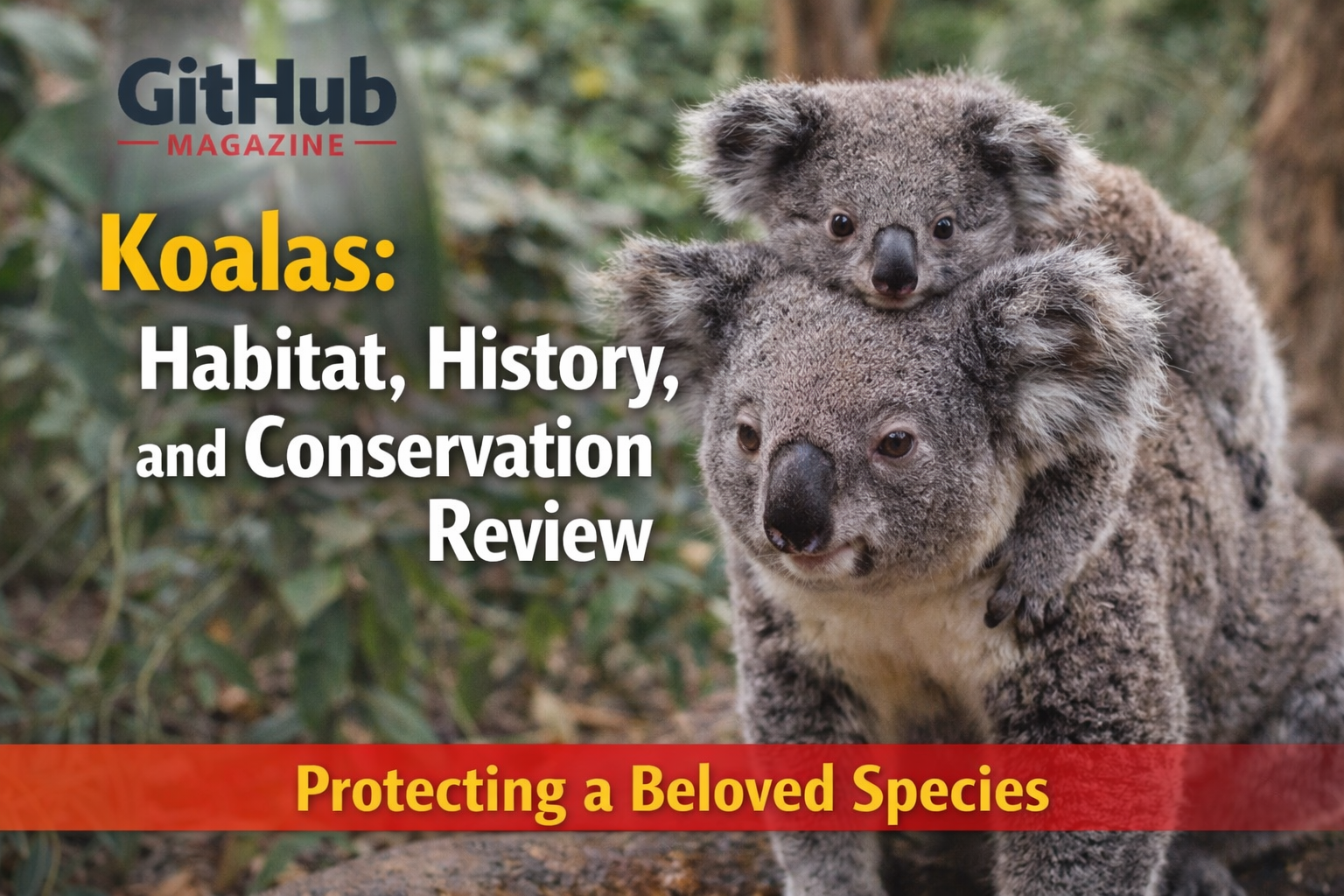
Koalas Habitat History and Conservation Review
When I look at the koala, I see more than a soft-furred animal quietly resting in a eucalyptus tree. The species represents a remarkable story of evolution, environmental adaptation, and the fragile balance between wildlife and human expansion. Koalas are among the most recognizable animals on Earth, yet their survival depends on ecosystems that have changed dramatically over the last two centuries.
Koalas are tree-dwelling marsupials native to eastern and southeastern Australia. Scientifically known as Phascolarctos cinereus, they spend nearly their entire lives in eucalyptus trees where they eat leaves, sleep, and move slowly through forest canopies. Their specialized diet, unusual digestive system, and low-energy lifestyle make them one of the most unique mammals in the world.
However, the modern story of koalas is not only about biology. It is also about conservation and environmental responsibility. Habitat loss, climate change, disease, and urban expansion have placed significant pressure on many koala populations. In several regions of Australia the species is now considered endangered.
For readers seeking a clear understanding of koalas, the most important point is simple. These animals depend almost entirely on healthy eucalyptus forests. When those forests disappear, koalas struggle to survive.
Understanding the koala means exploring its evolutionary origins, ecological role, and the challenges scientists face while trying to protect one of the planet’s most iconic wildlife species.
Evolutionary Origins of the Koala
Koalas belong to a distinctive branch of mammals known as marsupials. Unlike placental mammals, marsupials give birth to extremely underdeveloped young that continue their development in a pouch. Australia became the primary home of these animals because its long geographic isolation allowed them to evolve without competition from many placental mammals.
The ancestors of modern koalas appeared millions of years ago as Australia’s climate became drier and eucalyptus forests expanded across the continent. These early animals gradually adapted to feeding on eucalyptus leaves, which contain chemicals toxic to most other mammals.
To survive on such a diet, koalas evolved a specialized digestive system. Their intestines contain microbial communities that break down toxins and extract nutrients from leaves that would otherwise be indigestible. This adaptation allowed koalas to occupy a food niche that few other animals could exploit.
Evolutionary specialization also explains many aspects of their behavior. Because eucalyptus leaves provide limited energy, koalas conserve energy by sleeping or resting for long periods. Their slow metabolism allows them to survive on a diet that would be insufficient for most mammals.
The evolutionary story of koalas illustrates a broader ecological principle. When animals adapt strongly to a specific food source and habitat, they become highly successful within that niche but vulnerable when environmental conditions change.
Physical Characteristics and Behavior
Koalas possess a distinctive appearance that makes them instantly recognizable. Their compact bodies, thick grey fur, and round ears create an almost teddy-bear-like impression. Despite this gentle appearance, koalas are highly adapted climbers capable of gripping branches securely with powerful limbs and sharp claws.
Their hands and feet feature opposable digits that function almost like thumbs, allowing them to grasp tree trunks while moving through forest canopies. Strong limbs support their weight while climbing and resting on branches.
Koalas typically measure between 60 and 85 centimeters in length and weigh between 6 and 12 kilograms depending on their geographic region. Individuals in southern Australia tend to be larger because colder climates favor thicker fur and larger body mass.
The animals follow a remarkably consistent daily routine. Most of the day is spent resting or sleeping, often up to twenty hours. The remaining time is dedicated to feeding and slowly moving between nearby trees.
Koalas rely heavily on scent and vocal communication. Adult males possess scent glands on their chests that mark territory by rubbing against tree trunks. During breeding season they produce deep bellows that can travel through forests and attract females.
These behaviors highlight how well adapted koalas are to life in trees, where food, shelter, and communication all revolve around the eucalyptus forest environment.
Geographic Distribution Across Australia
Historically koalas inhabited vast areas of eastern Australia. Today their distribution remains concentrated in forest regions stretching from Queensland through New South Wales and into Victoria and parts of South Australia.
Although koalas still occupy several Australian states, the density of populations varies significantly. Some areas maintain stable numbers while others have experienced dramatic declines due to habitat loss and urban development.
The table below summarizes the general distribution patterns of koalas in modern Australia.
| Region | Population Status | Typical Habitat |
|---|---|---|
| Queensland | Declining populations | Coastal eucalyptus forests |
| New South Wales | Endangered in many areas | Fragmented woodland habitats |
| Victoria | More stable populations | Temperate forest landscapes |
| South Australia | Managed populations | Protected forest environments |
Urban expansion near coastal regions has had particularly strong effects on koala populations. As cities expand, forests are divided into smaller patches that limit the movement of animals between feeding areas.
When habitats become fragmented, koalas must travel across roads or open land, increasing their risk of injury or death from vehicles and predators.
These regional differences demonstrate why conservation strategies must be tailored to specific landscapes rather than applied uniformly across the country.
Historical Impact of the Fur Trade
One of the most dramatic threats to koalas occurred during the late nineteenth and early twentieth centuries when their fur became highly valuable in international markets. The thick, soft pelts of koalas were widely used to manufacture coats, rugs, and other luxury items.
Commercial hunting expanded rapidly during this period. Millions of koalas were killed and exported as pelts, causing severe population declines in many regions. By the early twentieth century some areas had nearly lost their koala populations entirely.
Public concern over the scale of hunting eventually sparked conservation movements. Citizens and environmental advocates began pressuring governments to regulate the trade and protect remaining animals.
In response, several Australian states introduced hunting bans and wildlife protection laws. Sanctuaries and protected forest areas were also established to help koala populations recover.
These early conservation efforts represent one of the first large-scale wildlife protection movements in Australia. They demonstrated how public awareness can lead to policy changes that safeguard vulnerable species.
Modern Threats to Koala Survival
While large-scale hunting has disappeared, modern environmental pressures now threaten koala populations in different ways. Habitat destruction remains the most significant challenge.
Urban development, road construction, and agricultural expansion have cleared large areas of eucalyptus forest. When forests disappear, koalas lose both their food source and shelter.
Another major concern is disease. Chlamydia infections affect many koala populations and can cause blindness, infertility, and fatal illness. Researchers are currently developing vaccines and treatment programs to reduce the impact of this disease.
Urbanization introduces additional dangers. Vehicle collisions and attacks by domestic dogs are responsible for many koala deaths each year, particularly near suburban areas where forest fragments intersect with human neighborhoods.
Climate change adds another layer of difficulty. Increasing temperatures and prolonged droughts reduce the nutritional quality of eucalyptus leaves. Bushfires, intensified by dry conditions, can destroy enormous areas of habitat in a single season.
These combined threats create a complex conservation challenge that scientists and policymakers continue to address.
Population Trends and Conservation Status
Estimating koala populations is challenging because the animals spend much of their time hidden in forest canopies. However, ecological monitoring programs provide approximate trends that reveal significant changes over time.
The following table outlines key population patterns observed during the past century.
| Period | Estimated Population Trend | Influencing Factors |
|---|---|---|
| Early 1900s | Large populations | Extensive forest habitat |
| 1920s | Severe decline | Commercial fur hunting |
| Late 20th century | Partial recovery | Conservation laws |
| 21st century | Regional declines | Habitat loss and disease |
Recent conservation assessments have identified several populations at risk of extinction if habitat destruction continues. As a result, koalas have been listed as endangered in some Australian regions.
Monitoring programs now use advanced tools such as acoustic sensors, satellite mapping, and citizen science reporting to track population changes and identify critical habitats.
Accurate data is essential for developing effective conservation strategies and allocating resources where they are most needed.
Scientific Research and Conservation Programs
Scientists and environmental organizations have launched numerous initiatives aimed at protecting koalas and restoring their habitats. One of the most important approaches focuses on habitat conservation.
Protecting existing eucalyptus forests prevents further habitat fragmentation and ensures that koalas maintain access to food sources. Reforestation projects are also underway in several regions, where volunteers and environmental groups plant eucalyptus trees to rebuild wildlife corridors.
Wildlife corridors allow animals to travel safely between forest patches. This connectivity helps maintain genetic diversity within populations and reduces the risk of local extinction.
Researchers are also studying koala health in greater detail. Veterinary teams monitor disease outbreaks and develop treatments to reduce mortality rates. Vaccination research targeting chlamydia infections represents one of the most promising advances in koala conservation.
Environmental scientists emphasize that protecting koalas benefits entire ecosystems. Eucalyptus forests support numerous birds, reptiles, insects, and mammals that depend on the same habitats.
In this way, the koala functions as a flagship species whose protection helps preserve broader biodiversity.
Cultural Importance and Global Symbolism
Beyond ecology, koalas hold deep cultural significance within Australia. Indigenous communities have included the animal in traditional stories and knowledge systems for thousands of years. These stories often emphasize harmony between humans and the natural world.
In modern culture, the koala has become one of Australia’s most recognizable symbols. Tourism campaigns frequently feature the animal as an ambassador for the country’s unique wildlife.
International attention often intensifies during environmental crises such as major bushfires. Images of injured or rescued koalas can spark global empathy and encourage conservation funding.
This emotional connection plays a powerful role in environmental awareness. Many conservation organizations rely on the koala’s iconic status to raise support for forest protection and wildlife research.
As a result, the survival of koalas carries symbolic meaning that extends far beyond biology.
Future Challenges in a Changing Climate
The long-term future of koalas will depend largely on how Australia and the global community respond to environmental change. Climate models predict that rising temperatures and shifting rainfall patterns may alter the distribution of eucalyptus forests.
Some researchers are studying whether certain koala populations possess genetic traits that make them more resilient to heat and drought. Understanding these traits could help guide conservation planning.
Habitat restoration and sustainable land management will also play critical roles. Protecting large connected forest areas increases the likelihood that koalas can adapt to changing environmental conditions.
Urban planning may also influence outcomes. Designing wildlife crossings, protecting green corridors, and reducing deforestation near urban areas can significantly reduce mortality rates.
The challenge is balancing economic development with ecological sustainability. The decisions made over the next several decades will shape whether koalas remain abundant in Australia’s forests or become increasingly rare.
Key Takeaways
• Koalas are tree-dwelling marsupials native to eucalyptus forests of eastern and southeastern Australia.
• Their specialized diet of eucalyptus leaves influences their slow metabolism and long resting periods.
• The fur trade of the early twentieth century caused severe population declines before conservation laws were introduced.
• Habitat destruction, disease, and climate change now represent the primary threats to their survival.
• Conservation programs focus on habitat protection, wildlife corridors, and disease research.
• Koalas serve as a flagship species whose protection benefits entire forest ecosystems.
Conclusion
When I reflect on the story of koalas, I am reminded that wildlife conservation often depends on understanding both biology and human behavior. These animals have survived for millions of years by adapting perfectly to eucalyptus forests, yet their future now depends on how people manage the landscapes they inhabit.
The koala’s gentle appearance has made it one of the most beloved animals in the world. That popularity carries responsibility. Protecting the species requires preserving forests, supporting scientific research, and designing communities that coexist with wildlife rather than displacing it.
Encouragingly, many conservation programs already show progress. Habitat restoration, disease treatment, and improved monitoring systems offer hope that koala populations can stabilize in coming decades.
Ultimately the fate of the koala reflects a broader environmental truth. When ecosystems are protected, countless species benefit. By ensuring that eucalyptus forests remain healthy and connected, Australia can preserve not only its iconic marsupial but also the rich biodiversity that depends on the same landscapes.
FAQs
What do koalas eat
Koalas feed almost exclusively on eucalyptus leaves, selecting specific species that contain lower toxin levels and higher nutritional value.
Where are koalas found
Koalas live mainly in eastern and southeastern Australia, including Queensland, New South Wales, Victoria, and South Australia.
Why do koalas sleep so much
Eucalyptus leaves provide limited energy, so koalas conserve energy by sleeping or resting for long periods each day.
Are koalas related to bears
No. Despite the nickname “koala bear,” they are marsupials more closely related to wombats and kangaroos.
What threatens koala populations
Major threats include habitat destruction, disease, vehicle collisions, dog attacks, and climate-driven environmental changes.

Related Posts

Scrub Cap Guide: Purpose, Types, and Evolution

How to Sell a House Step by Step Guide