
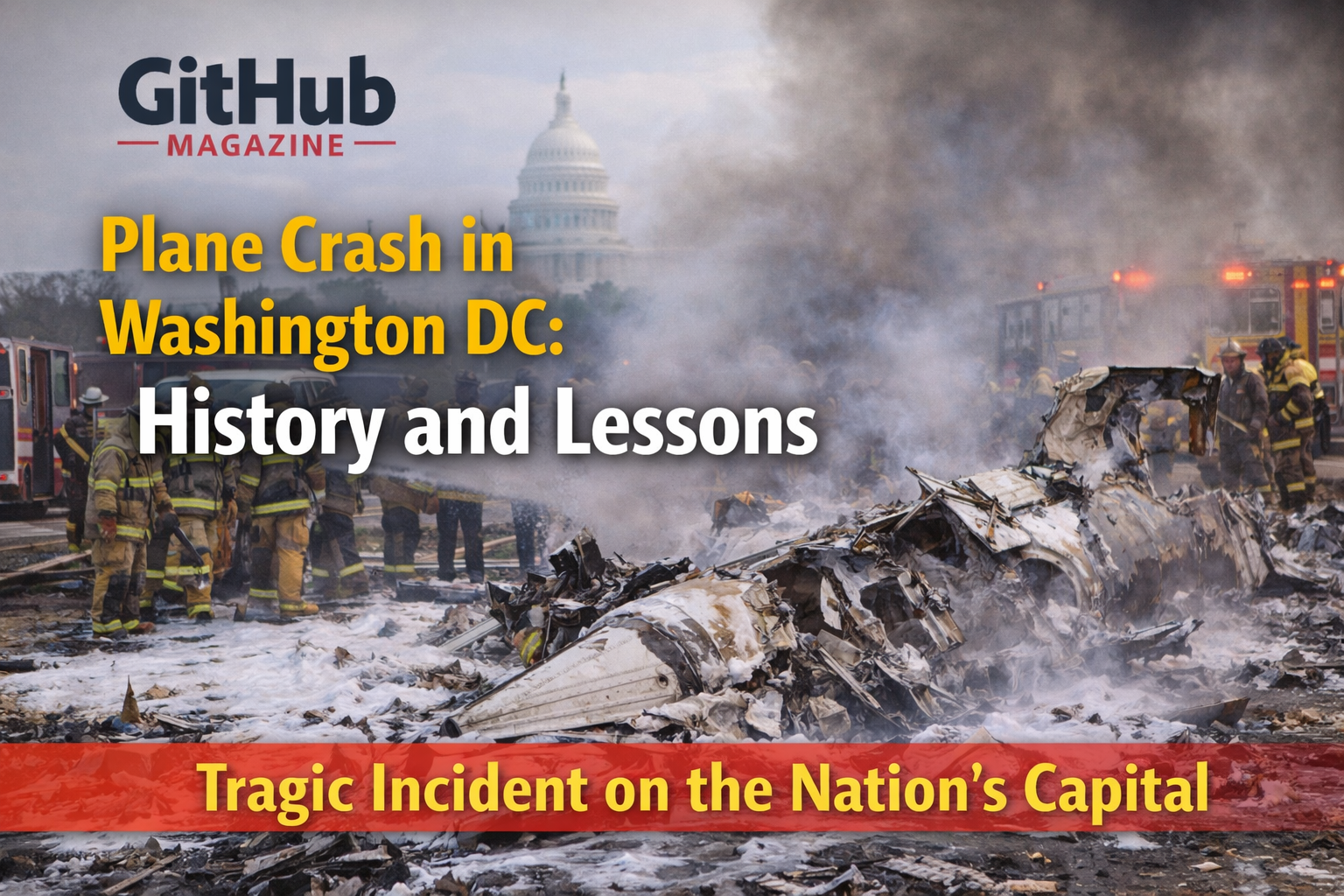
Plane Crash in Washington DC: History and Lessons
When people search for information about a plane crash in Washington, D.C., they are usually referring to a series of tragic aviation accidents that occurred in or near the nation’s capital. The most widely remembered is Air Florida Flight 90, which crashed into the 14th Street Bridge and the icy Potomac River on January 13, 1982, shortly after departing Washington National Airport. The disaster killed 78 people and remains one of the most haunting aviation tragedies in modern American history.
I approach the subject not simply as a recounting of catastrophe but as a story about how aviation safety evolves after tragedy. Plane crashes around Washington, D.C., have repeatedly triggered sweeping reforms in pilot training, aircraft technology, and air traffic control procedures. Each disaster revealed vulnerabilities in the system that were previously invisible.
The geography of Washington adds complexity to aviation operations. Aircraft arriving at or departing from Reagan National Airport must navigate dense urban development, strict airspace restrictions, and heavy traffic from military and government flights. The result is one of the most tightly controlled aviation corridors in the world.
Yet the lessons from these tragedies extend far beyond the capital region. Investigations into accidents near Washington have influenced global aviation standards, affecting pilot training programs, weather procedures, cockpit communication rules, and emergency response systems. By examining these events closely, we gain insight into how aviation safety improves over time and how investigators transform loss into knowledge.
The Geography of Aviation Around Washington, D.C.
Flying into Washington, D.C., is unlike approaching most other major cities. The capital’s primary airport, Ronald Reagan Washington National Airport, sits directly along the Potomac River just minutes from the White House, the Pentagon, and Capitol Hill. Because of security concerns and airspace restrictions, aircraft must follow narrow approach corridors that wind along the river before landing.
These constraints create an environment where precision is essential. Pilots must carefully follow flight paths to avoid restricted airspace surrounding federal buildings and military installations. At the same time, air traffic controllers coordinate a dense flow of aircraft traveling to nearby airports such as Dulles International and Baltimore-Washington International.
The complexity of the region’s airspace means that weather, equipment performance, and pilot decision making can have amplified consequences. Snowstorms, fog, and strong winter winds often affect the region, increasing the difficulty of takeoffs and landings.
Aviation safety expert John Goglia, a former member of the National Transportation Safety Board, once explained that urban airports require “extraordinary coordination between pilots, aircraft systems, and air traffic control.” When any part of that system fails, the results can be catastrophic.
Understanding the geography of Washington’s aviation environment helps explain why accidents in this region have attracted intense scrutiny and led to significant regulatory changes.
Air Florida Flight 90: A Defining Disaster
The most infamous plane crash associated with Washington, D.C., occurred on January 13, 1982. Air Florida Flight 90, a Boeing 737 bound for Fort Lauderdale, attempted to take off from Washington National Airport during a severe winter storm.
Snow and ice had covered the aircraft while it waited on the runway. Although the plane was de-iced, investigators later determined that improper procedures and pilot misjudgment contributed to the aircraft’s inability to generate sufficient lift.
Moments after takeoff, the aircraft struggled to gain altitude. Witnesses reported seeing the plane wobble before it struck the 14th Street Bridge, colliding with several vehicles before plunging into the frozen Potomac River.
The crash killed 74 passengers and crew members along with four people on the bridge. Only five passengers survived.
Timeline of the Air Florida Flight 90 Disaster
| Time | Event |
|---|---|
| Morning, Jan 13, 1982 | Severe snowstorm hits Washington, D.C. |
| 3:15 PM | Flight 90 begins takeoff roll |
| Seconds later | Aircraft fails to gain altitude |
| Impact | Plane strikes 14th Street Bridge |
| Aftermath | Wreckage falls into the Potomac River |
The tragedy became a defining moment in American aviation safety. Investigators later concluded that ice contamination on the wings and improper engine power settings contributed to the accident.
The Heroism That Followed
Although the crash itself was devastating, the aftermath produced extraordinary acts of courage that captured national attention.
Television footage showed survivors clinging to wreckage in the icy Potomac River as rescue helicopters arrived. One passenger, Arland D. Williams Jr., repeatedly passed a rescue line to other survivors instead of taking it himself. He died before rescuers could reach him again.
President Ronald Reagan later praised Williams for his bravery, describing his actions as an example of “the spirit of American heroism.”
The rescue operation involved helicopters from the U.S. Park Police and emergency personnel from across the city. The dramatic scenes were broadcast live, turning the rescue into a moment of shared national grief and admiration.
These events highlighted the importance of rapid emergency response systems in aviation disasters.
Investigating the Causes
Following the crash, the National Transportation Safety Board conducted a detailed investigation that examined aircraft systems, pilot training, weather conditions, and air traffic control procedures.
The final report identified several key factors:
- Ice accumulation on the aircraft’s wings
- Incorrect engine thrust settings
- Inadequate cockpit communication
- Failure to abort takeoff despite warning signs
Investigators found that the aircraft’s engines were producing insufficient thrust because sensors had been affected by ice.
Aviation historian James Chiles later wrote that the disaster “illustrated how a chain of small errors can combine into catastrophic failure.”
This concept, often referred to as the accident chain, became central to aviation safety analysis in subsequent decades.
How the Crash Changed Aviation Safety
The lessons from the 1982 crash reshaped aviation policy in the United States and beyond.
One major reform involved improved pilot training for winter weather conditions. Airlines introduced stricter guidelines for de-icing procedures and aircraft inspection before takeoff.
Another significant change involved cockpit communication standards. Investigators concluded that the crew failed to challenge each other’s decisions effectively during the flight.
This insight helped accelerate the adoption of Crew Resource Management, a training approach that encourages pilots and crew members to speak up when they notice potential problems.
Aviation safety scholar Earl Wiener once explained that Crew Resource Management “transformed cockpit culture from rigid hierarchy to collaborative decision making.”
These changes dramatically improved aviation safety worldwide.
Other Aviation Incidents Near Washington
Although the Air Florida crash is the most well known, other aviation accidents near Washington have also influenced safety reforms.
Selected Aviation Incidents Near Washington, D.C.
| Year | Incident | Key Issue |
|---|---|---|
| 1949 | Capital Airlines crash | Weather and navigation errors |
| 1982 | Air Florida Flight 90 | Ice contamination |
| 2015 | Gyrocopter landing at Capitol | Airspace security breach |
Each incident prompted reviews of airspace management, technology, or security policies.
The Washington region remains one of the most closely monitored airspaces in the world due to the presence of government institutions and military facilities.
Expert Perspectives on Aviation Safety
Aviation experts frequently emphasize that modern aviation is one of the safest forms of transportation because every accident is studied extensively.
Aviation safety analyst William Langewiesche once wrote that aviation investigators “treat every crash as a puzzle whose solution prevents the next disaster.”
Similarly, former NTSB chairman Robert Sumwalt noted that “most aviation accidents involve a chain of events rather than a single cause.”
These perspectives highlight the central principle guiding aviation safety: learning from failure.
Because of this approach, fatal airline accidents in the United States have become extremely rare in recent decades.
The Human Impact of Aviation Tragedies
Behind every aviation accident lies a story of families, communities, and lives suddenly altered.
Memorials honoring the victims of the 1982 crash now stand near the Potomac River. Each year, relatives gather there to remember those who died.
These memorials remind visitors that aviation safety is not merely a technical discipline but also a deeply human responsibility.
Investigators, engineers, and regulators often speak about their work in personal terms. Many entered the field because of a desire to prevent future tragedies.
The history of aviation safety is therefore not only about technology and regulation but also about empathy and remembrance.
Key Takeaways
- The most famous Washington, D.C., aviation disaster was Air Florida Flight 90 in 1982.
- Ice accumulation and pilot decision making played major roles in the crash.
- Investigations led to improvements in de-icing procedures and cockpit communication.
- Crew Resource Management training became standard after accidents like this.
- Aviation safety evolves through detailed investigation of every incident.
- The Washington region remains one of the most tightly controlled airspaces in the world.
Conclusion
Looking back at the history of plane crashes associated with Washington, D.C., I see more than tragedy. Each accident represents a turning point in the evolution of aviation safety.
The crash of Air Florida Flight 90 remains one of the most vivid reminders of how quickly routine flights can turn into disasters when small errors accumulate. Yet the lessons drawn from that event transformed aviation training, cockpit communication, and weather procedures.
Modern aviation safety systems are built upon decades of investigation and reform. Engineers analyze aircraft systems in extraordinary detail, pilots undergo extensive training, and air traffic controllers manage complex airspace with sophisticated technology.
Because of these efforts, commercial aviation today is far safer than it was during earlier decades. The tragedies that occurred near Washington helped shape that progress.
Remembering these events is not only about honoring those who lost their lives. It is also about understanding how the aviation community continues striving to ensure that such disasters become ever more rare.
FAQs
What plane crash happened in Washington, D.C.?
The most well known crash was Air Florida Flight 90 in 1982, when a Boeing 737 struck the 14th Street Bridge and crashed into the Potomac River during a snowstorm.
How many people died in the 1982 Washington plane crash?
A total of 78 people died, including passengers, crew members, and individuals on the bridge.
What caused the Air Florida crash?
Investigators determined that ice buildup on the wings and incorrect engine thrust settings prevented the aircraft from gaining sufficient lift during takeoff.
Did anyone survive the crash?
Yes. Five passengers survived after rescue teams pulled them from the icy Potomac River.
What safety changes resulted from the disaster?
The crash contributed to stronger de-icing procedures and greater emphasis on Crew Resource Management training for pilots.
.