
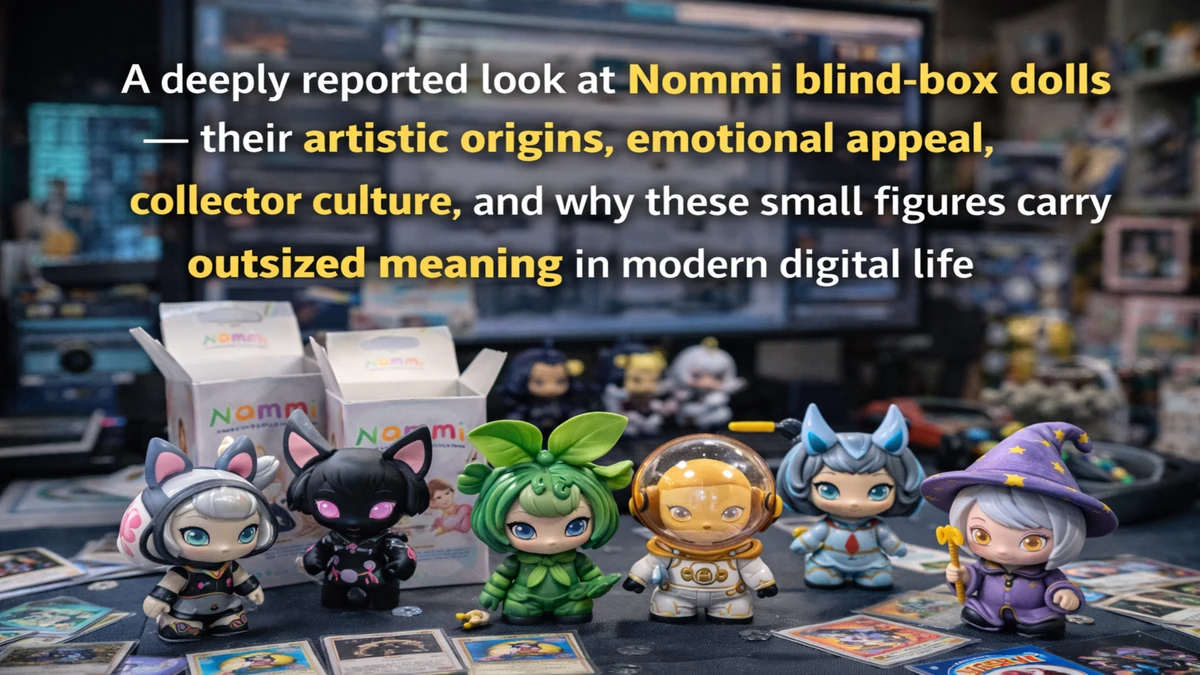
Nommi Blind Box Dolls: The Emotional Collectible Trend Redefining Toy Culture
Nommi is a line of collectible blind-box figures that blend plush softness, sculpted vinyl detail, and emotional storytelling into a single, intimate object. Each Nommi arrives sealed inside a mystery box, revealing a character associated with a feeling, a mood, or a small inner narrative gentleness, sleepiness, curiosity, melancholy, joy. This combination of tactile comfort, surprise, and symbolic meaning explains why Nommi has grown from a niche designer toy into a global cultural object shared across social platforms, collector communities, and personal desks.
Unlike mass-market toys built primarily for play, No-mmi is built for emotional resonance. The figures are small enough to be held in one hand, soft enough to be squeezed, and detailed enough to be displayed. They invite touch and contemplation at the same time. For many collectors, Nommi functions as a tiny emotional artifact — something between a plush toy, an art object, and a mood talisman.
The blind-box format plays a crucial role. Each purchase contains uncertainty, and that uncertainty produces anticipation, ritual, and emotional engagement. Opening a No-mmi box is not only about acquiring an object, but about experiencing a moment. That moment is what collectors return for.
Nommi’s success reflects broader cultural changes. As digital life accelerates, people seek physical objects that feel gentle, meaningful, and slow. Nommi fits into that desire precisely. It is not loud, flashy, or aggressive. It is quiet, pastel, rounded, and emotionally legible. In a world saturated with information, Nommi offers presence.
The Origin Story of Nommi
Nommi began as an artistic concept before it became a commercial product. The characters were designed to feel like emotional beings rather than fictional mascots. Their proportions are intentionally childlike but not infantile, expressive but not exaggerated, soft but not shapeless. This careful balance gives No-mmi its distinct identity.
The earliest Nommi series focused on emotional states rather than narratives. Instead of building a fantasy universe with elaborate lore, the designers created archetypes of feeling — sleepy figures, shy figures, gentle figures — that collectors could project their own meanings onto. This openness is central to Nommi’s appeal. The figures do not tell you what to feel; they give you something to feel with.
Over time, the series expanded into themed collections, seasonal variations, and limited editions. Some figures became rarer, creating a secondary market and deeper collector engagement. Yet the core design philosophy remained stable: softness, emotional symbolism, and intimate scale.
Nommi’s growth was organic rather than explosive. It spread through social media sharing, unboxing videos, desk photography, and fan art rather than traditional advertising. The brand did not tell people what Nommi was supposed to be; collectors showed each other what No-mmi meant to them.
What Collectors Are Really Collecting
On the surface, collectors are acquiring objects. Underneath, they are collecting moments, feelings, and identity signals.
Nommi allows collectors to externalize internal states. A sleepy Nommi might represent exhaustion, rest, or permission to slow down. A cheerful Nommi might represent optimism during a difficult time. Displaying a Nommi on a desk or shelf becomes a subtle form of emotional self-expression.
Collectors are also participating in ritual. The act of purchasing, opening, revealing, and sharing becomes a repeated ceremony. Ritual provides stability, and in an unstable world, stability is valuable.
Finally, collectors are joining a culture. Sharing collections online, trading duplicates, discussing authenticity, and chasing rare figures creates belonging. No-mmi is not only an object; it is a social language.
Market Structure and Series Landscape
| Series Type | Typical Price Range | Material Style | Intended Audience |
|---|---|---|---|
| Standard blind box | Low to mid | Plush + vinyl | Casual collectors |
| Themed blind box | Mid | Plush + vinyl | Fans and hobbyists |
| Limited editions | High | Premium plush | Dedicated collectors |
| Oversized editions | Very high | Art-grade plush | Art toy collectors |
| Year | Milestone |
|---|---|
| Initial launch | First emotional archetype series |
| Expansion | Multiple themed collections |
| Community growth | Social media sharing and fan art |
| Collector tier | Limited editions and rare figures |
These tiers show how Nommi accommodates multiple forms of engagement, from casual enjoyment to serious collecting.
Psychological and Cultural Meaning
Experts in consumer psychology often describe blind-box collecting as a form of low-risk uncertainty reward. The unknown creates excitement, while the known quality of the brand creates safety. Nommi strengthens this by adding emotional meaning to the reward itself.
From a cultural perspective, Nommi fits into a growing movement toward “soft culture” — a preference for gentle aesthetics, pastel tones, rounded forms, and emotional openness. This movement contrasts with earlier decades dominated by edginess, minimalism, or aggressive branding.
Nommi also reflects the rise of “slow consumption.” Instead of buying many disposable objects, collectors buy fewer objects that feel meaningful. Nommi’s softness and symbolism support that shift.
Community and Social Sharing
Nommi communities thrive online because the product is visually shareable and emotionally legible. A photograph of a Nommi on a windowsill communicates mood without explanation. A video of opening a blind box invites viewers into a moment of anticipation.
Collectors discuss series, rarity, authenticity, and emotional attachment. They trade duplicates, gift figures, and build narratives around their collections. This transforms consumption into participation.
The community does not revolve around competition alone. While rarity matters, kindness and sharing are equally central. Many collectors gift figures to friends during difficult times, using Nommi as a form of emotional support.
Nommi as an Object of Care
One of Nommi’s most distinctive traits is that people treat it gently. It is not thrown into toy bins or forgotten in drawers. It is placed carefully on desks, beside lamps, near beds, or inside display cases. This care reflects the emotional projection placed onto the object.
Nommi becomes a small companion. Not in the sense of replacing human relationships, but in offering quiet presence. For some, it is a reminder to rest. For others, a reminder to be gentle with themselves. That function cannot be separated from its success.
Takeaways
- Nommi combines tactile softness with emotional symbolism.
- The blind-box format creates ritual and anticipation.
- Collectors engage with Nommi as emotional artifacts, not just toys.
- Social sharing transformed Nommi into a participatory culture.
- Soft aesthetics reflect broader shifts in digital-age values.
Conclusion
Nommi’s success is not accidental, and it is not purely commercial. It represents a shift in what people want from objects. In an age of endless information, speed, and abstraction, Nommi offers slowness, touch, and feeling. It does not shout for attention; it waits quietly to be noticed.
That quietness is precisely its power. Nommi does not demand meaning; it invites meaning. Each collector brings their own story, mood, and moment into the figure they open. The result is a distributed narrative — thousands of tiny emotional stories embodied in soft, rounded forms.
Nommi reminds us that culture does not only live in large institutions or major events. It also lives in small rituals, private moments, and gentle objects that sit quietly beside us while life continues.
FAQs
What is Nommi?
Nommi is a line of collectible blind-box figures that combine plush softness, vinyl detail, and emotional themes.
Why are Nommi figures sold blind?
The blind format creates surprise, anticipation, and ritual, making each unboxing emotionally engaging.
Are Nommi figures toys or collectibles?
They function as both, but are primarily designed for display, emotional expression, and collecting.
Why do people feel attached to Nommi?
Because the figures represent emotions and moods that people project meaning onto.
Is Nommi a trend or a lasting phenomenon?
Its emotional and cultural grounding suggests longer relevance than short-term novelty trends.