
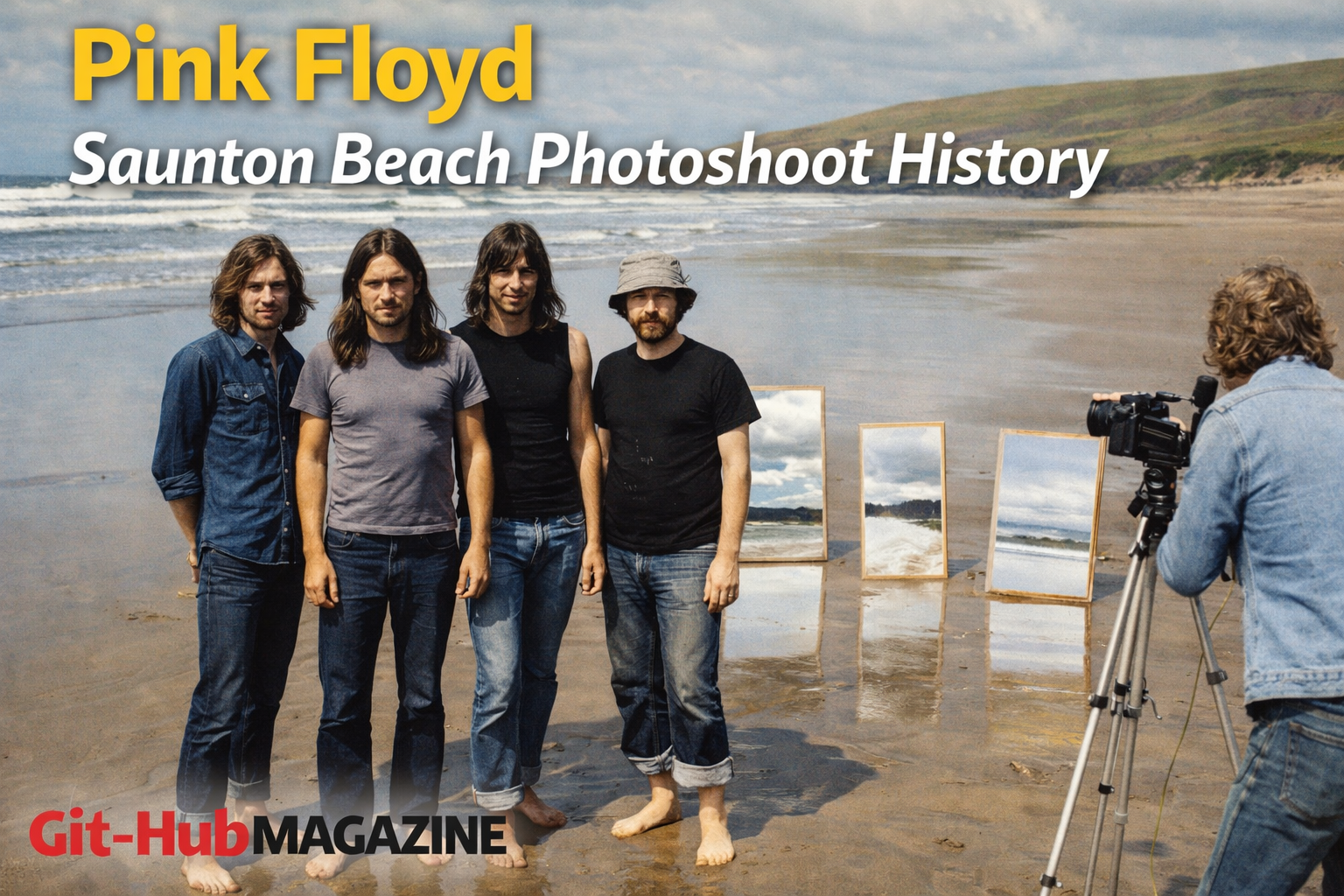
Pink Floyd Saunton Beach Photoshoot History
I have always believed that some of rock music’s most revealing moments happen far away from concert stages. The Pink Floyd photoshoot at Saunton Beach in Devon, England, stands as one of those rare cultural snapshots. Conducted in the late 1960s as the band began rising within Britain’s psychedelic music scene, the photos captured a transitional moment when Pink Floyd was evolving artistically and culturally. Fans searching for the Saunton Beach photoshoot are often looking for the origin and context of these images: when they were taken, why the band traveled there, and what they reveal about Pink Floyd’s early identity.
Saunton Beach, a wide stretch of sand on the North Devon coast, offered photographers an atmospheric setting far removed from London’s clubs and recording studios. Windswept dunes, gray skies, and the open Atlantic created a natural backdrop that contrasted sharply with the psychedelic imagery associated with the band’s music.
During the late 1960s, Pink Floyd consisted of Roger Waters, Richard Wright, Nick Mason, and Syd Barrett, who served as the band’s early creative leader. Barrett’s imaginative songwriting defined the group’s first recordings, including their debut album The Piper at the Gates of Dawn released in 1967.
Photographs from the Saunton Beach shoot reflect that era’s experimentation and youthful ambition. The images show the musicians walking across the shoreline, standing in relaxed poses, and interacting casually with their surroundings.
Decades later, these photographs remain important artifacts of rock history. They document a band on the edge of transformation, just before Pink Floyd evolved into one of the most influential progressive rock groups of all time.
Pink Floyd’s Early Rise in the Psychedelic Era
To understand the significance of the Saunton Beach photoshoot, it is important to examine the period in which it occurred. The mid to late 1960s were a time of rapid change in British music, particularly within London’s underground scene.
Pink Floyd emerged from that environment, performing at venues such as the UFO Club where psychedelic light shows and experimental music defined the atmosphere. Syd Barrett’s songwriting combined surreal imagery with innovative guitar techniques, quickly drawing attention from audiences and critics.
Their debut album, The Piper at the Gates of Dawn, released in August 1967, became one of the defining records of British psychedelic rock. Music historian Mark Blake describes the album as “a vivid snapshot of London’s psychedelic underground at its most imaginative stage.”
During this early period, the band frequently participated in promotional photoshoots organized by record labels and photographers seeking to capture the emerging visual identity of psychedelic rock.
The Saunton Beach session occurred within this context, when Pink Floyd was gaining attention yet still experimenting with its public image.
The Setting: Saunton Beach in North Devon
Saunton Beach lies along the North Devon coastline near the village of Braunton. Stretching for nearly three miles, it is known for its expansive shoreline, sand dunes, and dramatic views of the Atlantic Ocean.
The beach has long attracted surfers, photographers, and filmmakers because of its natural scenery and changing coastal light. In the 1960s, however, the area remained relatively quiet compared with Britain’s urban cultural centers.
For photographers, Saunton offered a landscape that felt cinematic without requiring elaborate staging. Rolling dunes and windswept skies created natural depth and atmosphere.
Music journalist Andy Mabbett has noted that Pink Floyd’s early visual imagery often relied on natural environments rather than studio settings. Such locations helped emphasize the band’s experimental and unconventional identity.
By choosing Saunton Beach as a backdrop, photographers captured the musicians in a space that felt expansive and slightly mysterious, reflecting the mood of the psychedelic era.
The beach setting also allowed the band to appear relaxed and informal, far removed from the structured promotional photographs typically produced by record companies.
The Photographers Behind the Shoot
Photographs of Pink Floyd from the late 1960s were often taken by prominent music photographers who documented the evolving rock scene. Among them was Vic Singh, who photographed the band during the period surrounding their first album.
Singh’s work frequently emphasized natural light and candid expressions rather than staged studio portraits. This style aligned well with the Saunton Beach environment.
Photography historian Jill Furmanovsky has described 1960s rock photography as a turning point in visual culture. According to Furmanovsky, photographers began portraying musicians as creative individuals rather than simply promotional figures.
The Saunton Beach images follow this tradition. Instead of rigid poses, the photographs show the band walking along the sand, interacting casually with one another, and gazing toward the ocean.
Such imagery helped shape the emerging visual language of rock music, where environment and mood became as important as the musicians themselves.
Timeline of Pink Floyd Around the Saunton Beach Era
| Year | Event | Cultural Impact |
|---|---|---|
| 1965 | Pink Floyd forms in London | Early psychedelic experimentation |
| 1967 | Release of The Piper at the Gates of Dawn | Landmark psychedelic album |
| 1967–1968 | Promotional photoshoots including beach sessions | Establish visual identity |
| 1968 | Syd Barrett leaves the band | Creative shift toward progressive rock |
The Saunton Beach photographs sit within this pivotal window when the band was transitioning between its psychedelic beginnings and later progressive sound.
Visual Style and Atmosphere of the Photoshoot
Examining the Saunton Beach photographs reveals a distinctive visual tone. Unlike the colorful studio imagery often associated with psychedelic music, these images rely on muted coastal light and natural textures.
The musicians appear dressed in casual clothing typical of the late 1960s counterculture. Their posture is relaxed, suggesting that the shoot allowed them to move freely rather than posing in rigid arrangements.
Art critic Simon Reynolds has written that rock photography of the era often sought to capture authenticity. Images that appeared spontaneous or unposed were believed to represent the true spirit of the musicians.
The Saunton Beach photographs embody this approach. The wind moving across the dunes, the uneven shoreline, and the band members’ informal gestures create an atmosphere that feels both intimate and cinematic.
These visual elements contribute to the lasting appeal of the images among fans and collectors.
Comparing Pink Floyd’s Early Photoshoots
| Location | Style | Cultural Significance |
|---|---|---|
| London studios | Formal portraits | Record label promotion |
| UFO Club imagery | Psychedelic lighting | Underground music scene |
| Saunton Beach | Natural landscape photography | Transitional band identity |
The Saunton Beach shoot stands apart because of its simplicity and environmental context.
Cultural Context of the Late 1960s
The late 1960s represented a turning point not only for Pink Floyd but also for popular culture. Music, fashion, and visual art were undergoing rapid experimentation.
Rock bands increasingly viewed photography as part of their artistic identity. Album covers, magazine spreads, and promotional images all contributed to a band’s cultural narrative.
According to music historian Jon Savage, the psychedelic movement encouraged artists to explore new forms of expression that blended music with visual art.
Pink Floyd became one of the leading examples of this approach. Their later album artwork, including the iconic prism design of The Dark Side of the Moon, would become some of the most recognizable images in music history.
The Saunton Beach photographs represent an early step in that visual journey.
Expert Perspectives on Rock Photography
Music photography experts frequently emphasize the historical importance of candid promotional shoots.
Photographer Jill Furmanovsky once observed that many of the most enduring rock photographs were created outside studios, where musicians appeared more natural and expressive.
Similarly, cultural critic Greil Marcus has argued that rock imagery often reveals as much about a band’s identity as the music itself.
Music historian Mark Blake also notes that Pink Floyd’s early photographs captured a moment before the band developed its later conceptual image.
These expert perspectives highlight why seemingly simple photographs can carry significant historical meaning.
Key Takeaways
- The Pink Floyd Saunton Beach photoshoot occurred during the band’s early psychedelic era in the late 1960s.
- Saunton Beach in Devon provided a natural and atmospheric setting for rock photography.
- The photographs captured the band before major lineup changes reshaped its musical direction.
- Early promotional images helped establish Pink Floyd’s evolving visual identity.
- Natural outdoor photography reflected broader trends in 1960s rock culture.
- The images remain valuable historical artifacts for fans and music historians.
Conclusion
When I look at the photographs from Pink Floyd’s Saunton Beach session, I see more than a band posing for promotional images. I see a moment suspended in time, when a group of young musicians stood at the edge of creative transformation.
The windswept coastline of North Devon provided a setting that felt both quiet and expansive, echoing the experimental spirit of the psychedelic era. In those images, Pink Floyd appears relaxed, almost contemplative, unaware of the extraordinary influence they would soon exert on the world of music.
Within a few years, the band would release albums that reshaped progressive rock and established one of the most iconic catalogs in popular music. Yet the Saunton Beach photographs remind us that every legendary career begins with smaller, quieter moments.
Today, fans and historians continue to study these images not only for their aesthetic value but also for the glimpse they offer into the early days of a band still discovering its identity.
In that sense, the Saunton Beach photoshoot stands as a visual prologue to one of rock music’s most remarkable stories.
FAQs
When was the Pink Floyd Saunton Beach photoshoot taken
The photoshoot took place during the late 1960s when the band was promoting its early music and establishing its visual identity.
Why was Saunton Beach chosen for the photoshoot
Saunton Beach offered dramatic natural scenery and quiet surroundings, making it an ideal location for atmospheric rock photography.
Who was in Pink Floyd during that time
The band included Syd Barrett, Roger Waters, Richard Wright, and Nick Mason during the early psychedelic era.
Are the Saunton Beach photos widely published
Some photographs appear in music books, archives, and collector publications documenting Pink Floyd’s early career.
Why are these photos historically important
They capture Pink Floyd during a transitional moment just before the band’s musical style evolved into progressive rock.