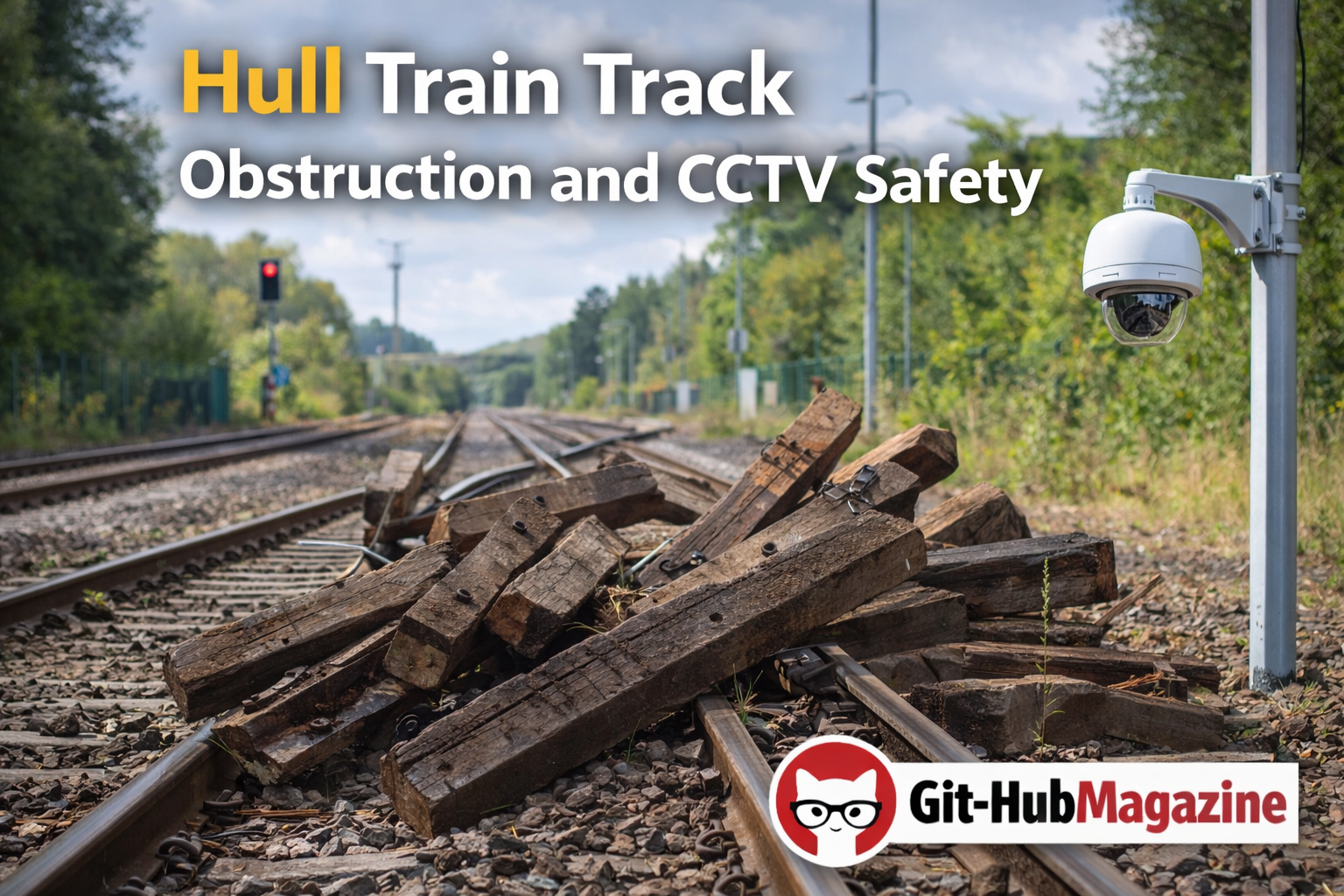
Hull Train Track Obstruction and CCTV Safety
I began examining the Hull train track obstruction CCTV incident to understand what happened, why it mattered, and how railway authorities responded. In simple terms, a reported obstruction on railway tracks near Hull was captured on closed circuit television, prompting emergency response measures, service disruption, and renewed warnings about the dangers of trespass and interference with rail infrastructure. Incidents of objects placed on tracks, debris left near lines, or unauthorized access to railway corridors are not isolated events in the United Kingdom. Network Rail has repeatedly documented thousands of trespass and vandalism cases annually, some of which pose life threatening risks to passengers and railway staff. CCTV systems installed across stations, level crossings, and key junctions play a critical role in identifying hazards and supporting investigations. In Hull and the surrounding East Yorkshire region, rail routes connect communities to Leeds, York, and London, making safety interruptions particularly disruptive. The CCTV footage in this case did more than record a moment. It underscored how modern rail networks rely on surveillance technology to prevent tragedy, enforce the law, and reassure the public that safety remains paramount.
The Context of Railway Obstructions in Britain
Railway obstructions range from fallen trees and weather debris to deliberate acts of vandalism. According to Network Rail, thousands of trespass incidents are recorded across Great Britain each year, with a significant proportion involving young people. Even seemingly minor objects placed on tracks can derail trains or damage rolling stock, especially at high speeds.
The Rail Safety and Standards Board has long warned that track interference is not harmless mischief. Trains can take over a mile to stop when traveling at full line speed. Any obstruction, intentional or accidental, poses a severe risk.
Hull sits along routes managed by Network Rail’s Eastern region. The city’s rail connections are vital to regional commerce and commuting. When an obstruction is detected, services may be halted while drivers receive instructions and maintenance teams inspect the line. These safety protocols, though disruptive, are designed to prevent catastrophic outcomes.
The CCTV footage associated with the Hull incident reflects this wider national challenge.
How CCTV Protects the Rail Network
Closed circuit television is now embedded in British rail infrastructure. Cameras monitor platforms, track approaches, depots, and level crossings. They provide real time feeds to control centers and record footage for evidentiary use.
The British Transport Police frequently rely on CCTV when investigating trespass, vandalism, and obstruction cases. Under the Regulation of Railways Act 1868 and subsequent safety legislation, interfering with railway operations is a criminal offense.
Security analyst Professor Martin Gill has written that surveillance in transport environments serves both deterrent and investigative functions. Visible cameras can discourage risky behavior, while recorded footage strengthens prosecutions.
In the Hull case, CCTV allowed operators to identify the presence of an obstruction quickly and coordinate response measures. Without such systems, detection might have depended solely on driver reports or track inspections, potentially increasing risk.
Railway Safety Statistics Overview
| Category | Approximate Annual Figures (Great Britain) |
|---|---|
| Trespass incidents | Over 15,000 recorded cases |
| Vandalism reports | Several thousand annually |
| Level crossing misuse cases | Thousands per year |
| Fatalities from trespass | Dozens annually |
These figures underscore why surveillance and rapid response matter.
The Immediate Impact on Services
When an obstruction is reported or detected, railway control centers initiate strict procedures. Drivers are alerted via signaling systems, and trains may be held at preceding stations. Maintenance crews are dispatched to inspect the track.
In and around Hull, services operated by Northern and Hull Trains connect to major urban centers. Even a brief suspension can ripple outward, affecting commuters and long distance travelers.
Transport economist Christian Wolmar has observed that rail networks operate on tightly synchronized timetables. Disruptions in one corridor can cascade across interconnected routes. Thus, a local obstruction has regional implications.
Passengers may see delays or cancellations but rarely witness the unseen coordination required to ensure safety. CCTV accelerates this coordination by confirming hazards visually, enabling faster decision making and minimizing unnecessary shutdowns once the risk is cleared.
Legal Consequences of Track Interference
Placing objects on railway tracks or trespassing can lead to prosecution. The British Transport Police enforce laws under the Malicious Damage Act 1861 and other statutes. Convictions may result in fines or imprisonment, depending on severity and intent.
In recent years, courts have treated deliberate railway obstruction as a serious offense. The Crown Prosecution Service emphasizes that interference with transport infrastructure endangers public safety.
Legal scholar Professor Graham Virgo has noted that public infrastructure crimes carry heightened penalties because they risk mass harm. A single act on railway tracks can endanger hundreds of passengers.
CCTV footage often provides decisive evidence. Clear images identifying individuals near tracks can support arrests and convictions, reinforcing the deterrent message that such acts are neither anonymous nor trivial.
Community Reactions in Hull
Incidents involving railway safety resonate locally. Hull, a port city with deep maritime and industrial heritage, relies heavily on its rail links for economic vitality. Residents often express frustration at disruptions but also concern for safety.
Community leaders in East Yorkshire have supported awareness campaigns discouraging trespass. Schools collaborate with Network Rail on educational outreach, emphasizing the dangers of track access.
Psychologist Professor Rory O’Connor, who studies risk behavior, has argued that young people often underestimate the speed and stopping distance of trains. Public education, combined with visible enforcement, aims to counteract that misperception.
The CCTV footage from the Hull obstruction incident circulated in local media, reinforcing the seriousness of the event and prompting renewed dialogue about personal responsibility.
Technology and Preventive Innovation
Beyond CCTV, modern rail safety incorporates motion sensors, track circuits, and remote monitoring systems. Artificial intelligence is increasingly deployed to detect unusual patterns or intrusions automatically.
Network Rail has piloted technology capable of alerting control rooms when objects appear on tracks near vulnerable areas. Such systems complement traditional cameras by reducing reliance on human monitoring alone.
Security consultant Jane Frankland has highlighted the importance of integrating digital surveillance with rapid response protocols. Cameras without action plans provide limited benefit. The Hull case illustrates how surveillance must connect seamlessly with operational decision making.
Investment in safety technology remains ongoing. As passenger numbers recover post pandemic, maintaining confidence in rail travel depends on minimizing preventable hazards.
Comparison of Detection Methods
| Method | Strength | Limitation |
|---|---|---|
| CCTV Cameras | Visual confirmation, evidentiary value | Requires monitoring or review |
| Track Circuits | Automatic detection of disruptions | May not identify small objects |
| Driver Reports | Immediate human observation | Depends on visibility |
| AI Monitoring | Rapid anomaly detection | Emerging technology, cost factors |
Combining methods offers layered protection.
National Policy and Rail Safety Strategy
The Department for Transport and the Office of Rail and Road oversee rail safety standards in Britain. Strategic frameworks emphasize reducing trespass and vandalism through design, enforcement, and community engagement.
The Rail Safety and Standards Board publishes annual safety performance reports documenting trends and recommending interventions. These reports highlight that while overall railway fatalities have declined compared with previous decades, trespass remains a persistent challenge.
Hull’s incident fits within this broader policy environment. Each recorded obstruction informs national data sets that shape funding priorities and prevention strategies.
Policy makers increasingly view public awareness as critical. Campaigns such as “You vs Train” use stark messaging to discourage risky behavior near tracks.
Broader Implications for Public Surveillance
The Hull CCTV footage also raises questions about privacy and public monitoring. Britain is among the most surveilled societies in Europe, with extensive camera coverage in transport networks.
Civil liberties advocates caution that surveillance must balance security with proportionality. The Information Commissioner’s Office provides guidance on data retention and lawful use of CCTV.
Professor Clive Norris, a scholar of surveillance studies, has argued that public acceptance of cameras often hinges on perceived safety benefits. Railway incidents tend to reinforce support for monitoring when footage demonstrably prevents harm.
In this context, the Hull obstruction becomes more than a local event. It contributes to the ongoing negotiation between security and privacy in modern Britain.
Takeaways
• CCTV detected and documented a railway obstruction near Hull, enabling rapid response.
• Railway obstructions pose serious risks due to high train speeds and long stopping distances.
• British law criminalizes interference with rail infrastructure.
• Surveillance systems play both deterrent and investigative roles.
• Community education campaigns aim to reduce trespass incidents.
• The incident reflects national debates about safety and privacy.
Conclusion
As I reflect on the Hull train track obstruction CCTV footage, I am struck by how a single object on steel rails can illuminate an entire ecosystem of safety, technology, law, and public trust. The cameras did not merely record. They activated a chain of prevention that protected passengers traveling at high speed through East Yorkshire. Railway systems function on precision and predictability, yet they remain vulnerable to human action. Surveillance, education, and enforcement together form the protective architecture that keeps trains moving safely. Hull’s experience reminds us that infrastructure is both physical and social. Tracks and signals matter, but so do responsibility and awareness. In an age where cameras watch over much of public life, moments like this justify their presence, provided that oversight and accountability accompany their use. The railways have long symbolized connection and progress. Protecting them demands vigilance from authorities and citizens alike.
FAQs
What happened in the Hull train track obstruction incident
CCTV captured an obstruction on railway tracks near Hull, prompting safety checks and service disruption.
Is placing objects on railway tracks illegal in the UK
Yes. Interfering with railway operations is a criminal offense and can result in fines or imprisonment.
How does CCTV help prevent rail accidents
Cameras provide real time monitoring and recorded evidence, enabling rapid response and investigation.
Who investigates railway obstruction cases
The British Transport Police typically lead investigations, supported by Network Rail.
Are railway obstructions common
Thousands of trespass and vandalism incidents are recorded annually across Great Britain.