
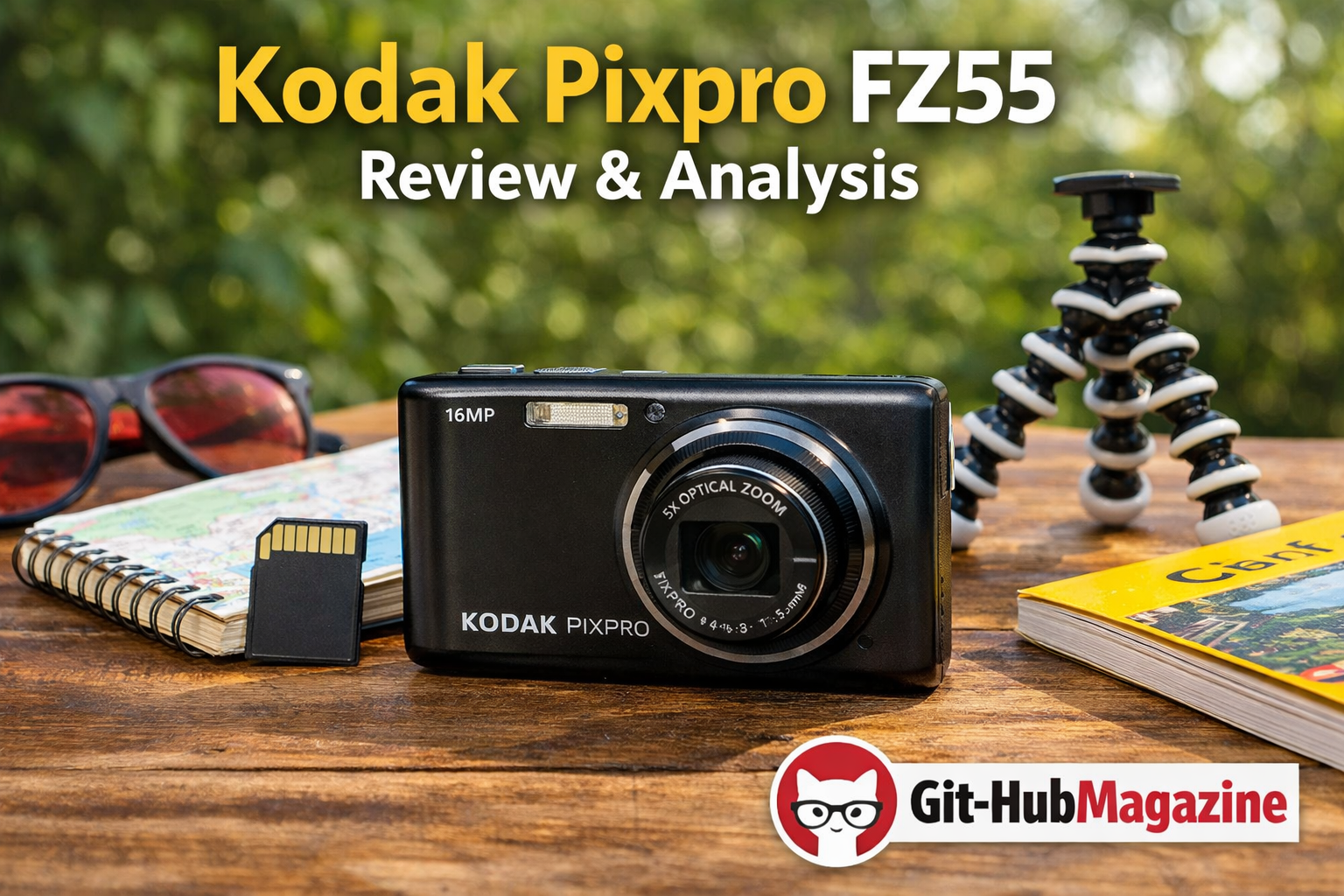
Kodak Pixpro FZ55 Review and Analysis
I have spent years watching the slow fade of the compact camera, a once essential gadget that now competes with smartphones boasting computational photography and ever expanding lens arrays. Yet the Kodak Pixpro FZ55 exists as a quiet rebuttal to the idea that point and shoot cameras are obsolete. If you are wondering whether the Kodak Pixpro FZ55 is worth buying, what features it offers, and how it compares to modern smartphones or rival budget cameras, the answer lies in its simplicity. Released as part of Kodak’s Friendly Zoom line under license by JK Imaging, the FZ55 features a 16 megapixel 1/2.3 inch CMOS sensor, a 5x optical zoom lens equivalent to 28 to 140mm, Full HD 1080p video recording, and a compact body weighing under 110 grams without battery. It targets beginners, students, and casual travelers who want optical zoom and tactile controls without navigating smartphone menus. In an age of algorithm driven imaging, the FZ55 leans on traditional optics and straightforward design. As I explored the camera’s capabilities, its appeal became less about competing with flagship phones and more about reclaiming a focused, distraction free way to capture everyday life.
The Legacy Behind the Name
The Kodak brand carries weight. Founded in 1888 by George Eastman, Eastman Kodak once dominated global photography, pioneering roll film and consumer cameras. Although the company filed for bankruptcy protection in 2012, the Kodak name persists through licensing agreements in consumer electronics. The Pixpro line, including the FZ55, is manufactured by JK Imaging Ltd., which licenses the Kodak brand for digital cameras.
This lineage matters. For many buyers, Kodak represents accessibility and memory making rather than cutting edge innovation. The FZ55 inherits that legacy. It does not promise professional performance, but it does evoke the company’s long standing philosophy of making photography available to everyday users.
Camera historian Jeff Curto has noted that Kodak’s original mission was to simplify photography for the masses. That ethos resonates in the FZ55’s user interface, which prioritizes ease of use over customization depth. The camera’s presence in retail stores today demonstrates how legacy branding still influences purchasing decisions, especially among younger users discovering standalone cameras for the first time.
Core Specifications and Features
At its heart, the Kodak Pixpro FZ55 is defined by modest but practical specifications. The camera uses a 16 megapixel CMOS sensor paired with a 5x optical zoom lens. The lens offers a 28mm wide angle equivalent at its widest point, expanding to approximately 140mm at full zoom. Optical zoom, rather than digital cropping, allows users to capture distant subjects with minimal image degradation compared to smartphone digital zoom.
The rear of the camera features a 2.7 inch LCD screen with a resolution of approximately 230,000 dots. It records video in Full HD 1080p at 30 frames per second and supports SD and SDHC memory cards. Power comes from a rechargeable lithium ion battery, charged via micro USB.
These specifications position the FZ55 as an entry level device. It does not include Wi Fi connectivity or advanced image stabilization found in higher tier models. Yet its lightweight design, compact footprint, and intuitive controls make it accessible to beginners.
Key Specifications Overview
| Feature | Kodak Pixpro FZ55 |
|---|---|
| Sensor | 16MP 1/2.3 inch CMOS |
| Optical Zoom | 5x (28 to 140mm equivalent) |
| Video | 1080p Full HD |
| Screen | 2.7 inch LCD |
| Weight | Approx. 106g without battery |
| Storage | SD and SDHC cards |
This combination reflects a deliberate balance between portability and essential photographic capability.
Performance in Real World Use
I carried the FZ55 through city streets and into low lit cafes to test how it handles common scenarios. In bright daylight, the camera produces crisp images with accurate color reproduction. The 16 megapixel resolution allows for moderate cropping without sacrificing clarity for social media or small prints.
Low light performance is more limited. The small sensor struggles with noise at higher ISO settings, a common limitation among compact cameras with 1/2.3 inch sensors. Images taken indoors without flash can appear grainy. The built in flash helps in close range situations but lacks the subtlety of larger camera systems.
Autofocus performance is reasonably quick in well lit environments, though it can hesitate in dim conditions. Shutter lag is minimal for casual shooting. Overall, the camera performs predictably within its design constraints.
Photography educator Derrick Story has often emphasized that entry level cameras should encourage experimentation rather than intimidate users. In that regard, the FZ55 succeeds by offering straightforward shooting modes and scene presets that simplify decision making.
Comparison With Smartphone Photography
The modern smartphone presents the FZ55’s greatest competition. Flagship phones from Apple and Samsung offer multiple lenses, advanced computational HDR, and night modes powered by artificial intelligence. Yet smartphones rely heavily on digital zoom beyond their primary lens range.
The FZ55’s 5x optical zoom remains its defining advantage. Optical zoom physically adjusts the lens elements to magnify subjects without cropping the sensor output. For travelers capturing distant landmarks or parents photographing school performances, this optical reach can produce more natural results than digital enlargement.
However, smartphones excel in connectivity and processing. They allow instant sharing, cloud backup, and sophisticated image enhancement. The FZ55 requires transferring files via SD card or USB.
Compact Camera vs Smartphone
| Capability | Pixpro FZ55 | Typical Smartphone |
|---|---|---|
| Optical Zoom | Yes, 5x | Limited or hybrid |
| Manual Controls | Basic | App dependent |
| Instant Sharing | No built in Wi Fi | Yes |
| Computational HDR | Limited | Advanced AI driven |
| Portability | Highly compact | Always carried device |
The choice ultimately depends on whether a user values optical zoom and a dedicated shooting experience over seamless connectivity.
Market Position and Audience
The FZ55 occupies a specific niche within the shrinking compact camera market. According to industry reports from the Camera and Imaging Products Association, global shipments of digital cameras have declined dramatically since the early 2010s, largely due to smartphone adoption. Yet demand persists in the entry level segment.
Retail listings position the FZ55 as a budget friendly option often priced under one hundred dollars. This affordability makes it attractive to students, children, and travelers seeking a lightweight backup camera.
Technology analyst Thom Hogan has argued that compact cameras survive by serving audiences who desire simplicity or specific features like optical zoom. The FZ55 aligns with this assessment. It does not attempt to rival mirrorless systems or professional DSLRs. Instead, it offers a focused value proposition centered on portability and ease of use.
Design Philosophy and Build
Physically, the FZ55 feels lightweight and minimalist. Its plastic body keeps costs low while maintaining portability. The control layout includes a top mounted shutter button and zoom rocker, rear directional pad, and dedicated video recording button.
The design echoes traditional point and shoot cameras from the early 2000s. For users who grew up with digital compacts, this familiarity can be reassuring. For younger users raised on touchscreens, the tactile buttons introduce a different kind of engagement.
Industrial design critic Alice Rawsthorn has written that simplicity often reflects intentional restraint rather than technological limitation. In the FZ55, the absence of advanced features becomes part of its identity. The camera encourages deliberate framing instead of endless menu exploration.
Image Quality and Color Science
Kodak’s reputation for color science stems from its film heritage. While the Pixpro FZ55 operates in the digital domain, its color rendering aims for natural tones with slightly warm highlights. Outdoor images display balanced contrast without overly aggressive saturation.
Dynamic range remains moderate due to sensor size. Bright skies can lose detail in high contrast scenes unless exposure compensation is adjusted. The camera includes scene modes such as portrait, landscape, and night, which automatically tweak settings for common scenarios.
Image sharpness at base ISO is satisfactory for prints up to standard sizes. For online sharing, resolution and clarity are more than sufficient. The FZ55’s limitations become apparent primarily in challenging lighting conditions.
The Broader Context of Compact Camera Revival
In recent years, social media trends have sparked renewed interest in compact digital cameras. Younger creators embrace early 2000s aesthetics, valuing flash photography and candid snapshots that differ from polished smartphone images.
The FZ55 benefits from this nostalgia wave. Its straightforward interface and flash capability align with the aesthetic preferences of a generation seeking distinct visual textures.
Industry observers note that while overall camera shipments remain low compared with a decade ago, niche enthusiasm for compact models has grown. The FZ55 enters this cultural moment as an affordable gateway to standalone photography.
Takeaways
• The Kodak Pixpro FZ55 features a 16MP sensor and 5x optical zoom in a lightweight body.
• It prioritizes simplicity and affordability over advanced connectivity.
• Optical zoom distinguishes it from many smartphones.
• Low light performance is limited due to sensor size.
• The camera appeals to beginners, students, and nostalgia driven users.
• Its design reflects Kodak’s legacy of accessible photography.
Conclusion
As I reflect on the Kodak Pixpro FZ55, I see it not as a challenger to cutting edge smartphone technology but as a quiet affirmation of dedicated photography tools. It offers optical zoom, tactile controls, and distraction free shooting at a price accessible to beginners. In bright light, it produces pleasing images suitable for everyday documentation. Its limitations in low light and connectivity are clear, yet they define rather than diminish its purpose. The FZ55 embodies a philosophy rooted in accessibility and simplicity, echoing Kodak’s historical mission. In a world saturated with multipurpose devices, the appeal of a single purpose camera endures. For travelers seeking reach beyond a phone lens or newcomers eager to explore photography without overwhelming complexity, the FZ55 remains a relevant, if modest, companion.
FAQs
What type of sensor does the Kodak Pixpro FZ55 use
It uses a 16 megapixel 1/2.3 inch CMOS sensor typical of entry level compact cameras.
Does the FZ55 have Wi Fi connectivity
No, the camera does not include built in Wi Fi for wireless transfer.
Is the Kodak Pixpro FZ55 good for beginners
Yes, its simple interface and automatic modes make it suitable for first time camera users.
Can the FZ55 record video
Yes, it records Full HD 1080p video at 30 frames per second.
How does it compare to smartphones
It offers true 5x optical zoom but lacks advanced computational photography and instant sharing features.