
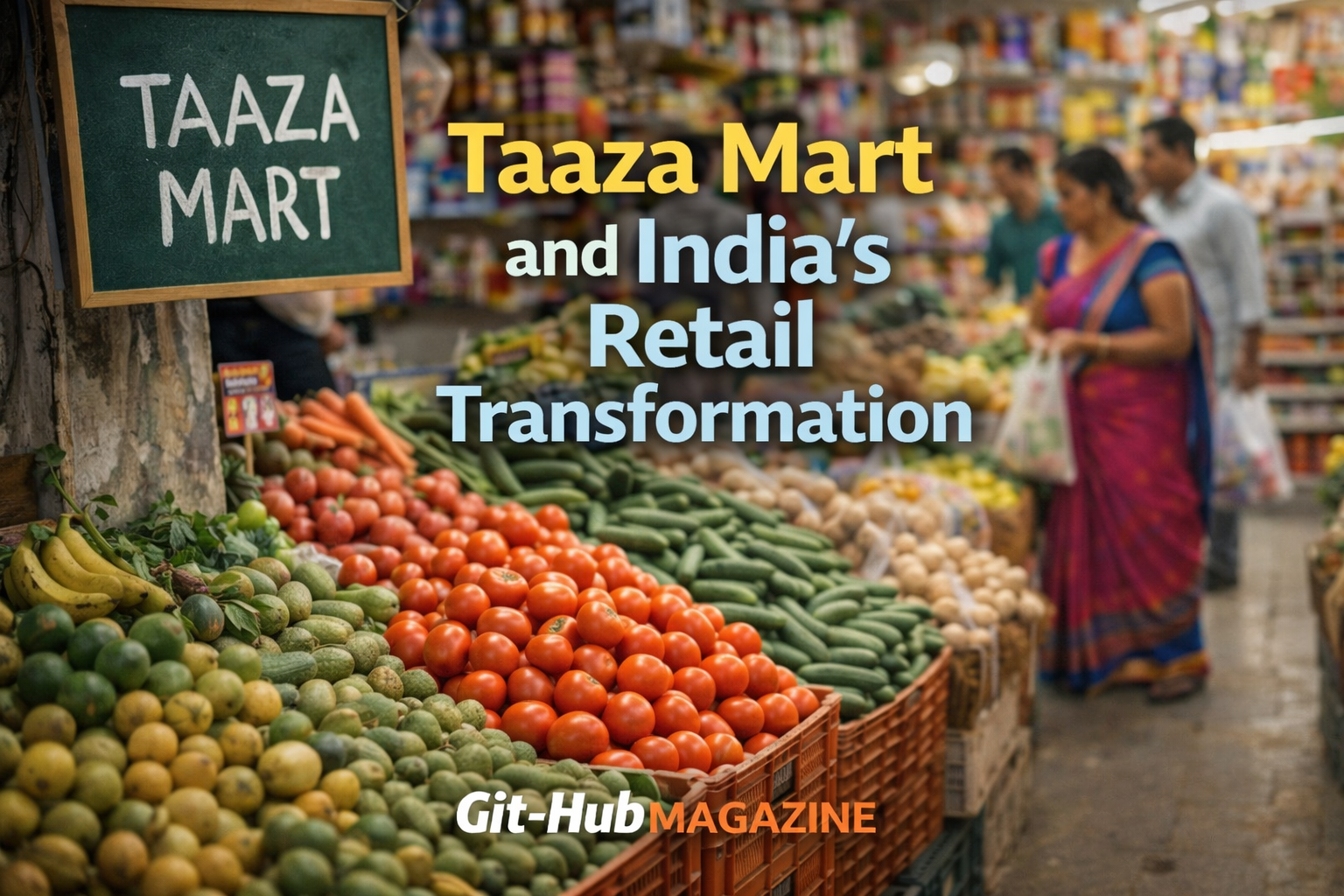
Taaza Mart and India’s Retail Transformation
Taaza Mart is part of a growing class of Indian neighborhood grocery stores that blend traditional kirana retail with modern logistics, digital payments and hyperlocal delivery models. For customers, it promises fresh produce, daily essentials and convenience within walking distance. For small retailers, it represents adaptation in a retail landscape reshaped by e-commerce giants and venture-backed quick-commerce platforms.
India’s grocery sector is one of the largest in the world. Food and grocery account for nearly 60 percent of India’s retail market, according to the India Brand Equity Foundation (IBEF, 2023). For decades, this market has been dominated by kirana stores, small, family-run shops embedded in residential communities. But in the past ten years, online grocery platforms such as BigBasket, Blinkit and Swiggy Instamart have transformed consumer expectations around speed and convenience.
In this evolving environment, Taaza Mart operates at the intersection of familiarity and modernization. It is not merely a store selling vegetables and staples. It is a reflection of how India’s retail ecosystem is rebalancing between physical proximity and digital integration. Understanding Taaza Mart requires examining India’s broader retail transformation, consumer behavior shifts and the economic resilience of small-scale commerce.
The Indian Grocery Landscape
India’s retail market was valued at approximately $836 billion in 2022 and is projected to grow significantly over the coming decade (IBEF, 2023). Grocery remains the dominant category, accounting for the majority of consumer spending. Unlike Western markets where supermarkets and hypermarkets dominate, India’s grocery ecosystem is highly fragmented.
According to a 2021 report by Deloitte, more than 12 million kirana stores operate across India, forming the backbone of daily household consumption (Deloitte, 2021). These stores are characterized by personalized service, informal credit systems and hyperlocal relationships.
The retail structure can be broadly categorized as follows:
| Retail Format | Approximate Share | Characteristics |
|---|---|---|
| Kirana stores | 80–85% | Small, family-run, neighborhood based |
| Modern trade (supermarkets, hypermarkets) | 10–12% | Organized chains, urban centers |
| Online grocery | 3–5% | App-based ordering, delivery focused |
Taaza Mart situates itself within this kirana tradition but often integrates elements of modern trade, including digital billing, inventory management systems and UPI-based payments.
Modernization of the Kirana Model
The traditional kirana store has long thrived on proximity and trust. Shopkeepers often know customers by name and extend informal credit. However, the digital wave in India accelerated after the launch of the Unified Payments Interface in 2016, which simplified mobile payments nationwide (National Payments Corporation of India, 2016).
By 2023, UPI processed billions of monthly transactions, making digital payments commonplace even in small neighborhood stores. Taaza Mart outlets frequently display QR codes alongside handwritten price boards, symbolizing the fusion of old and new.
Retail analyst Arvind Singhal of Technopak Advisors has observed that “India’s retail story is not about replacing kiranas but upgrading them” (Technopak, 2020). This insight helps explain Taaza Mart’s positioning. Rather than competing head-on with e-commerce platforms, such stores adapt operationally while retaining community roots.
Supply Chains and Freshness
Fresh produce is central to Taaza Mart’s identity. The word “taaza,” meaning fresh in Hindi and Urdu, signals a promise of quality vegetables, fruits and dairy items. India’s agricultural supply chain, however, has historically faced inefficiencies.
The Food and Agriculture Organization estimates that significant post-harvest losses occur due to inadequate cold storage and transportation infrastructure (FAO, 2019). In recent years, government initiatives and private investments have aimed to strengthen cold chains and farm-to-market linkages.
Taaza Mart often sources from local mandis, wholesale agricultural markets regulated under state Agricultural Produce Market Committee frameworks. By shortening procurement cycles and maintaining daily replenishment, neighborhood stores can compete on freshness against larger chains.
This operational agility reflects a broader trend: decentralized retail can sometimes respond faster to local demand shifts than centralized distribution hubs.
Competition from Quick Commerce
The rise of quick-commerce platforms has intensified pressure on neighborhood grocery stores. Companies such as Blinkit, formerly Grofers, promise delivery within minutes. Urban consumers increasingly expect rapid fulfillment of daily essentials.
A 2022 RedSeer report highlighted that India’s quick-commerce market could reach billions in value over the next few years, driven by urban density and smartphone penetration (RedSeer, 2022). Yet profitability remains a challenge for many of these platforms due to logistics costs.
The comparison between neighborhood stores like Taaza Mart and quick-commerce platforms reveals strategic differences:
| Dimension | Taaza Mart | Quick-Commerce Apps |
|---|---|---|
| Delivery Speed | Walk-in or local delivery | 10–20 minutes |
| Cost Structure | Low overhead, family labor | High logistics investment |
| Customer Relationship | Personal, recurring | App-based, transactional |
| Payment Modes | Cash, UPI, card | Digital only |
Retail economist Professor R. Venkatesan has argued that “India’s retail future will be hybrid, not exclusively digital” (Indian Institute of Management Bangalore, 2021). Taaza Mart exemplifies that hybridization.
Consumer Trust and Community Capital
In densely populated urban neighborhoods, grocery stores serve as social anchors. Customers rely on them not only for goods but also for reliability during disruptions. During the COVID-19 lockdowns in 2020, local kirana stores played a crucial role in maintaining food access when larger supply chains faltered.
According to a 2020 study by the Confederation of All India Traders, small retailers ensured continuity of essential supplies during mobility restrictions. Taaza Mart outlets operating in residential zones benefited from their accessibility and established trust networks.
Sociologist Ashwin Mahesh has noted that “informal retail networks create resilience in Indian cities” (Observer Research Foundation, 2020). This resilience is less visible in financial statements but central to long-term sustainability.
Taaza Mart’s identity is therefore partly economic and partly social. It operates within the cultural ecosystem of neighborhood interdependence.
Pricing Strategies and Margins
Grocery retail in India is margin-sensitive. Staple items often yield thin profit margins, sometimes as low as 5 to 10 percent. Fresh produce margins can be slightly higher but fluctuate with seasonal supply.
Taaza Mart’s pricing strategy typically balances competitive rates with loyalty incentives. While large online platforms may offer deep discounts funded by venture capital, neighborhood stores rely on steady repeat business.
A simplified view of grocery economics appears below:
| Category | Typical Margin Range |
|---|---|
| Packaged staples | 5–8% |
| Branded FMCG products | 8–15% |
| Fresh produce | 15–25% |
| Dairy | 5–10% |
Because overhead costs are relatively low, especially when family labor is involved, Taaza Mart can sustain operations even with modest margins.
Digital Integration and Data
The digitization of India’s retail ecosystem extends beyond payments. Inventory management software, GST-compliant billing systems and supplier apps are increasingly accessible to small retailers.
Following the rollout of the Goods and Services Tax in 2017, many small stores adopted digital recordkeeping to comply with tax requirements (Government of India, 2017). Taaza Mart outlets using billing software gain better visibility into stock turnover and purchasing patterns.
This data driven approach allows optimization of shelf space and reduction of wastage, especially for perishables. It also enables participation in B2B wholesale platforms that connect retailers directly with distributors.
The result is a gradual professionalization of small scale retail without erasing its local character.
Urbanization and Retail Evolution
India’s urban population continues to grow, with the United Nations projecting substantial urban expansion over the coming decades (United Nations, 2018). Urban density shapes grocery demand patterns.
In high-density neighborhoods, small footprint stores like Taaza Mart benefit from proximity. Consumers prioritize speed and convenience over large weekly shopping trips. Smaller households also purchase in lower quantities, favoring neighborhood restocking.
Meanwhile, rising disposable incomes have increased demand for premium and imported food products. Taaza Mart outlets in metropolitan areas often diversify product offerings to meet evolving tastes.
Retail consultant Devangshu Dutta has emphasized that “proximity retail will remain relevant as long as urban living spaces remain compact” (Third Eyesight, 2022). This dynamic supports the persistence of neighborhood formats even amid supermarket expansion.
Regulatory Environment
India’s retail sector operates within a complex regulatory framework involving state level licensing, food safety compliance under the Food Safety and Standards Authority of India and local municipal approvals.
Small grocery stores must adhere to food safety standards for handling perishables and packaged goods. Compliance requirements have increased over time, but digital tools have simplified documentation.
Foreign direct investment policies have also shaped organized retail growth. Restrictions in multi-brand retail have historically protected small traders from rapid consolidation.
Taaza Mart’s operating model aligns with this regulatory environment by maintaining local ownership structures and community embeddedness.
The Economics of Survival and Growth
While many small retailers struggle with rising rents and competition, others adapt successfully through incremental modernization. Partnerships with FMCG distributors, use of digital payment incentives and participation in hyperlocal delivery networks enhance viability.
India’s retail transformation does not follow a simple replacement model. Instead, it reflects layered coexistence. Large supermarkets expand in urban malls. Quick-commerce platforms target affluent neighborhoods. Kirana style stores like Taaza Mart continue serving daily consumption needs.
This coexistence underscores the complexity of India’s consumer economy. It is shaped not only by technology but also by social habits, urban design and regulatory nuance.
Takeaways
• Taaza Mart reflects the modernization of India’s traditional kirana model
• Grocery remains the largest segment of India’s retail economy
• Digital payments and GST compliance accelerated retail digitization
• Quick-commerce platforms challenge but do not eliminate neighborhood stores
• Fresh produce sourcing remains central to competitive differentiation
• Community trust provides resilience during disruptions
• Hybrid retail models are likely to define India’s retail future
Conclusion
Taaza Mart is more than a grocery store format. It represents an adaptive response within one of the world’s most complex retail ecosystems. As India urbanizes and digitalizes, neighborhood retailers face pressure to evolve without losing identity.
The story of Taaza Mart illustrates a broader economic truth. Modernization does not always require displacement. Sometimes it requires integration. QR codes sit beside handwritten price lists. Inventory apps coexist with verbal credit ledgers.
In the balance between convenience apps and corner shops, India’s grocery future appears layered rather than linear. Taaza Mart stands within that layered reality, navigating competition, regulation and community expectations.
Its significance lies not in scale alone but in its embodiment of retail continuity amid rapid technological change.
FAQs
What is Taaza Mart
Taaza Mart is a neighborhood grocery retail model in India combining traditional kirana practices with modern payment and supply systems.
How does Taaza Mart compete with online grocery apps
It relies on proximity, community relationships and low overhead costs rather than rapid app-based logistics.
Why are kirana stores important in India
They account for the majority of grocery retail and provide localized, trust-based services.
Does Taaza Mart accept digital payments
Yes, most neighborhood grocery stores now support UPI and other digital payment systems.
Is the grocery sector growing in India
Yes, grocery remains the largest retail category and continues expanding with urbanization and income growth.

Related Posts
budget travel tips expensive cities usa

Mygreenbucks kenneth jones: Sustainable Personal Finance Guide