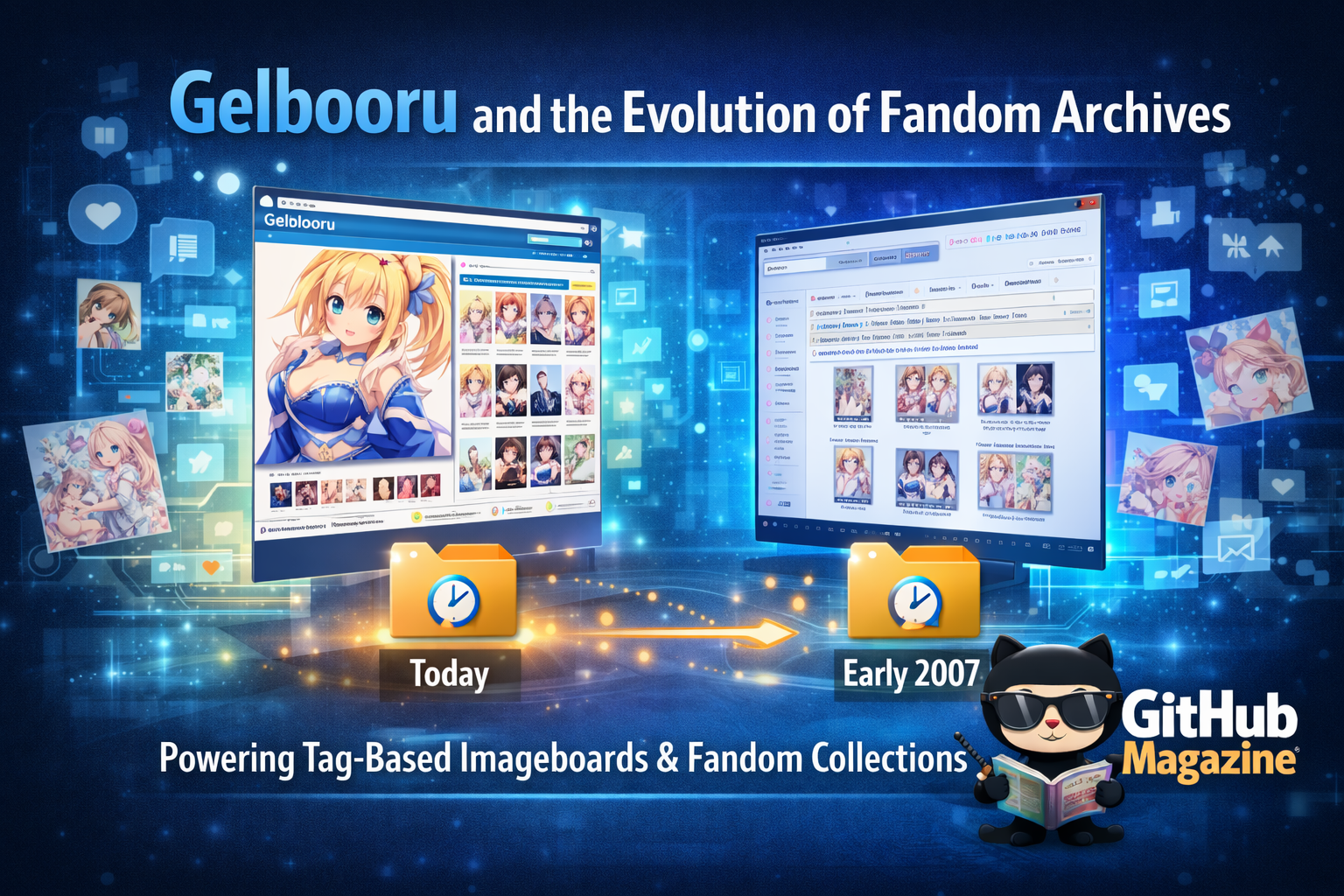
Gelbooru and the Evolution of Fandom Archives
When I first encountered Gelbooru, I wanted to understand what it actually was beyond the shorthand descriptions scattered across forums. Gelbooru is a user-driven image board and tagging database primarily focused on anime, manga, and game-related artwork, operating within the broader “booru” ecosystem that emerged in the early 2000s. It allows users to upload, tag, categorize, and search millions of images through an extensive folksonomic system. In simple terms, it is a searchable archive of fan art and illustrations organized by community-created metadata.
Yet to describe Gelbooru merely as an image repository misses its deeper significance. It is part archive, part fandom engine, part experiment in collaborative cataloging. Built on an open tagging structure, it reflects the participatory nature of Web 2.0 culture, where users not only consume content but actively classify and curate it. The site exists within a larger network of booru-style platforms, including Danbooru, which popularized the tagging architecture in 2005.
Over nearly two decades, Gelbooru has grown into a digital subculture space where art, fandom, identity, and controversy intersect. Its influence reaches far beyond anime circles, offering insight into how communities build decentralized archives and how digital classification systems shape what we see and how we search.
The Origins of the Booru Model
I often think of the early 2000s internet as chaotic yet deeply creative. Out of that environment emerged Danbooru in 2005, created by programmer Albert “albert” Chiang, introducing a tag-based image board system that allowed granular categorization of anime artwork (Chiang, 2005). The model was simple yet powerful. Every image could be assigned multiple descriptive tags, allowing users to filter content with remarkable precision.
Gelbooru followed soon after, adapting and expanding the booru software model into a more open and less centralized moderation structure. While Danbooru emphasized stricter content guidelines and subscription tiers, Gelbooru embraced a broader community-driven ethos. The architecture relied heavily on what scholars call folksonomy, a system in which users collaboratively generate metadata rather than relying on a centralized taxonomy (Vander Wal, 2007).
This tagging flexibility allowed users to search by character names, series titles, artistic styles, or thematic attributes. In doing so, Gelbooru exemplified a key Web 2.0 principle: the power of collective organization.
How the Tagging System Works
At the heart of Gelbooru is its tag database. Each uploaded image can carry dozens of tags describing characters, franchises, visual traits, poses, and narrative contexts. Tags are categorized into general, character, copyright, and artist types, enabling layered search queries.
This system reflects the broader digital evolution toward metadata-driven search. In his influential work on information architecture, Clay Shirky argued that user-generated tagging allows systems to adapt dynamically to cultural shifts rather than relying on static classification (Shirky, 2005). Gelbooru operationalizes that theory daily.
Consider a hypothetical example: a user searching for a specific anime character in a particular costume style can combine tags to refine results instantly. Unlike algorithmic recommendation engines, this search process remains user-directed and transparent.
Below is a simplified structural comparison of tagging approaches.
| Feature | Traditional Taxonomy | Folksonomy (Booru Model) |
|---|---|---|
| Controlled Vocabulary | Central authority | Community generated |
| Flexibility | Limited | Highly adaptable |
| Search Precision | Structured but rigid | Granular and combinatorial |
| Cultural Adaptation | Slow | Immediate |
Gelbooru’s power lies in this combinatorial flexibility, enabling intricate discovery pathways across millions of images.
Scale and Growth
Digital image repositories have expanded dramatically alongside broadband access. According to the Pew Research Center, the rise of user-generated content defined much of the mid-2000s internet culture (Pew Research Center, 2006). Gelbooru grew during that period, benefiting from anime’s global surge in popularity.
While exact internal statistics fluctuate, booru-style platforms collectively host millions of tagged images. The tagging system allows content to remain discoverable years after upload, ensuring archival continuity.
This scale creates both opportunity and complexity. Large decentralized archives require active moderation and community oversight. Tags must be corrected, merged, or standardized to maintain consistency. In many ways, Gelbooru functions like a living encyclopedia of fandom art, continuously revised by its users.
An internet archivist once observed that “community-curated image boards are among the most detailed examples of participatory cataloging on the web.” That observation captures the site’s hybrid identity as both social space and database.
Content Moderation and Legal Context
Any discussion of Gelbooru must address the legal and ethical dimensions of hosting user-generated content. Platforms that allow uploads operate under frameworks such as the Digital Millennium Copyright Act of 1998, which provides safe harbor protections if copyright holders can request takedowns (U.S. Congress, 1998).
Gelbooru, like many user-content platforms, relies on DMCA compliance mechanisms. Copyright enforcement can be complicated in fandom spaces, where fan art exists in a gray zone between homage and infringement.
Moderation policies also shape community standards. Unlike mainstream social networks, booru platforms often separate content by explicit tagging rather than algorithmic suppression. Users can filter or blacklist specific tags, customizing their experience.
This decentralized filtering model differs significantly from centralized content moderation strategies employed by major platforms like Facebook or YouTube. It reflects an earlier internet ethos emphasizing user responsibility over algorithmic oversight.
Comparing Image Board Platforms
| Platform | Founded | Core Focus | Moderation Style | Tag Complexity |
|---|---|---|---|---|
| Danbooru | 2005 | Anime art | Structured, subscription tiers | Highly standardized |
| Gelbooru | Mid-2000s | Anime & fandom art | Open, community-driven | Extensive |
| DeviantArt | 2000 | Broad digital art | Centralized moderation | Limited tagging |
| Pixiv | 2007 | Japanese illustration | Account-based | Moderate |
This comparison illustrates Gelbooru’s distinct emphasis on metadata richness and search granularity rather than social networking features.
Cultural Impact in Fandom Communities
When I look at Gelbooru’s broader influence, I see an archive that mirrors the evolution of global anime fandom. The site provides not just images but a searchable map of characters, genres, and artistic reinterpretations.
Henry Jenkins, a scholar of participatory culture, argues that fan communities transform media consumption into collaborative production (Jenkins, 2006). Gelbooru exemplifies this principle by enabling fans to preserve and categorize reinterpretations of mainstream media.
Artists gain visibility through tagging systems that credit creators and series. At the same time, anonymity remains possible, reflecting the duality of internet identity.
The platform’s database has, over time, become a cultural record of aesthetic trends. Shifts in character popularity, stylistic evolution, and emerging franchises are traceable through tag frequency patterns.
The Ethics of Archiving Fan Art
Archiving raises ethical questions. Should fan art be stored indefinitely without explicit artist permission? How do creators balance exposure with control?
Legal scholars have long debated the boundaries of transformative works. The U.S. Supreme Court’s interpretation of fair use hinges on transformation and market impact (Campbell v. Acuff-Rose Music, Inc., 1994). Fan art occupies a complex space within that framework.
Gelbooru’s tagging system ensures attribution when available, yet the decentralized nature of uploads can complicate rights management.
A digital rights advocate recently noted that “open archives thrive on participation, but they also demand transparent consent practices.” That tension underscores ongoing debates within fandom communities.
Technology and Open Source Roots
The booru software model itself has open source origins. Danbooru’s Ruby on Rails foundation allowed developers to fork and adapt the code, leading to multiple derivatives.
Open source culture aligns with the collaborative tagging philosophy. According to the Open Source Initiative, open code fosters iterative improvement and community innovation (Open Source Initiative, 2007). Gelbooru reflects that tradition by evolving through community feedback.
This technological openness contributed to the proliferation of specialized booru sites catering to niche fandoms. Each adaptation demonstrates how modular architecture can empower decentralized cultural production.
The Future of Booru Platforms
I see Gelbooru at an inflection point shaped by broader digital trends. Artificial intelligence image generation, stricter copyright enforcement, and evolving platform policies all influence its trajectory.
AI-generated art introduces new tagging complexities. Distinguishing between human and machine-created works may require additional metadata categories. Meanwhile, global regulatory shifts could impact hosting practices.
Despite these challenges, the core strength of the booru model remains its adaptability. User-driven tagging continues to offer search precision unmatched by algorithmic feeds.
As digital culture becomes increasingly mediated by opaque recommendation systems, platforms like Gelbooru represent a more transparent alternative. The user controls the query, not the algorithm.
Takeaways
• Gelbooru is a community-driven image board built on collaborative tagging principles
• The booru model emerged in 2005 with Danbooru and expanded into diverse platforms
• Folksonomy enables flexible, granular image discovery
• Legal frameworks like the DMCA shape content hosting practices
• The platform reflects participatory culture and fandom archiving
• Ethical questions persist regarding consent and copyright
• Future developments may involve AI integration and evolving moderation strategies
Conclusion
When I step back from the technical details and controversies, I see Gelbooru as a digital artifact of Web 2.0 optimism. It embodies the belief that communities can self-organize information effectively and collaboratively. Through tags and uploads, users construct a living archive that maps the contours of global fandom.
The platform’s challenges mirror those facing the broader internet: copyright complexity, ethical stewardship, and cultural accountability. Yet its resilience over nearly two decades speaks to the enduring power of participatory systems.
In an era increasingly shaped by opaque algorithms and corporate gatekeeping, Gelbooru’s transparent search logic feels almost archival in spirit. It preserves not only images but also the traces of how communities choose to describe and rediscover them.
FAQs
What is Gelbooru?
Gelbooru is a user-driven image board that hosts and tags anime and fandom-related artwork using a collaborative tagging system.
How does the tagging system work?
Users assign descriptive tags to images, allowing precise and combinatorial search queries.
Is Gelbooru legal?
It operates under DMCA safe harbor provisions and responds to copyright takedown requests.
What makes Gelbooru different from social media?
It prioritizes searchable metadata over social networking features or algorithmic feeds.
Does Gelbooru allow explicit content?
Content is categorized through tags, enabling users to filter according to preferences and site guidelines.

Related Posts

SOA OS23 Explained Across Technology and Construction

Sesame Motor CEO Profile and Industrial Strategy